
Level:
Correct: 0
Incorrect: 0
Marks: 0/0
Exam Practice
Subject:
Topics:
AQA GCSE Chemistry Smart practice A mixed round aimed at your weak spots
Unit 1
Atomic structure and the periodic table
Unit 2
Bonding, structure, and the properties of matter
Unit 3
Quantitative chemistry
Unit 4
Chemical changes
Unit 5
Energy changes
Unit 6
The rate and extent of chemical change
Unit 7
Organic chemistry
Unit 8
Chemical analysis
Unit 9
Chemistry of the atmosphere
Unit 10
Using resources
Avg
score:
–
Topics
done:
0/124

Ways of reducing the use of resources

Practise 31 exam-style questions on Ways of reducing the use of resources for AQA GCSE Chemistry. Write your answer as you would in the exam and get it marked in seconds against the mark scheme, point by point, with an AI tutor on hand if you get stuck.

  • 31 questions
  • 1–6 marks each
  • Instant marking
  • No sign-up needed
20 questions, marked as you go

Sample questions with model answers

Here are 4 of the questions in this topic, each with a model answer, an explanation of why it earns the marks and the mark scheme an examiner would use.

Question 1

2 marks

Metals, glass, building materials, clay ceramics and most plastics are produced from limited raw materials.

Explain what is meant by a limited raw material. Give one example.

Model answer

A limited raw material is one that is finite: it is not being replaced as fast as it is used, so it will eventually run out. An example is iron ore.

Explanation

Materials obtained from the Earth by mining and quarrying, such as ores, limestone and crude oil, are finite. Using less of them, reusing and recycling make them last longer.

Mark scheme
  1. 1 mark

    a raw material that will run out / is not being replaced (as fast as it is used) / is finite

    allow non-renewable

  2. 1 mark

    example: metal ores / crude oil / limestone / sand / clay

    allow any named ore, e.g. iron ore, bauxite
Question 2

2 marks

A drinks company redesigns its plastic bottles so that each bottle contains 20% less plastic.

Explain how this reduces the use of limited resources.

Model answer

Each bottle needs less plastic, so less crude oil is used as a raw material. Less energy is also needed to make the bottles, and the lighter bottles use less fuel to transport.

Explanation

Reducing the amount of material used is the first of the three Rs. It saves raw materials and energy at every stage, without any extra energy for collection or reprocessing.

Mark scheme
  1. 1 mark

    less plastic is needed, so less crude oil is used

  2. 1 mark

    less energy (from fossil fuels) is needed to make and transport the bottles

    allow lighter bottles use less fuel to transport

Question 3

3 marks

Limestone is quarried to make building materials and glass.

Give three environmental impacts of quarrying limestone.

Model answer

Quarrying destroys habitats, causes noise and dust from blasting and machinery, and leaves a large scar on the landscape.

Explanation

Obtaining raw materials from the Earth by quarrying and mining has environmental impacts. Reducing, reusing and recycling materials reduces the amount of quarrying needed.

Mark scheme
  1. 1 mark

    destroys habitats

    max 3

  2. 1 mark

    scars the landscape / visual pollution

  3. 1 mark

    noise (from blasting / machinery)

  4. 1 mark

    dust

  5. 1 mark

    more lorries / traffic, releasing carbon dioxide and pollutants

    allow uses energy / burns fossil fuels

  6. 1 mark

    waste rock / spoil heaps

Question 4

4 marks

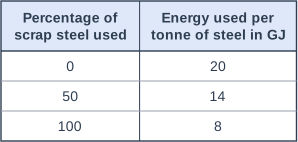
The table shows the energy used to make steel when different percentages of scrap steel are used.

Calculate the energy saved by making 500 tonnes of steel from 100% scrap steel rather than from 0% scrap steel, and the percentage saving. Suggest one reason why not all steel is made from 100% scrap steel.

Table with columns "Percentage of scrap steel used", "Energy used per tonne of steel in GJ". Percentage of scrap steel used: 0; Energy used per tonne of steel in GJ: 20 | Percentage of scrap steel used: 50; Energy used per tonne of steel in GJ: 14 | Percentage of scrap steel used: 100; Energy used per tonne of steel in GJ: 8.

Model answer

energy saved per tonne = 20 − 8 = 12 GJ
energy saved for 500 tonnes = 12 × 500 = 6000 GJ
percentage saving = (12 ÷ 20) × 100 = 60%
Not all steel is made from scrap because there is not enough scrap steel available to meet the demand for steel.

Explanation

Work out the saving per tonne first, then scale up. Recycling steel saves a lot of energy, but the amount of scrap is limited and it may contain other metals, so new iron from iron ore is still needed.

Mark scheme
  1. 1 mark

    energy saved per tonne = 20 − 8 = 12 (GJ)

    correct answer with no working scores full marks

  2. 1 mark

    energy saved for 500 tonnes = 12 × 500 = 6000 (GJ)

    allow ecf; allow (20 × 500) − (8 × 500) = 10 000 − 4000

  3. 1 mark

    percentage saving = 12 ÷ 20 × 100 = 60 (%)

    allow 6000 ÷ 10 000 × 100

  4. 1 mark

    not enough scrap steel is available / scrap contains other metals or impurities that affect the properties / some steels need a precise composition

Ready to try the rest? Every answer you write is marked against the mark scheme, so you can see exactly where the marks are.

AI Tutor Hints first, answers after you try

Hi! Stuck? Ask me for a hint and I’ll help you work it out. Once you’ve checked your answer I can explain exactly where the marks are.