Practise 13 exam-style questions on Metal oxides for AQA GCSE Chemistry. Write your answer as you would in the exam and get it marked in seconds against the mark scheme, point by point, with an AI tutor on hand if you get stuck.
13 questions
1–6 marks each
Instant marking
No sign-up needed
13 questions, marked as you go
Sample questions with model answers
Here are 4 of the questions in this topic, each with a model answer, an explanation of why it earns the marks and the mark scheme an examiner would use.
Question 1
2 marks
Magnesium burns in oxygen with a bright white flame to produce magnesium oxide.
Write a balanced symbol equation for this reaction.
Model answer
2Mg + O₂ → 2MgO
Explanation
Oxygen is diatomic, so it must be written as O₂. Magnesium ions are Mg²⁺ and oxide ions are O²⁻, so magnesium oxide is MgO; two MgO are needed to use both oxygen atoms, so two Mg atoms are needed too.
Mark scheme
1 mark
correct formulae: Mg + O₂ → MgO
do not accept O instead of O₂
1 mark
balanced: 2Mg + O₂ → 2MgO
allow multiples; ignore state symbols
Question 2
2 marks
Iron slowly reacts with oxygen to form iron(III) oxide, Fe₂O₃.
Write a balanced symbol equation for this reaction.
Model answer
4Fe + 3O₂ → 2Fe₂O₃
Explanation
Balance the oxygen first: Fe₂O₃ has 3 oxygen atoms and O₂ has 2, so use 2Fe₂O₃ (6 oxygen atoms) and 3O₂. Two Fe₂O₃ contain 4 iron atoms, so 4Fe is needed.
Mark scheme
1 mark
correct formulae: Fe + O₂ → Fe₂O₃
1 mark
balanced: 4Fe + 3O₂ → 2Fe₂O₃
allow multiples; ignore state symbols
Question 3
3 marks
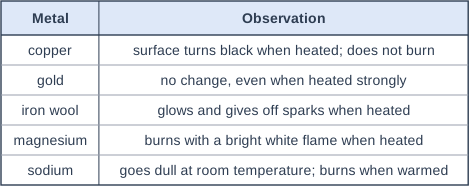
A student investigated how some metals react with oxygen. The table shows the student's observations.
Use the observations to place the five metals in order of reactivity, starting with the most reactive. Explain how you decided.
Model answer
Sodium, magnesium, iron, copper, gold. Sodium reacts with oxygen even without heating, so it is the most reactive. Magnesium burns brightly but needs heating, iron only glows and sparks, copper just forms a black coating and gold does not react at all, so the more vigorous the reaction, the more reactive the metal.
Explanation
More reactive metals react with oxygen more readily and more vigorously. Reacting at room temperature shows very high reactivity, while needing strong heating, forming only a surface coating or not reacting at all shows lower reactivity.
Mark scheme
1 mark
sodium (first, most reactive) and gold (last, least reactive)
correct full order is sodium, magnesium, iron, copper, gold
1 mark
magnesium, iron, copper in that order (in the middle)
1 mark
the more reactive the metal, the more vigorously it reacts / the less heating it needs to react with oxygen
allow sodium reacts without heating so it is the most reactive; gold does not react so it is the least reactive
Question 4
4 marks
When hydrogen gas is passed over heated copper(II) oxide, copper and water are produced: CuO + H₂ → Cu + H₂O
Identify the substance that is oxidised and the substance that is reduced in this reaction. Explain your answers in terms of oxygen.
Model answer
Hydrogen is oxidised because it gains oxygen to form water. Copper(II) oxide is reduced because it loses oxygen to form copper.
Explanation
Oxidation and reduction always happen together: the oxygen removed from the copper(II) oxide is gained by the hydrogen. Be careful to name the compound copper(II) oxide as the substance reduced, not 'copper', because copper is the product.
Mark scheme
1 mark
hydrogen is oxidised
allow H₂
1 mark
because hydrogen gains oxygen (to form water)
1 mark
copper(II) oxide is reduced
allow copper oxide or CuO; do not accept copper
1 mark
because copper(II) oxide loses oxygen (to form copper)
Ready to try the rest? Every answer you write is marked against the mark scheme, so you can see exactly where the marks are.
Ctrl + Enter to check
AI TutorHints first, answers after you try
Hi! Stuck? Ask me for a hint and I’ll help you work it out. Once you’ve checked your answer I can explain exactly where the marks are.