
Level:
Correct: 0
Incorrect: 0
Marks: 0/0
Exam Practice
Subject:
Topics:
AQA GCSE Chemistry Smart practice A mixed round aimed at your weak spots
Unit 1
Atomic structure and the periodic table
Unit 2
Bonding, structure, and the properties of matter
Unit 3
Quantitative chemistry
Unit 4
Chemical changes
Unit 5
Energy changes
Unit 6
The rate and extent of chemical change
Unit 7
Organic chemistry
Unit 8
Chemical analysis
Unit 9
Chemistry of the atmosphere
Unit 10
Using resources
Avg
score:
–
Topics
done:
0/124

The effect of temperature changes on equilibrium (HT only)

Practise 22 exam-style questions on The effect of temperature changes on equilibrium (HT only) for AQA GCSE Chemistry. Write your answer as you would in the exam and get it marked in seconds against the mark scheme, point by point, with an AI tutor on hand if you get stuck.

  • 22 questions
  • 1–6 marks each
  • Instant marking
  • No sign-up needed
20 questions, marked as you go

Sample questions with model answers

Here are 4 of the questions in this topic, each with a model answer, an explanation of why it earns the marks and the mark scheme an examiner would use.

Question 1

2 marks

Methanol is made by this reaction:
CO(g) + 2H₂(g) ⇌ CH₃OH(g)
The forward reaction is exothermic.

Predict the effect of increasing the temperature on the yield of methanol at equilibrium. Explain your answer.

Model answer

The yield of methanol decreases. Increasing the temperature shifts the equilibrium in the endothermic direction. The forward reaction is exothermic, so the reverse reaction is endothermic and the equilibrium shifts to the left.

Explanation

For an exothermic forward reaction, the relative amount of products at equilibrium decreases when the temperature is increased, because the system counteracts the rise in temperature by favouring the reaction that takes in energy.

Mark scheme
  1. 1 mark

    the yield of methanol decreases

  2. 1 mark

    increasing the temperature shifts the equilibrium in the endothermic direction, which is the reverse reaction / to the left
Question 2

3 marks

Ammonia is made in the Haber process:
N₂(g) + 3H₂(g) ⇌ 2NH₃(g)
When 1 mole of nitrogen reacts with 3 moles of hydrogen to form 2 moles of ammonia, 92 kJ of energy is transferred to the surroundings.

Give the energy change when 2 moles of ammonia decompose into nitrogen and hydrogen.

Predict and explain the effect of decreasing the temperature on the yield of ammonia at equilibrium.

Model answer

When 2 moles of ammonia decompose, 92 kJ of energy is taken in from the surroundings (the reverse reaction is endothermic).
Decreasing the temperature increases the yield of ammonia. A lower temperature shifts the equilibrium in the exothermic direction, which is the forward reaction, so the equilibrium moves to the right.

Explanation

If a reversible reaction is exothermic in one direction, it is endothermic in the opposite direction, and the same amount of energy is transferred. A decrease in temperature always favours the exothermic direction.

Mark scheme
  1. 1 mark

    92 kJ is taken in from the surroundings (endothermic)

    both the value and the direction (taken in / endothermic) needed

  2. 1 mark

    decreasing the temperature increases the yield of ammonia

  3. 1 mark

    because decreasing the temperature shifts the equilibrium in the exothermic direction, which is the forward reaction / to the right

Question 3

3 marks

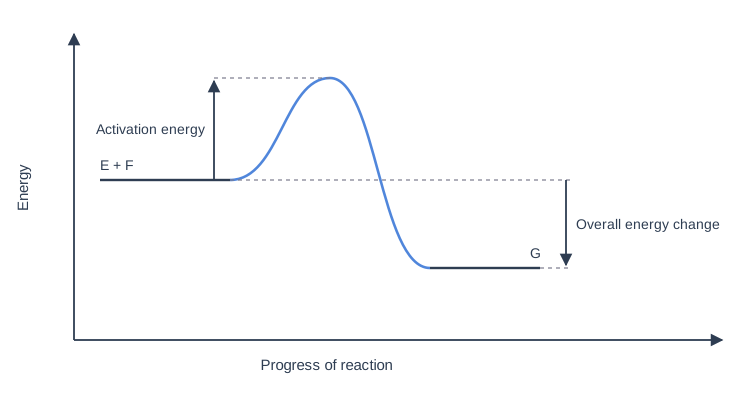
The diagram shows the reaction profile for the forward reaction of a reversible reaction:
E(g) + F(g) ⇌ G(g)

Use the diagram to predict the effect of decreasing the temperature on the yield of G at equilibrium. Explain your answer.

Reaction profile (energy against progress of reaction). The reactants (E + F) are higher in energy than the products (G); the curve rises to a peak between them. An upward arrow from the reactants' level to the top of the peak is labelled "Activation energy". An arrow from the reactants' level down to the products' level is labelled "Overall energy change".

Model answer

The diagram shows that the product is at a lower energy level than the reactants, so the forward reaction is exothermic. Decreasing the temperature shifts the equilibrium in the exothermic direction, to the right, so the yield of G increases.

Explanation

On a reaction profile, products lower than reactants means energy has been released to the surroundings, so the reaction is exothermic. Cooling favours the exothermic direction.

Mark scheme
  1. 1 mark

    the products have less energy than the reactants, so the forward reaction is exothermic

  2. 1 mark

    decreasing the temperature shifts the equilibrium in the exothermic direction / to the right

  3. 1 mark

    so the yield of G increases

    allow ecf for a consistent prediction from an incorrect identification (max 1 for the last two points)

Question 4

4 marks

Hydrogen for use as a fuel can be stored by reacting it with magnesium to form magnesium hydride:
Mg(s) + H₂(g) ⇌ MgH₂(s)
The forward reaction is exothermic.

Explain how changing the temperature can be used to store the hydrogen and then to release it when it is needed.

Model answer

To store the hydrogen, the magnesium is kept at a lower temperature. The forward reaction is exothermic, so a lower temperature shifts the equilibrium to the right and hydrogen is taken up to form magnesium hydride.
To release the hydrogen, the magnesium hydride is heated. A higher temperature favours the endothermic direction, which is the reverse reaction, so the equilibrium shifts to the left and the magnesium hydride decomposes, releasing hydrogen gas.

Explanation

The same reversible reaction can be pushed either way by changing the temperature. Cooling favours the exothermic direction and heating favours the endothermic direction.

Mark scheme
  1. 1 mark

    to store hydrogen, use a lower temperature

  2. 1 mark

    a lower temperature favours the exothermic forward reaction, so the equilibrium shifts right and hydrogen is taken up as MgH₂

  3. 1 mark

    to release hydrogen, heat the magnesium hydride / use a higher temperature

  4. 1 mark

    a higher temperature favours the endothermic reverse reaction, so the equilibrium shifts left and MgH₂ decomposes to release hydrogen

Ready to try the rest? Every answer you write is marked against the mark scheme, so you can see exactly where the marks are.

AI Tutor Hints first, answers after you try

Hi! Stuck? Ask me for a hint and I’ll help you work it out. Once you’ve checked your answer I can explain exactly where the marks are.