Practise 20 exam-style questions on Formulations for AQA GCSE Chemistry. Write your answer as you would in the exam and get it marked in seconds against the mark scheme, point by point, with an AI tutor on hand if you get stuck.
20 questions
1–6 marks each
Instant marking
No sign-up needed
20 questions, marked as you go
Sample questions with model answers
Here are 4 of the questions in this topic, each with a model answer, an explanation of why it earns the marks and the mark scheme an examiner would use.
Question 1
2 marks
Explain why the components of a formulation must be mixed in carefully measured quantities.
Model answer
The quantities are carefully measured so that the product has exactly the properties it was designed to have. If there were too much or too little of one component, the product might not work, could be unsafe, or might be different from one batch to the next.
Explanation
The properties of a formulation depend on its exact composition. For example, a medicine with too much active ingredient could be dangerous, and one with too little would not work.
Mark scheme
1 mark
so that the product has the required properties / works as intended
1 mark
too much or too little of a component could make the product ineffective / unsafe / different each time
allow 'so that every batch is the same'
Question 2
2 marks
Toothpaste is a formulation. It contains a fluoride compound to help prevent tooth decay.
Suggest why the amount of fluoride compound in toothpaste must be carefully controlled.
Model answer
If there is too little fluoride compound, the toothpaste will not protect the teeth from decay. If there is too much, it could be harmful to the person using it. So the amount must be carefully measured.
Explanation
Each component of a formulation is there for a reason, and its quantity is chosen to give the right effect safely. 'Too little does not work, too much is harmful' applies to many formulations, especially medicines and products used on the body.
Mark scheme
1 mark
too little would not protect the teeth / would be ineffective
1 mark
too much could be harmful
allow 'toxic' or 'could damage teeth'
Question 3
3 marks
A paracetamol tablet contains paracetamol (the active ingredient), starch, a binder and a coating. Each tablet contains exactly 500 mg of paracetamol.
Explain why the tablet is described as a formulation.
Model answer
The tablet is a mixture of several components that has been designed as a useful product. Each component has a purpose: the paracetamol relieves pain, the binder holds the tablet together and the coating makes it easier to swallow. The components are mixed in carefully measured quantities, so that every tablet contains exactly 500 mg of paracetamol and gives the correct dose.
Explanation
To identify a formulation from information, look for three features: a mixture, designed for a use, with measured quantities of each component. A medicine tablet shows all three.
Mark scheme
1 mark
it is a mixture of several components
1 mark
it is designed as a useful product, with each component having a particular purpose
allow an example of a purpose, e.g. the binder holds the tablet together / the coating makes it easier to swallow
1 mark
the components are in carefully measured quantities (e.g. exactly 500 mg of paracetamol so the dose is correct)
Question 4
4 marks
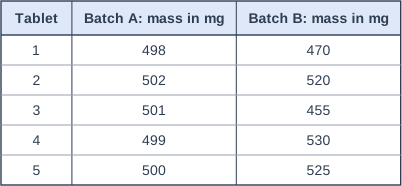
A company makes tablets that should each contain 500 mg of active ingredient. A tablet is acceptable if it contains between 475 mg and 525 mg. The table shows the mass of active ingredient in five tablets from each of two batches, A and B.
Calculate the mean mass of active ingredient for each batch. Explain which batch should be rejected.
Model answer
Batch A: mean = (498 + 502 + 501 + 499 + 500) ÷ 5 = 2500 ÷ 5 = 500 mg Batch B: mean = (470 + 520 + 455 + 530 + 525) ÷ 5 = 2500 ÷ 5 = 500 mg Both batches have the correct mean, but batch B contains tablets with 455 mg, 470 mg and 530 mg, which are outside the acceptable range of 475-525 mg. Batch B should be rejected, because a patient taking one of these tablets would get the wrong dose. In batch A every tablet is within the range.
Explanation
A mean can hide large variation. In a medicine every single tablet must contain the right amount, which is why the components of a formulation must be measured and mixed carefully. Always look at the spread of the data as well as the mean.
Mark scheme
1 mark
mean for batch A = 2500 ÷ 5 = 500 mg
1 mark
mean for batch B = 2500 ÷ 5 = 500 mg
1 mark
batch B has tablets outside the acceptable range (455 mg, 470 mg and 530 mg)
at least one value outside the range identified
1 mark
so batch B should be rejected, even though its mean is correct, because each tablet must give the correct dose
allow 'the components are not mixed in carefully controlled quantities in batch B'
Ready to try the rest? Every answer you write is marked against the mark scheme, so you can see exactly where the marks are.
Ctrl + Enter to check
AI TutorHints first, answers after you try
Hi! Stuck? Ask me for a hint and I’ll help you work it out. Once you’ve checked your answer I can explain exactly where the marks are.