Level:
Correct: 0
Incorrect: 0
Marks: 0/0
Exam Practice
Subject:
Topics:
AQA GCSE Chemistry Smart practice A mixed round aimed at your weak spots
Unit 1
Atomic structure and the periodic table
Unit 2
Bonding, structure, and the properties of matter
Unit 3
Quantitative chemistry
Unit 4
Chemical changes
Unit 5
Energy changes
Unit 6
The rate and extent of chemical change
Unit 7
Organic chemistry
Unit 8
Chemical analysis
Unit 9
Chemistry of the atmosphere
Unit 10
Using resources
Avg
score:
–
Topics
done:
0/124

Alcohols (chemistry only)

Practise 28 exam-style questions on Alcohols (chemistry only) for AQA GCSE Chemistry. Write your answer as you would in the exam and get it marked in seconds against the mark scheme, point by point, with an AI tutor on hand if you get stuck.

  • 28 questions
  • 1–6 marks each
  • Instant marking
  • No sign-up needed
20 questions, marked as you go

Sample questions with model answers

Here are 4 of the questions in this topic, each with a model answer, an explanation of why it earns the marks and the mark scheme an examiner would use.

Question 1

2 marks

Here are the formulae of six compounds:
A CH₃OH
B CH₃COOH
C C₂H₆
D NaOH
E C₄H₉OH
F C₃H₆

Give the letters of the two compounds that are alcohols.

Model answer

A (CH₃OH, methanol) and E (C₄H₉OH, butanol).

Explanation

Alcohols contain an –OH group attached to a chain of carbon and hydrogen atoms. CH₃COOH has the –COOH group of a carboxylic acid, and NaOH is an ionic metal hydroxide, not an alcohol. C₂H₆ is an alkane and C₃H₆ is an alkene.

Mark scheme
  1. 1 mark

    A

    deduct 1 mark for each additional letter given

  2. 1 mark

    E

Question 2

2 marks

Fermentation produces a solution containing at most about 15% ethanol.

Explain why the concentration of ethanol does not rise any higher, and name the process used to obtain more concentrated ethanol from the solution.

Model answer

As the ethanol concentration rises, the ethanol becomes toxic to the yeast and kills it, so fermentation stops. More concentrated ethanol is obtained by fractional distillation.

Explanation

Yeast cannot survive high concentrations of ethanol, so fermentation stops on its own. Ethanol boils at a lower temperature (78 °C) than water, so it can be separated by fractional distillation; this is how spirits such as whisky are made.

Mark scheme
  1. 1 mark

    the ethanol kills the yeast / denatures the enzymes in yeast (so fermentation stops)

    allow 'ethanol is toxic to yeast'

  2. 1 mark

    (fractional) distillation

Question 3

3 marks

Ethanol is produced by fermentation:
C₆H₁₂O₆ → 2C₂H₅OH + 2CO₂

Calculate the maximum mass of ethanol that can be produced from 45 g of glucose.
Relative atomic masses (Ar): H = 1, C = 12, O = 16

Model answer

Mr of C₆H₁₂O₆ = (6 × 12) + (12 × 1) + (6 × 16) = 180
Mr of C₂H₅OH = (2 × 12) + (6 × 1) + 16 = 46
moles of glucose = 45 ÷ 180 = 0.25 mol
moles of ethanol = 2 × 0.25 = 0.50 mol
mass of ethanol = 0.50 × 46 = 23 g

Explanation

The key step is using the 1 : 2 ratio from the equation: each glucose molecule gives two ethanol molecules. Forgetting the 2 is the most common mistake and gives 11.5 g.

Mark scheme
  1. 1 mark

    Mr of glucose = 180 and Mr of ethanol = 46

  2. 1 mark

    moles of glucose = 45 ÷ 180 = 0.25, so moles of ethanol = 0.50

    allow ecf from incorrect Mr values

  3. 1 mark

    mass of ethanol = 0.50 × 46 = 23 (g)

    allow ecf; correct answer with no working scores 3 marks; allow ratio method: 180 g gives 92 g, so 45 g gives 23 g

Question 4

4 marks

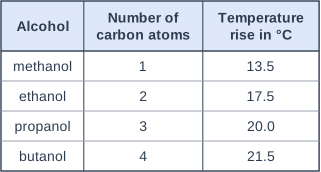
A student burned 1.00 g of each of four alcohols in turn in a spirit burner. Each time, the flame heated 200 cm³ of water in a copper can. The table shows the results.

Describe the trend in the results and state which alcohol releases the most energy per gram. Suggest one reason why the temperature rises were lower than expected from the energy released by each alcohol.

Table with columns "Alcohol", "Number of carbon atoms", "Temperature rise in °C". Alcohol: methanol; Number of carbon atoms: 1; Temperature rise in °C: 13.5 | Alcohol: ethanol; Number of carbon atoms: 2; Temperature rise in °C: 17.5 | Alcohol: propanol; Number of carbon atoms: 3; Temperature rise in °C: 20.0 | Alcohol: butanol; Number of carbon atoms: 4; Temperature rise in °C: 21.5.

Model answer

The temperature rise increases as the number of carbon atoms in the alcohol increases, from 13.5 °C for methanol to 21.5 °C for butanol, but each increase is smaller than the one before (4.0, 2.5 and 1.5 °C). Butanol releases the most energy per gram. The temperature rises were lower than expected because a lot of the energy was lost to the surrounding air instead of heating the water.

Explanation

Read the whole data set: the rise increases, but by smaller amounts each time. Because every alcohol heated the same volume of water with the same mass of fuel, a bigger temperature rise means more energy released per gram. In simple calorimetry most of the energy escapes to the surroundings, so results are always lower than data book values.

Mark scheme
  1. 1 mark

    the temperature rise increases as the number of carbon atoms increases

    allow 'increases from methanol to butanol'

  2. 1 mark

    but the increase gets smaller each time

    allow increases of 4.0, 2.5 and 1.5 °C quoted

  3. 1 mark

    butanol (releases the most energy per gram)

  4. 1 mark

    energy / heat lost to the surroundings

    allow incomplete combustion; allow heat used to warm the copper can; ignore 'human error'

Ready to try the rest? Every answer you write is marked against the mark scheme, so you can see exactly where the marks are.

AI Tutor Hints first, answers after you try

Hi! Stuck? Ask me for a hint and I’ll help you work it out. Once you’ve checked your answer I can explain exactly where the marks are.