Practise 30 exam-style questions on Ionic bonding for AQA GCSE Chemistry. Write your answer as you would in the exam and get it marked in seconds against the mark scheme, point by point, with an AI tutor on hand if you get stuck.
30 questions
1–6 marks each
Instant marking
No sign-up needed
20 questions, marked as you go
Sample questions with model answers
Here are 4 of the questions in this topic, each with a model answer, an explanation of why it earns the marks and the mark scheme an examiner would use.
Question 1
2 marks
Chlorine is in Group 7 of the periodic table.
Explain why chlorine forms chloride ions with a 1− charge.
Model answer
A chlorine atom has seven electrons in its outer shell (2,8,7). It gains one electron to complete its outer shell, giving the electronic structure of argon (2,8,8). The ion now has one more electron than protons, so its charge is 1−.
Explanation
Non-metal atoms gain electrons to fill their outer shell. Group 7 atoms need one more electron, so they form 1− ions; gaining a negative electron makes the ion negative.
Mark scheme
1 mark
a chlorine atom has seven electrons in its outer shell
allow 2,8,7
1 mark
it gains one electron (to get a full outer shell / noble gas electronic structure)
allow the ion has one more electron than protons
Question 2
3 marks
Magnesium has the atomic number 12. Magnesium forms Mg²⁺ ions.
Give the electronic structure of a magnesium atom and of a magnesium ion. Name the noble gas that has the same electronic structure as the magnesium ion.
Model answer
Magnesium atom: 2,8,2 Magnesium ion, Mg²⁺: 2,8 (the two outer electrons have been lost) The noble gas with the electronic structure 2,8 is neon.
Explanation
A magnesium atom loses its two outer electrons to form Mg²⁺, leaving the full shells 2,8. Ions formed by metals in Groups 1 and 2 have the electronic structure of the noble gas in the period before them.
Mark scheme
1 mark
magnesium atom: 2,8,2
allow 2.8.2
1 mark
magnesium ion: 2,8
allow [2,8]²⁺
1 mark
neon
allow ecf from an incorrect ion structure that matches a noble gas
Question 3
3 marks
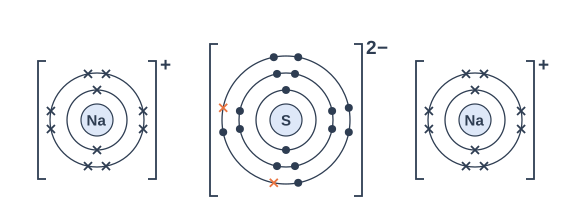
The diagram shows the ions in sodium sulfide. Electrons from sodium are shown as crosses and electrons from sulfur are shown as dots.
Use the diagram to explain why the formula of sodium sulfide is Na₂S.
Model answer
Each sodium atom can lose only one electron, forming a Na⁺ ion. The sulfur atom needs to gain two electrons to fill its outer shell, forming an S²⁻ ion; the diagram shows two crosses in its outer shell. So two sodium atoms are needed to provide the two electrons, and two Na⁺ ions balance the 2− charge of one S²⁻ ion, giving Na₂S.
Explanation
Count the electrons transferred: each sodium gives one, and sulfur needs two. Balancing electrons lost and gained gives the same formula as balancing the charges on the ions.
Mark scheme
1 mark
each sodium atom loses one electron, forming Na⁺
1 mark
the sulfur atom gains two electrons, forming S²⁻
allow the sulfide ion has two crosses in its outer shell
1 mark
so two Na⁺ ions are needed to balance the 2− charge of one S²⁻ ion
allow two sodium atoms are needed to provide the two electrons
Question 4
4 marks
A student drew a dot and cross diagram for magnesium chloride. The student's diagram showed one Mg²⁺ ion and one Cl²⁻ ion, each with eight electrons in the outer shell.
Identify two errors in the student's diagram and explain the correct version.
Model answer
First, the chloride ion should be Cl⁻, not Cl²⁻: a chlorine atom has seven outer electrons, so it only needs to gain one electron to fill its outer shell. Second, there should be two chloride ions: a magnesium atom loses two electrons, and each chlorine atom can accept only one, so two chlorine atoms are needed. The correct diagram shows one Mg²⁺ ion and two Cl⁻ ions, giving MgCl₂.
Explanation
A Group 7 element always forms a 1− ion. When the metal ion has a bigger charge than the non-metal ion, more non-metal ions are needed to balance the charges, so the diagram must show the correct number of each ion.
Mark scheme
1 mark
the chloride ion should have a 1− charge (Cl⁻), not 2−
1 mark
because a chlorine atom has seven outer electrons so gains only one electron
1 mark
there should be two chloride ions
1 mark
because magnesium loses two electrons, one to each chlorine atom / two Cl⁻ balance one Mg²⁺
Ready to try the rest? Every answer you write is marked against the mark scheme, so you can see exactly where the marks are.
Ctrl + Enter to check
AI TutorHints first, answers after you try
Hi! Stuck? Ask me for a hint and I’ll help you work it out. Once you’ve checked your answer I can explain exactly where the marks are.