
Level:
Correct: 0
Incorrect: 0
Marks: 0/0
Exam Practice
Subject:
Topics:
AQA GCSE Chemistry Smart practice A mixed round aimed at your weak spots
Unit 1
Atomic structure and the periodic table
Unit 2
Bonding, structure, and the properties of matter
Unit 3
Quantitative chemistry
Unit 4
Chemical changes
Unit 5
Energy changes
Unit 6
The rate and extent of chemical change
Unit 7
Organic chemistry
Unit 8
Chemical analysis
Unit 9
Chemistry of the atmosphere
Unit 10
Using resources
Avg
score:
–
Topics
done:
0/124

Cells and batteries (chemistry only)

Practise 27 exam-style questions on Cells and batteries (chemistry only) for AQA GCSE Chemistry. Write your answer as you would in the exam and get it marked in seconds against the mark scheme, point by point, with an AI tutor on hand if you get stuck.

  • 27 questions
  • 1–6 marks each
  • Instant marking
  • No sign-up needed
20 questions, marked as you go

Sample questions with model answers

Here are 4 of the questions in this topic, each with a model answer, an explanation of why it earns the marks and the mark scheme an examiner would use.

Question 1

2 marks

What is a battery? Give the reason why cells are connected together to make a battery.

Model answer

A battery is two or more cells connected together in series. This provides a greater voltage than a single cell.

Explanation

When cells are connected in series their voltages add together, so a battery of several cells gives a bigger voltage. A single cell is not strictly a battery, even though people often call it one.

Mark scheme
  1. 1 mark

    two or more cells connected together in series

    must indicate more than one cell; allow 'cells joined in series'

  2. 1 mark

    to provide a greater voltage

    allow higher potential difference; ignore 'more power' / 'more energy' / 'last longer'
Question 2

3 marks

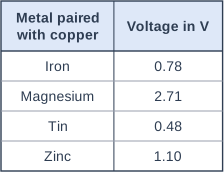
A student made simple cells by pairing four different metals with copper in the same electrolyte. The table shows the voltage of each cell. Each metal was more reactive than copper.

Use the data to put the four metals in order of reactivity, most reactive first. Give a reason for your answer.

Table with columns "Metal paired with copper", "Voltage in V". Metal paired with copper: Iron; Voltage in V: 0.78 | Metal paired with copper: Magnesium; Voltage in V: 2.71 | Metal paired with copper: Tin; Voltage in V: 0.48 | Metal paired with copper: Zinc; Voltage in V: 1.10.

Model answer

Magnesium, zinc, iron, tin. The greater the voltage, the bigger the difference in reactivity between the metal and copper, so the metal with the highest voltage is the most reactive.

Explanation

Because every metal is paired with the same metal (copper) in the same electrolyte, the only thing changing is the reactivity of the other metal. A bigger difference in reactivity gives a bigger voltage.

Mark scheme
  1. 1 mark

    magnesium (most reactive) then zinc

  2. 1 mark

    then iron then tin (least reactive)

    full order magnesium > zinc > iron > tin for both marks

  3. 1 mark

    the greater the voltage, the greater the difference in reactivity from copper (so the more reactive the metal)

    allow higher voltage means more reactive

Question 3

3 marks

Each lemon cell made with a zinc nail and a copper coin produces 0.9 V. A student wants to light an LED that needs at least 3.0 V.

Calculate the minimum number of lemon cells the student needs and state how they should be connected.

Model answer

3.0 ÷ 0.9 = 3.3, so 3 cells are not enough (3 × 0.9 = 2.7 V).
4 cells give 4 × 0.9 = 3.6 V, so the student needs 4 lemon cells connected in series.

Explanation

When cells are connected in series to make a battery, their voltages add up. You must round up, because 3 cells give only 2.7 V, which is less than the 3.0 V needed.

Mark scheme
  1. 1 mark

    3.0 ÷ 0.9 = 3.3

    allow 3 cells give only 2.7 V

  2. 1 mark

    4 cells

    allow 4 × 0.9 = 3.6 V shown; correct answer with no working scores 2 marks

  3. 1 mark

    connected in series

Question 4

4 marks

A company is choosing rechargeable cells to power a small drone. The drone needs a voltage of at least 7.4 V and must be as light as possible. The cells will be connected in series.

The table shows information about three types of rechargeable cell.

Which type of cell should the company choose? Justify your answer using the data.

Table with columns "Type of cell", "Voltage of one cell in V", "Mass of one cell in g", "Cost of one cell in £", "Number of recharges". Type of cell: A; Voltage of one cell in V: 3.7; Mass of one cell in g: 45; Cost of one cell in £: 8.00; Number of recharges: 500 | Type of cell: B; Voltage of one cell in V: 1.2; Mass of one cell in g: 25; Cost of one cell in £: 3.00; Number of recharges: 1000 | Type of cell: C; Voltage of one cell in V: 2.0; Mass of one cell in g: 120; Cost of one cell in £: 4.00; Number of recharges: 300.

Model answer

Type A: 7.4 ÷ 3.7 = 2 cells, mass = 2 × 45 = 90 g, cost £16
Type B: 7 cells are needed (6 cells give only 7.2 V), mass = 7 × 25 = 175 g, cost £21
Type C: 4 cells are needed (8.0 V), mass = 4 × 120 = 480 g, cost £16
The company should choose type A because it gives the required voltage with by far the lowest total mass, and it is also the cheapest option (joint with C). Type B can be recharged more times, but it is almost twice as heavy.

Explanation

Cells in series add their voltages, so first work out how many cells of each type are needed, then compare the total mass. A single type B cell is the lightest, but so many are needed that the battery ends up heavier than type A.

Mark scheme
  1. 1 mark

    type A: 2 cells needed (7.4 V), total mass 90 g

    max 4

  2. 1 mark

    type B needs 7 cells (8.4 V, 175 g) and type C needs 4 cells (8.0 V, 480 g)

    allow either B or C worked out correctly for this mark

  3. 1 mark

    choose type A because it gives the lowest total mass

    must be based on total mass, not mass of one cell

  4. 1 mark

    type A is also cheapest or joint cheapest (£16, compared with £21 for B and £16 for C)

  5. 1 mark

    but type B can be recharged more times (1000 compared with 500)

Ready to try the rest? Every answer you write is marked against the mark scheme, so you can see exactly where the marks are.

AI Tutor Hints first, answers after you try

Hi! Stuck? Ask me for a hint and I’ll help you work it out. Once you’ve checked your answer I can explain exactly where the marks are.
