
Level:
Correct: 0
Incorrect: 0
Marks: 0/0
Exam Practice
Subject:
Topics:
AQA GCSE Chemistry Smart practice A mixed round aimed at your weak spots
Unit 1
Atomic structure and the periodic table
Unit 2
Bonding, structure, and the properties of matter
Unit 3
Quantitative chemistry
Unit 4
Chemical changes
Unit 5
Energy changes
Unit 6
The rate and extent of chemical change
Unit 7
Organic chemistry
Unit 8
Chemical analysis
Unit 9
Chemistry of the atmosphere
Unit 10
Using resources
Avg
score:
–
Topics
done:
0/124

Representation of reactions at electrodes as half equations (HT only)

Practise 16 exam-style questions on Representation of reactions at electrodes as half equations (HT only) for AQA GCSE Chemistry. Write your answer as you would in the exam and get it marked in seconds against the mark scheme, point by point, with an AI tutor on hand if you get stuck.

  • 16 questions
  • 1–6 marks each
  • Instant marking
  • No sign-up needed
16 questions, marked as you go

Sample questions with model answers

Here are 4 of the questions in this topic, each with a model answer, an explanation of why it earns the marks and the mark scheme an examiner would use.

Question 1

1 mark

Write a half equation for the formation of potassium from potassium ions at the cathode.

Model answer

K⁺ + e⁻ → K

Explanation

Potassium is in Group 1, so its ion has a 1+ charge and needs to gain one electron to become an atom. The charge is 0 on both sides.

Mark scheme
  1. 1 mark

    K⁺ + e⁻ → K

    allow K+ + e- → K; ignore state symbols
Question 2

2 marks

Explain how you can tell that this half equation is balanced:
2Br⁻ → Br₂ + 2e⁻

Model answer

There are two bromine atoms on the left (in 2Br⁻) and two on the right (in Br₂), so the atoms balance. The total charge on the left is 2 × (−1) = −2, and on the right it is 0 + 2 × (−1) = −2, so the charges also balance.

Explanation

A half equation must balance both atoms and charge. Electrons carry the charge, so counting them is how you make the charges equal.

Mark scheme
  1. 1 mark

    there are two bromine atoms on each side

    allow the atoms balance

  2. 1 mark

    the total charge is the same on both sides (2−)

    allow the charges balance; do not accept 'the electrons balance' alone

Question 3

3 marks

In the electrolysis of aluminium oxide the half equations are:
Al³⁺ + 3e⁻ → Al
2O²⁻ → O₂ + 4e⁻

Use the half equations to explain why 4 moles of aluminium are produced for every 3 moles of oxygen.

Model answer

The electrons released at the anode are the same electrons that are used at the cathode, so the numbers must be equal. Making 4 mol of aluminium needs 4 × 3 = 12 mol of electrons. Each mole of O₂ formed releases 4 mol of electrons, so 12 mol of electrons are released when 3 mol of O₂ forms. So 4 mol of Al are made for every 3 mol of O₂.

Explanation

To combine half equations, multiply them so that the electrons are equal: 4Al³⁺ + 12e⁻ → 4Al and 6O²⁻ → 3O₂ + 12e⁻. This gives the overall ratio 4Al : 3O₂, matching 2Al₂O₃ → 4Al + 3O₂.

Mark scheme
  1. 1 mark

    the number of electrons lost at the anode must equal the number gained at the cathode

  2. 1 mark

    4 mol of Al needs 4 × 3 = 12 mol of electrons

  3. 1 mark

    12 mol of electrons are released when 3 mol of O₂ forms (3 × 4 = 12)

Question 4

4 marks

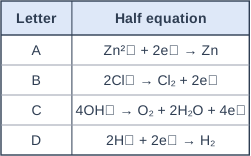
The table shows four half equations, A to D, for reactions at electrodes during electrolysis.

For each half equation, state whether it happens at the cathode or at the anode, and whether it is oxidation or reduction.

Table with columns "Letter", "Half equation". Letter: A; Half equation: Zn²⁺ + 2e⁻ → Zn | Letter: B; Half equation: 2Cl⁻ → Cl₂ + 2e⁻ | Letter: C; Half equation: 4OH⁻ → O₂ + 2H₂O + 4e⁻ | Letter: D; Half equation: 2H⁺ + 2e⁻ → H₂.

Model answer

A: cathode, reduction
B: anode, oxidation
C: anode, oxidation
D: cathode, reduction

Explanation

Half equations with electrons on the left are reductions and happen at the cathode, where positive ions gain electrons. Those with electrons on the right are oxidations and happen at the anode, where negative ions lose electrons.

Mark scheme
  1. 1 mark

    A: cathode, reduction

    both needed for each mark

  2. 1 mark

    B: anode, oxidation

  3. 1 mark

    C: anode, oxidation

  4. 1 mark

    D: cathode, reduction

Ready to try the rest? Every answer you write is marked against the mark scheme, so you can see exactly where the marks are.

AI Tutor Hints first, answers after you try

Hi! Stuck? Ask me for a hint and I’ll help you work it out. Once you’ve checked your answer I can explain exactly where the marks are.