Practise 18 exam-style questions on Concentration of solutions for AQA GCSE Chemistry. Write your answer as you would in the exam and get it marked in seconds against the mark scheme, point by point, with an AI tutor on hand if you get stuck.
18 questions
1–6 marks each
Instant marking
No sign-up needed
18 questions, marked as you go
Sample questions with model answers
Here are 4 of the questions in this topic, each with a model answer, an explanation of why it earns the marks and the mark scheme an examiner would use.
Question 1
2 marks
A student dissolved 10 g of sodium chloride in water to make 0.50 dm³ of solution.
Calculate the concentration of the solution in g/dm³.
Concentration is the mass of solute in each dm³ of solution. Half a dm³ contains 10 g, so a whole dm³ would contain 20 g.
Mark scheme
1 mark
concentration = 10 ÷ 0.50
1 mark
20 (g/dm³)
correct answer with no working scores 2 marks; 5 (multiplied instead of divided) scores 0
Question 2
2 marks
A student dissolved 10 g of sugar in 1.0 dm³ of water. The student said that the concentration of the solution was exactly 10 g/dm³.
Explain why the student is not correct.
Model answer
Concentration is the mass of solute per volume of solution, not per volume of water. When the sugar dissolves, the volume changes, so the solution does not have a volume of exactly 1.0 dm³ and the concentration is not exactly 10 g/dm³.
Explanation
To make a solution of known concentration, dissolve the solute and then add water until the total volume of solution is correct, rather than adding the solute to a measured volume of water.
Mark scheme
1 mark
concentration is mass per volume of solution, not per volume of water / solvent
1 mark
dissolving the sugar changes the volume, so the volume of solution is not exactly 1.0 dm³
allow volume of solution is more than 1.0 dm³
Question 3
3 marks
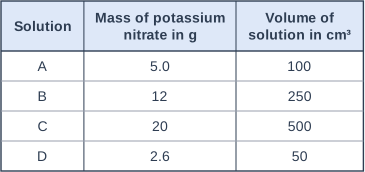
The table shows how four solutions of potassium nitrate were made.
Which solution is the most concentrated? Show your working.
Model answer
A: 5.0 ÷ 0.100 = 50 g/dm³ B: 12 ÷ 0.250 = 48 g/dm³ C: 20 ÷ 0.500 = 40 g/dm³ D: 2.6 ÷ 0.050 = 52 g/dm³ Solution D is the most concentrated.
Explanation
You cannot compare the masses alone because the volumes are different. Calculate the mass per dm³ for each solution; D has the smallest mass but also a very small volume, so it has the highest concentration.
Mark scheme
1 mark
at least two concentrations correct: A = 50, B = 48, C = 40, D = 52 (g/dm³)
1 mark
all four concentrations correct
1 mark
D
must be supported by working; allow ecf from their concentrations
Question 4
4 marks
A student mixed 50 cm³ of a sugar solution with a concentration of 20 g/dm³ with 150 cm³ of a sugar solution with a concentration of 60 g/dm³.
Calculate the concentration of sugar in the mixture in g/dm³. Assume the total volume is 200 cm³.
Model answer
mass of sugar in first solution = 20 × (50 ÷ 1000) = 1.0 g mass of sugar in second solution = 60 × (150 ÷ 1000) = 9.0 g total mass = 1.0 + 9.0 = 10.0 g in 200 cm³ = 0.200 dm³ concentration = 10.0 ÷ 0.200 = 50 g/dm³
Explanation
You cannot simply average the two concentrations because the volumes are different. Find the total mass of solute, then divide by the total volume of solution in dm³.
Mark scheme
1 mark
mass in first solution = 20 × 0.050 = 1.0 g
correct answer with no working scores full marks
1 mark
mass in second solution = 60 × 0.150 = 9.0 g
1 mark
total mass = 10.0 g in 0.200 dm³
allow ecf
1 mark
concentration = 10.0 ÷ 0.200 = 50 (g/dm³)
allow ecf; 40 g/dm³ (mean of the two concentrations) scores 0
Ready to try the rest? Every answer you write is marked against the mark scheme, so you can see exactly where the marks are.
Ctrl + Enter to check
AI TutorHints first, answers after you try
Hi! Stuck? Ask me for a hint and I’ll help you work it out. Once you’ve checked your answer I can explain exactly where the marks are.