
Level:
Correct: 0
Incorrect: 0
Marks: 0/0
Exam Practice
Subject:
Topics:
AQA GCSE Chemistry Smart practice A mixed round aimed at your weak spots
Unit 1
Atomic structure and the periodic table
Unit 2
Bonding, structure, and the properties of matter
Unit 3
Quantitative chemistry
Unit 4
Chemical changes
Unit 5
Energy changes
Unit 6
The rate and extent of chemical change
Unit 7
Organic chemistry
Unit 8
Chemical analysis
Unit 9
Chemistry of the atmosphere
Unit 10
Using resources
Avg
score:
–
Topics
done:
0/124

Reactions of alkenes (chemistry only)

Practise 28 exam-style questions on Reactions of alkenes (chemistry only) for AQA GCSE Chemistry. Write your answer as you would in the exam and get it marked in seconds against the mark scheme, point by point, with an AI tutor on hand if you get stuck.

  • 28 questions
  • 1–6 marks each
  • Instant marking
  • No sign-up needed
20 questions, marked as you go

Sample questions with model answers

Here are 4 of the questions in this topic, each with a model answer, an explanation of why it earns the marks and the mark scheme an examiner would use.

Question 1

2 marks

A student has a sample of a liquid hydrocarbon.

Describe a chemical test the student could do to show that the hydrocarbon is an alkene. Give the result of the test if the hydrocarbon is an alkene.

Model answer

Add a few drops of bromine water to the hydrocarbon and shake. If the hydrocarbon is an alkene, the bromine water turns from orange to colourless.

Explanation

Bromine adds across the C=C double bond of an alkene to form a colourless dibromo compound, so the orange colour disappears. Alkanes have no C=C bond, so the bromine water stays orange. 'Clear' is not the same as 'colourless' - orange bromine water is already clear.

Mark scheme
  1. 1 mark

    add bromine water (and shake)

    allow bromine solution; do not accept bromide

  2. 1 mark

    (bromine water) changes from orange to colourless

    allow decolourised; allow yellow / brown / orange-brown for orange; do not accept 'clear' for colourless
Question 2

2 marks

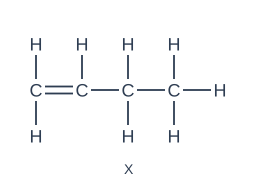
The diagram shows the displayed formula of alkene X.

Name alkene X and name the product formed when X reacts with hydrogen.

Displayed formula of butene (labelled "X").

Model answer

X is butene. It reacts with hydrogen to form butane.

Explanation

X has four carbon atoms and a C=C double bond, so it is butene, C₄H₈. Hydrogen adds across the double bond, turning the alkene into the alkane with the same number of carbon atoms, butane, C₄H₁₀.

Mark scheme
  1. 1 mark

    butene

    allow but-1-ene

  2. 1 mark

    butane

    allow C₄H₁₀

Question 3

3 marks

Propene reacts with hydrogen:
C₃H₆ + H₂ → C₃H₈

Calculate the volume of hydrogen, in dm³, needed to react completely with 2.1 g of propene at room temperature and pressure.
Relative atomic masses (Ar): H = 1, C = 12
One mole of any gas occupies 24 dm³ at room temperature and pressure.

Model answer

Mr of C₃H₆ = (3 × 12) + (6 × 1) = 42
moles of propene = 2.1 ÷ 42 = 0.050 mol
The ratio is 1 : 1, so 0.050 mol of H₂ is needed.
volume of H₂ = 0.050 × 24 = 1.2 dm³

Explanation

Each molecule of propene adds one molecule of hydrogen across its double bond, so the moles of hydrogen equal the moles of propene. Multiplying moles of gas by 24 dm³ gives the volume at room temperature and pressure.

Mark scheme
  1. 1 mark

    Mr of propene = 42

  2. 1 mark

    moles of propene (and of hydrogen) = 2.1 ÷ 42 = 0.050

    allow ecf from an incorrect Mr

  3. 1 mark

    volume = 0.050 × 24 = 1.2 (dm³)

    allow 1200 cm³ if the unit is given; allow ecf; correct answer with no working scores 3 marks

Question 4

4 marks

A sample of vegetable oil decolourises bromine water. The oil is then reacted with hydrogen using a nickel catalyst. After this reaction, the product does not decolourise bromine water.

Explain these observations.

Model answer

The vegetable oil molecules are unsaturated: they contain C=C double bonds. Bromine adds across these double bonds, so the bromine water turns from orange to colourless. When the oil reacts with hydrogen, hydrogen atoms add across the C=C bonds, which become C–C single bonds. The product is saturated, so there are no double bonds left for bromine to add to and the bromine water stays orange.

Explanation

Hydrogen and bromine both add across C=C double bonds, so once the double bonds have reacted with hydrogen there is nothing left for the bromine to react with. Bromine water is therefore a useful way of checking whether a compound is still unsaturated.

Mark scheme
  1. 1 mark

    the oil molecules contain C=C double bonds / the oil is unsaturated

  2. 1 mark

    bromine adds across the C=C bonds, so the bromine water is decolourised

  3. 1 mark

    hydrogen adds across the C=C bonds, converting them to C–C single bonds

    allow 'the oil becomes saturated'

  4. 1 mark

    no C=C bonds remain, so bromine cannot react / the bromine water stays orange

Ready to try the rest? Every answer you write is marked against the mark scheme, so you can see exactly where the marks are.

AI Tutor Hints first, answers after you try

Hi! Stuck? Ask me for a hint and I’ll help you work it out. Once you’ve checked your answer I can explain exactly where the marks are.