
Level:
Correct: 0
Incorrect: 0
Marks: 0/0
Exam Practice
Subject:
Topics:
AQA GCSE Chemistry Smart practice A mixed round aimed at your weak spots
Unit 1
Atomic structure and the periodic table
Unit 2
Bonding, structure, and the properties of matter
Unit 3
Quantitative chemistry
Unit 4
Chemical changes
Unit 5
Energy changes
Unit 6
The rate and extent of chemical change
Unit 7
Organic chemistry
Unit 8
Chemical analysis
Unit 9
Chemistry of the atmosphere
Unit 10
Using resources
Avg
score:
–
Topics
done:
0/124

DNA (deoxyribonucleic acid) and other naturally occurring polymers (chemistry only)

Practise 19 exam-style questions on DNA (deoxyribonucleic acid) and other naturally occurring polymers (chemistry only) for AQA GCSE Chemistry. Write your answer as you would in the exam and get it marked in seconds against the mark scheme, point by point, with an AI tutor on hand if you get stuck.

  • 19 questions
  • 1–6 marks each
  • Instant marking
  • No sign-up needed
19 questions, marked as you go

Sample questions with model answers

Here are 4 of the questions in this topic, each with a model answer, an explanation of why it earns the marks and the mark scheme an examiner would use.

Question 1

2 marks

Describe the structure of most DNA molecules.

Model answer

Most DNA molecules are made of two polymer chains, built from nucleotide monomers, which are twisted around each other in the form of a double helix.

Explanation

The key words are 'two polymer chains' and 'double helix'. Each chain is a polymer made from four different nucleotides.

Mark scheme
  1. 1 mark

    two polymer chains

    allow two strands

  2. 1 mark

    in the form of a double helix

    allow 'twisted together in a spiral'
Question 2

2 marks

DNA is made from only four different nucleotides, but it stores the genetic instructions for a whole organism.

Suggest how DNA can store so much information.

Model answer

The information is stored in the sequence of the four nucleotides along the polymer chains. Because DNA molecules are extremely long, there is an enormous number of possible sequences, so they can code for a very large number of different instructions.

Explanation

Just as a long message can be written with only a few letters, a long chain of just four nucleotides can carry a huge amount of information. It is the order of the monomers, not the number of types, that matters.

Mark scheme
  1. 1 mark

    the information is stored in the order / sequence of the nucleotides along the chain

  2. 1 mark

    DNA chains are very long, so a huge number of different sequences (instructions) are possible

    allow 'different sequences code for different instructions'

Question 3

3 marks

Here is a list of polymers:
poly(propene) cellulose nylon DNA protein PTFE starch

Which of these are naturally occurring polymers?

Model answer

Cellulose, DNA, protein and starch.

Explanation

Naturally occurring polymers are made by living organisms. Poly(propene), nylon and PTFE are synthetic polymers made by chemists from monomers obtained mainly from crude oil.

Mark scheme
  1. 1 mark

    any two of cellulose, DNA, protein, starch

    deduct 1 mark for each synthetic polymer included

  2. 1 mark

    any three of cellulose, DNA, protein, starch

  3. 1 mark

    all four: cellulose, DNA, protein and starch

Question 4

3 marks

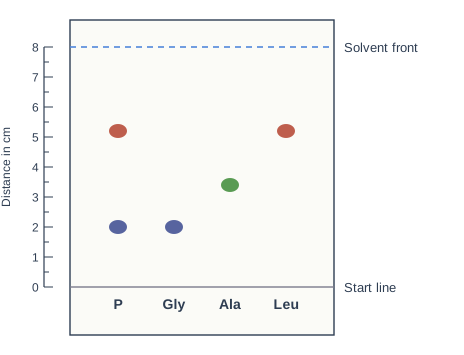
A protein was broken down into its amino acids. The mixture of amino acids, P, was analysed by paper chromatography alongside three known amino acids: glycine (Gly), alanine (Ala) and leucine (Leu). The spots were made visible with a locating agent. The chromatogram shows the results.

Which amino acids does the protein contain? Explain how the chromatogram shows this, and what it tells you about the structure of the protein.

Paper chromatogram. The solvent front is 8 cm above the start line. P: 2 spots at 2 cm, 5.2 cm; Gly: one spot at 2 cm; Ala: one spot at 3.4 cm; Leu: one spot at 5.2 cm. A centimetre scale is drawn beside the paper.

Model answer

The protein contains glycine and leucine. Mixture P gives two spots, one at the same height as the glycine spot and one at the same height as the leucine spot, so they have the same Rf values. There is no spot matching alanine. This shows that the protein was made from different amino acids combined in the same polymer chain.

Explanation

Breaking a natural polymer down gives its monomers, which can then be identified by chromatography. A spot that travels the same distance as a known substance in the same solvent is likely to be that substance. Proteins usually contain several different amino acids.

Mark scheme
  1. 1 mark

    glycine and leucine

    both needed; do not accept if alanine is included

  2. 1 mark

    the spots in P are at the same heights / have the same Rf values as glycine and leucine

    allow 'match' for same height

  3. 1 mark

    the protein is made from more than one (different) amino acid combined in the same chain

Ready to try the rest? Every answer you write is marked against the mark scheme, so you can see exactly where the marks are.

AI Tutor Hints first, answers after you try

Hi! Stuck? Ask me for a hint and I’ll help you work it out. Once you’ve checked your answer I can explain exactly where the marks are.