Level:
Correct: 0
Incorrect: 0
Marks: 0/0
Exam Practice
Subject:
Topics:
AQA GCSE Chemistry Smart practice A mixed round aimed at your weak spots
Unit 1
Atomic structure and the periodic table
Unit 2
Bonding, structure, and the properties of matter
Unit 3
Quantitative chemistry
Unit 4
Chemical changes
Unit 5
Energy changes
Unit 6
The rate and extent of chemical change
Unit 7
Organic chemistry
Unit 8
Chemical analysis
Unit 9
Chemistry of the atmosphere
Unit 10
Using resources
Avg
score:
–
Topics
done:
0/124

Covalent bonding

Practise 30 exam-style questions on Covalent bonding for AQA GCSE Chemistry. Write your answer as you would in the exam and get it marked in seconds against the mark scheme, point by point, with an AI tutor on hand if you get stuck.

  • 30 questions
  • 1–6 marks each
  • Instant marking
  • No sign-up needed
20 questions, marked as you go

Sample questions with model answers

Here are 4 of the questions in this topic, each with a model answer, an explanation of why it earns the marks and the mark scheme an examiner would use.

Question 1

2 marks

The diagram shows a dot and cross diagram for a molecule. Only the outer shells are shown.

Give the molecular formula of the substance and the number of covalent bonds in the molecule.
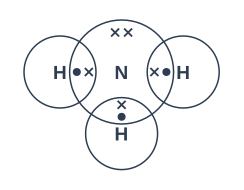
Dot and cross diagram (outer shells only) of a ammonia molecule, NH₃: overlapping circles for the atoms, 3 shared pairs of electrons in the overlaps and 1 lone pair.

Model answer

The molecular formula is NH₃ (ammonia). There are 3 covalent bonds, one between the nitrogen atom and each hydrogen atom.

Explanation

Count the atoms of each element to get the molecular formula, and count the shared pairs (electrons in the overlapping shells) to get the number of covalent bonds. The pair of electrons on nitrogen that is not in an overlap is a lone pair, not a bond.

Mark scheme
  1. 1 mark

    NH₃

    allow H₃N; allow ammonia

  2. 1 mark

    3 (covalent bonds)

Question 2

2 marks

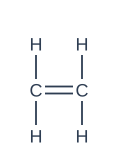
The diagram shows the displayed formula of ethene.

Give the molecular formula of ethene and the total number of pairs of electrons shared in one molecule.

Displayed formula of ethene.

Model answer

The molecular formula is C₂H₄. There are 6 shared pairs: two in the C=C double bond and one in each of the four C–H bonds.

Explanation

A double bond (two lines) is two shared pairs of electrons. Count each line in the displayed formula as one shared pair: 2 + 4 = 6.

Mark scheme
  1. 1 mark

    C₂H₄

  2. 1 mark

    6 (shared pairs)

    two in the C=C double bond and four in the C–H bonds

Question 3

3 marks

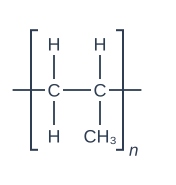
The diagram shows the repeating unit of the polymer poly(propene).

Give the molecular formula of the repeating unit. Calculate the relative formula mass (Mr) of a poly(propene) molecule in which n = 2000.

Relative atomic masses (Ar): H = 1, C = 12

Displayed formula of the repeating unit of an addition polymer (substituent CH₃).

Model answer

The repeating unit is C₃H₆.
Mr of repeating unit = (3 × 12) + (6 × 1) = 42
Mr of the polymer = 42 × 2000 = 84 000

Explanation

Count the atoms in the brackets, including those in the CH₃ side group. Because the polymer is n repeating units joined together, its Mr is n times the Mr of one unit (ignoring the tiny contribution of the ends of the chain).

Mark scheme
  1. 1 mark

    C₃H₆

  2. 1 mark

    Mr of repeating unit = (3 × 12) + (6 × 1) = 42

    allow ecf from an incorrect formula

  3. 1 mark

    Mr of polymer = 42 × 2000 = 84 000

    allow ecf; correct answer with no working scores the last two marks

Question 4

4 marks

Phosphorus is in Group 5 of the periodic table, below nitrogen. Phosphorus forms a compound with hydrogen.

Predict the formula of this compound. State the number of shared pairs and lone pairs around the phosphorus atom, and explain your answer.

Model answer

The formula is PH₃. Phosphorus has five electrons in its outer shell, so it needs three more to fill it. It shares one electron with each of three hydrogen atoms, forming 3 shared pairs. The remaining two outer electrons form 1 lone pair. This is the same as nitrogen in ammonia, NH₃.

Explanation

Elements in the same group have the same number of outer electrons, so they form the same number of covalent bonds. Knowing ammonia's structure lets you predict phosphine's.

Mark scheme
  1. 1 mark

    PH₃

  2. 1 mark

    3 shared pairs

    allow ecf from an incorrect formula

  3. 1 mark

    1 lone pair

  4. 1 mark

    phosphorus has five outer electrons so it needs three more / shares three electrons, leaving two unshared

    allow it is like nitrogen in ammonia, NH₃

Ready to try the rest? Every answer you write is marked against the mark scheme, so you can see exactly where the marks are.

AI Tutor Hints first, answers after you try

Hi! Stuck? Ask me for a hint and I’ll help you work it out. Once you’ve checked your answer I can explain exactly where the marks are.