
Level:
Correct: 0
Incorrect: 0
Marks: 0/0
Exam Practice
Subject:
Topics:
AQA GCSE Chemistry Smart practice A mixed round aimed at your weak spots
Unit 1
Atomic structure and the periodic table
Unit 2
Bonding, structure, and the properties of matter
Unit 3
Quantitative chemistry
Unit 4
Chemical changes
Unit 5
Energy changes
Unit 6
The rate and extent of chemical change
Unit 7
Organic chemistry
Unit 8
Chemical analysis
Unit 9
Chemistry of the atmosphere
Unit 10
Using resources
Avg
score:
–
Topics
done:
0/124

Titrations (chemistry only)

Practise 27 exam-style questions on Titrations (chemistry only) for AQA GCSE Chemistry. Write your answer as you would in the exam and get it marked in seconds against the mark scheme, point by point, with an AI tutor on hand if you get stuck.

  • 27 questions
  • 1–6 marks each
  • Instant marking
  • No sign-up needed
20 questions, marked as you go

Sample questions with model answers

Here are 4 of the questions in this topic, each with a model answer, an explanation of why it earns the marks and the mark scheme an examiner would use.

Question 1

2 marks

The diagram shows the apparatus used for a titration.

Name the piece of apparatus labelled A and give the purpose of B.
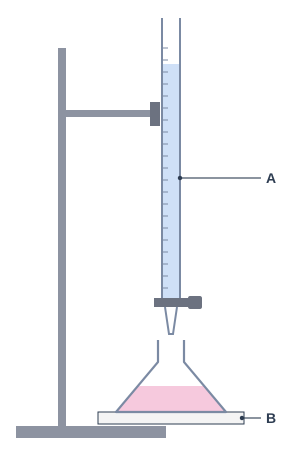
Diagram of a titration set-up. Label A points to the long, thin graduated glass tube held in the clamp; label B points to the white square the flask stands on.

Model answer

A is a burette. B is a white tile, which makes the colour change of the indicator easier to see so the end point can be judged accurately.

Explanation

The burette adds the solution in measured amounts and its scale allows readings to the nearest 0.05 cm³. The white tile gives a plain background so even a small colour change at the end point can be seen.

Mark scheme
  1. 1 mark

    A: burette

    do not accept pipette

  2. 1 mark

    B (white tile) makes it easier to see the colour change of the indicator

    allow so the end point can be seen clearly; naming it as a white tile alone does not score

Question 2

2 marks

A student washes a conical flask with distilled water and does not dry it before adding 25.0 cm³ of sodium hydroxide solution from a pipette for a titration.

Explain why the water left in the flask does not affect the titre.

Model answer

The water dilutes the sodium hydroxide, but the number of moles of sodium hydroxide in the flask is still the same. The volume of acid needed depends only on the number of moles of alkali it has to neutralise, so the titre does not change.

Explanation

Students often think any added water will spoil a titration. Water in the flask changes the concentration but not the amount of alkali, and it is the amount that decides how much acid reacts. Water in the burette or pipette is different, because it changes the amount delivered.

Mark scheme
  1. 1 mark

    the number of moles of sodium hydroxide in the flask is unchanged

    allow the amount of alkali stays the same

  2. 1 mark

    the volume of acid needed depends only on the number of moles of alkali present

    allow the same amount of acid is needed to neutralise it

Question 3

3 marks

A student titrates 25.0 cm³ of sodium hydroxide solution of unknown concentration with 0.100 mol/dm³ hydrochloric acid. In one titration the student adds too much acid and goes past the end point.

Explain the effect this has on the concentration of sodium hydroxide calculated from this titration.

Model answer

Overshooting the end point means the recorded titre is bigger than the volume really needed. The calculated number of moles of hydrochloric acid is therefore too large, and because moles of NaOH = moles of HCl, the calculated concentration of sodium hydroxide will be too high.

Explanation

Follow the error through the calculation: a larger volume of acid gives more moles of acid, which gives more moles of alkali in the same 25.0 cm³, so the concentration comes out too high. This is why acid is added drop by drop near the end point.

Mark scheme
  1. 1 mark

    the titre recorded is larger than it should be

    allow too much acid is recorded

  2. 1 mark

    so the moles of hydrochloric acid calculated are too large

  3. 1 mark

    so the calculated moles / concentration of sodium hydroxide is too high

    do not award if the concentration is said to be too low

Question 4

4 marks

A student wrote this method for a titration to find the volume of hydrochloric acid that neutralises 25 cm³ of sodium hydroxide solution.

1. Rinse a burette with water, then fill it with hydrochloric acid.
2. Use a measuring cylinder to put 25 cm³ of sodium hydroxide solution into a beaker.
3. Add a few drops of universal indicator.
4. Add the acid from the burette until the indicator changes colour.
5. Record the volume of acid added.

Suggest four improvements to the student's method that would give more accurate results.

Model answer

Rinse the burette with the hydrochloric acid rather than water, so the acid is not diluted. Use a pipette rather than a measuring cylinder to measure the 25.0 cm³ of alkali accurately. Use a single indicator such as phenolphthalein, which has a sharp colour change, instead of universal indicator. Use a conical flask on a white tile, swirl it, add the acid drop by drop near the end point, and repeat until concordant titres are obtained so a mean can be calculated.

Explanation

Each improvement removes a source of error: diluted acid, an inaccurate volume of alkali, an unclear end point, poor mixing or a single unchecked result. Titration questions often ask you to spot weaknesses like these in a given method.

Mark scheme
  1. 1 mark

    rinse the burette with the hydrochloric acid instead of water

    max 4

  2. 1 mark

    use a pipette instead of a measuring cylinder

  3. 1 mark

    use a single indicator such as phenolphthalein or methyl orange instead of universal indicator

  4. 1 mark

    use a conical flask (instead of a beaker) and swirl it while adding the acid

    allow swirl the mixture

  5. 1 mark

    add the acid drop by drop near the end point

    allow do a rough titration first

  6. 1 mark

    place the flask on a white tile

  7. 1 mark

    record initial and final burette readings (read from the bottom of the meniscus at eye level)

  8. 1 mark

    repeat until concordant results are obtained and calculate a mean

Ready to try the rest? Every answer you write is marked against the mark scheme, so you can see exactly where the marks are.

AI Tutor Hints first, answers after you try

Hi! Stuck? Ask me for a hint and I’ll help you work it out. Once you’ve checked your answer I can explain exactly where the marks are.