Practise 17 exam-style questions on Comparison with Group 1 elements (chemistry only) for AQA GCSE Chemistry. Write your answer as you would in the exam and get it marked in seconds against the mark scheme, point by point, with an AI tutor on hand if you get stuck.
17 questions
1–6 marks each
Instant marking
No sign-up needed
17 questions, marked as you go
Sample questions with model answers
Here are 4 of the questions in this topic, each with a model answer, an explanation of why it earns the marks and the mark scheme an examiner would use.
Question 1
2 marks
Iron is a transition metal and sodium is a Group 1 metal.
State two differences between the physical properties of iron and sodium.
Model answer
Iron has a much higher melting point than sodium. Iron is also much harder and stronger than sodium, which is soft enough to cut with a knife.
Explanation
Transition metals have high melting points and densities and are strong and hard. Group 1 metals are unusual metals: they have low melting points and low densities and are soft. Comparative words such as 'higher' are needed; 'iron has a high melting point' does not state the difference.
Mark scheme
1 mark
iron has a higher melting point
max 2; any two from the list; allow the converse for sodium, e.g. sodium has a lower melting point
1 mark
iron has a higher density
allow sodium floats on water
1 mark
iron is harder
allow sodium is soft / can be cut with a knife
1 mark
iron is stronger
Question 2
3 marks
Copper is used to make water pipes.
Explain why copper is suitable for water pipes but potassium would not be suitable.
Model answer
Copper does not react with water, so the pipe will not be damaged and the water stays clean. Copper is also strong and hard enough to make lasting pipes. Potassium reacts vigorously with water, producing hydrogen and potassium hydroxide, and it is soft and weak, so it could never be used.
Explanation
Choosing a material means matching its properties to the use. Transition metals are strong, hard and unreactive with water; Group 1 metals are soft and react vigorously with water, so they are useless as structural materials.
Mark scheme
1 mark
copper does not react with water
max 3; any three from the list
1 mark
copper is strong / hard
allow copper can be bent into shape
1 mark
potassium reacts (vigorously) with water
allow potassium reacts with water to form potassium hydroxide / hydrogen / catches fire
1 mark
potassium is soft / weak
allow potassium has a low melting point
Question 3
3 marks
A cube of an unknown metal has a volume of 2.0 cm³ and a mass of 17.8 g.
Calculate the density of the metal and suggest whether it is a Group 1 metal or a transition metal. Give a reason for your answer.
density = mass ÷ volume
Model answer
density = 17.8 ÷ 2.0 = 8.9 g/cm³ The metal is a transition metal, because transition metals have high densities, whereas Group 1 metals have low densities (lithium, sodium and potassium are even less dense than water).
Explanation
Transition metals typically have densities of about 7-9 g/cm³, while Group 1 metals are below 2 g/cm³. A density of 8.9 g/cm³ (which matches nickel or copper) is clearly a transition metal.
Mark scheme
1 mark
density = 17.8 ÷ 2.0 = 8.9 (g/cm³)
correct answer with no working scores the mark
1 mark
transition metal
allow ecf from an incorrect density
1 mark
because it has a high density / Group 1 metals have low densities (below about 2 g/cm³)
Question 4
4 marks
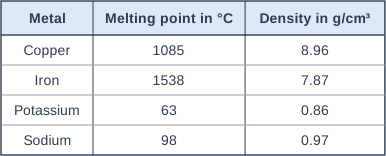
The table shows the melting points and densities of four metals.
A student says: 'All metals have high melting points and high densities.'
Use the data to evaluate the student's statement.
Model answer
The statement is true for the transition metals: copper and iron melt above 1000 °C and have densities of about 8 g/cm³. It is not true for the Group 1 metals: sodium and potassium melt below 100 °C and have densities below 1 g/cm³, so they are less dense than water. Therefore the statement is incorrect; it only applies to some metals, such as the transition metals.
Explanation
To evaluate, find data that support the statement and data that contradict it, then reach a conclusion. One counter-example is enough to show that 'all metals' is wrong, and the Group 1 metals are the obvious exceptions.
Mark scheme
1 mark
the statement is true for the transition metals / copper and iron have high melting points (above 1000 °C) and high densities
1 mark
sodium and potassium (Group 1 metals) have low melting points (below 100 °C)
1 mark
sodium and potassium have low densities (below 1 g/cm³ / less than water)
1 mark
so the statement is not correct for all metals / only applies to transition metals
a conclusion is needed for this mark
Ready to try the rest? Every answer you write is marked against the mark scheme, so you can see exactly where the marks are.
Ctrl + Enter to check
AI TutorHints first, answers after you try
Hi! Stuck? Ask me for a hint and I’ll help you work it out. Once you’ve checked your answer I can explain exactly where the marks are.