Using the Earth's resources and sustainable development
Practise 29 exam-style questions on Using the Earth's resources and sustainable development for AQA GCSE Chemistry. Write your answer as you would in the exam and get it marked in seconds against the mark scheme, point by point, with an AI tutor on hand if you get stuck.
29 questions
1–6 marks each
Instant marking
No sign-up needed
20 questions, marked as you go
Sample questions with model answers
Here are 4 of the questions in this topic, each with a model answer, an explanation of why it earns the marks and the mark scheme an examiner would use.
Question 1
2 marks
What is meant by sustainable development?
Model answer
Sustainable development is development that meets the needs of current generations without compromising the ability of future generations to meet their own needs.
Explanation
Learn this definition exactly: it has two parts, the needs of people now and the needs of people in the future. Using finite resources faster than necessary, or causing lasting damage, makes development less sustainable.
Mark scheme
1 mark
development that meets the needs of current generations
allow meets the needs of people today
1 mark
without compromising the ability of future generations to meet their own needs
allow without stopping future generations meeting their needs
Question 2
2 marks
Aspirin is a medicine that was first obtained from the bark of willow trees. Today aspirin is made synthetically in factories.
Suggest two advantages of making aspirin synthetically.
Model answer
Synthetic aspirin can be made in very large quantities to meet demand, without needing to harvest willow trees. It is also pure, so each tablet contains the same dose.
Explanation
Many medicines were first found in plants and are now made synthetically. Synthetic production gives a reliable supply of a pure product and protects the natural resource.
Mark scheme
1 mark
can be made in large quantities to meet demand
max 2
1 mark
does not depend on harvesting willow trees / a natural supply
1 mark
purer / each tablet contains a consistent dose
1 mark
cheaper to produce
Question 3
3 marks
Timber is a renewable resource. In some parts of the world, forests are being cut down faster than new trees can grow.
Explain whether the use of timber from these forests is sustainable.
Model answer
Timber can only be used sustainably if trees are replaced at the same rate as they are cut down. In these forests trees are cut down faster than they regrow, so the forests will shrink. This is not sustainable, because future generations will not have enough timber to meet their needs. Replanting trees at the rate they are cut would make it sustainable.
Explanation
Being renewable is not the same as being used sustainably. A renewable resource used faster than it is replaced behaves like a finite one.
Mark scheme
1 mark
a resource is only renewable if it is replaced at the rate it is used
max 3
1 mark
here trees are cut down faster than they regrow, so the forests will shrink / run out
1 mark
so it is not sustainable, because future generations will not be able to meet their needs for timber
1 mark
replanting / managed forests would make it sustainable
Question 4
4 marks
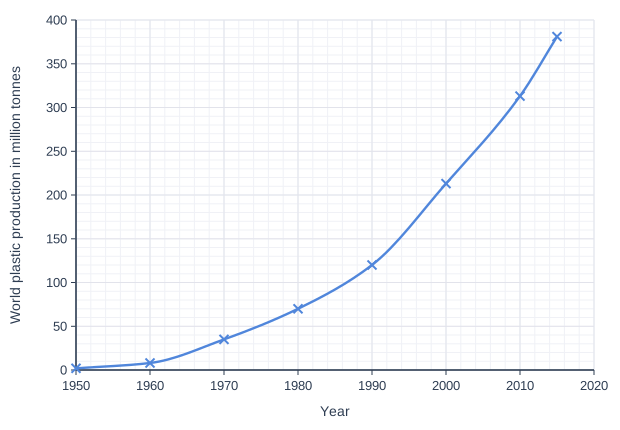
The graph shows world production of plastics from 1950 to 2015. Most plastics are made from crude oil.
Use the graph to calculate the percentage increase in plastic production between 1980 and 2010. Suggest why the increase in plastic production is a concern for sustainable development.
Model answer
In 1980 production was about 70 million tonnes and in 2010 about 313 million tonnes. percentage increase = (313 − 70) ÷ 70 × 100 = 347% This is a concern because most plastics are made from crude oil, which is a finite resource, so using more of it now leaves less for future generations to meet their needs.
Explanation
Read the values carefully from the scale and divide the increase by the 1980 value. Linking to sustainable development means considering the needs of future generations as well as people today.
Mark scheme
1 mark
values read as 70 million tonnes (1980) and 313 million tonnes (2010)
allow 65-75 and 305-320; correct answer with no working scores full marks
1 mark
(313 − 70) ÷ 70 × 100 = 347 (%)
allow ecf from readings; allow 330-370%
1 mark
crude oil is a finite resource that will run out
max 2 for concerns
1 mark
so future generations may not have crude oil to meet their needs
1 mark
most plastics are not biodegradable, so waste builds up
Ready to try the rest? Every answer you write is marked against the mark scheme, so you can see exactly where the marks are.
Ctrl + Enter to check
AI TutorHints first, answers after you try
Hi! Stuck? Ask me for a hint and I’ll help you work it out. Once you’ve checked your answer I can explain exactly where the marks are.