Level:
Correct: 0
Incorrect: 0
Marks: 0/0
Exam Practice
Subject:
Topics:
AQA GCSE Chemistry Smart practice A mixed round aimed at your weak spots
Unit 1
Atomic structure and the periodic table
Unit 2
Bonding, structure, and the properties of matter
Unit 3
Quantitative chemistry
Unit 4
Chemical changes
Unit 5
Energy changes
Unit 6
The rate and extent of chemical change
Unit 7
Organic chemistry
Unit 8
Chemical analysis
Unit 9
Chemistry of the atmosphere
Unit 10
Using resources
Avg
score:
–
Topics
done:
0/124

Flame emission spectroscopy (chemistry only)

Practise 20 exam-style questions on Flame emission spectroscopy (chemistry only) for AQA GCSE Chemistry. Write your answer as you would in the exam and get it marked in seconds against the mark scheme, point by point, with an AI tutor on hand if you get stuck.

  • 20 questions
  • 1–6 marks each
  • Instant marking
  • No sign-up needed
20 questions, marked as you go

Sample questions with model answers

Here are 4 of the questions in this topic, each with a model answer, an explanation of why it earns the marks and the mark scheme an examiner would use.

Question 1

2 marks

The output from flame emission spectroscopy is a line spectrum.

Give two pieces of information about the metal ions in a solution that can be found from its line spectrum.

Model answer

The line spectrum shows which metal ions are present in the solution, and it can be used to measure their concentrations.

Explanation

The positions of the lines identify the ions, and the intensity (brightness) of the lines depends on how much of each ion is present. This is why flame emission spectroscopy is both qualitative and quantitative.

Mark scheme
  1. 1 mark

    which metal ions are present / the identity of the metal ions

  2. 1 mark

    the concentration of the metal ions

    allow how much of each ion is present
Question 2

2 marks

A student analyses a sample of tap water using flame emission spectroscopy. There are no lines in the spectrum at any of the wavelengths for calcium. The student concludes: "The tap water contains no calcium ions at all."

Explain why this conclusion may not be correct.

Model answer

Calcium ions could still be present at a concentration below the smallest amount the instrument can detect. The result only shows that the concentration of calcium ions is very low, not that there are none at all.

Explanation

Instrumental methods are very sensitive, but every method has a detection limit. A negative result means 'not detected', which is not quite the same as 'not present'.

Mark scheme
  1. 1 mark

    calcium ions could be present at a concentration too low to detect

    allow below the detection limit of the instrument

  2. 1 mark

    the result only shows that any calcium is below a certain (very low) concentration

    allow even sensitive methods have a lower limit

Question 3

3 marks

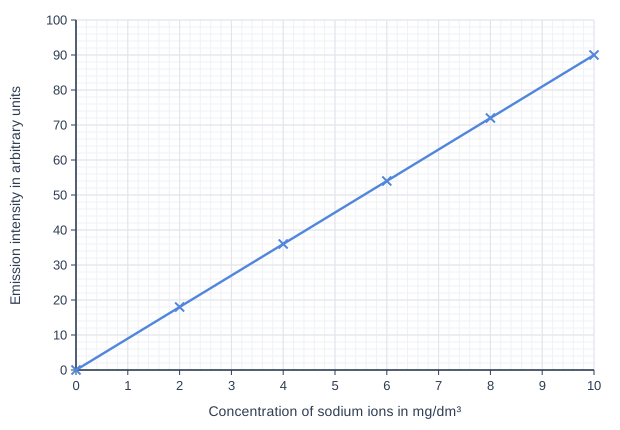
The graph shows a calibration graph for sodium ions made using flame emission spectroscopy.

A 10.0 cm³ sample of river water is diluted with distilled water to a total volume of 100 cm³. The diluted solution gives an emission intensity of 45 arbitrary units.

Calculate the concentration of sodium ions in the original river water.

Line graph of emission intensity in arbitrary units (y-axis, 0 to 100) against concentration of sodium ions in mg/dm³ (x-axis, 0 to 10). The line is a smooth curve through (0, 0), (2, 18), (4, 36), (6, 54), (8, 72), (10, 90).

Model answer

From the graph, an intensity of 45 corresponds to 5.0 mg/dm³ in the diluted solution.
The river water was diluted from 10.0 cm³ to 100 cm³, which is a factor of 100 ÷ 10.0 = 10.
concentration in river water = 5.0 × 10 = 50 mg/dm³

Explanation

Samples are often diluted so that their readings fall within the calibration range. The graph gives the concentration of the diluted solution, so you must multiply by the dilution factor to get the original concentration.

Mark scheme
  1. 1 mark

    concentration of diluted solution = 5(.0) mg/dm³

    allow 4.8-5.2; correct answer with no working scores full marks

  2. 1 mark

    dilution factor = 100 ÷ 10.0 = 10

    allow multiply by 10

  3. 1 mark

    50 mg/dm³

    allow ecf from the value read from the graph × 10; allow 48-52; unit needed

Question 4

4 marks

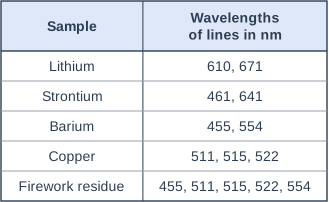
Barium compounds and copper compounds both give green flames in flame tests. The table shows the wavelengths of the lines in the flame emission spectra of four metal ions, and the lines in the spectrum of a firework residue.

Identify the metal ions in the firework residue. Explain why flame emission spectroscopy is more useful than a flame test for analysing this residue.

Table with columns "Sample", "Wavelengths of lines in nm". Sample: Lithium; Wavelengths of lines in nm: 610, 671 | Sample: Strontium; Wavelengths of lines in nm: 461, 641 | Sample: Barium; Wavelengths of lines in nm: 455, 554 | Sample: Copper; Wavelengths of lines in nm: 511, 515, 522 | Sample: Firework residue; Wavelengths of lines in nm: 455, 511, 515, 522, 554.

Model answer

The residue contains barium ions (lines at 455 nm and 554 nm) and copper ions (lines at 511, 515 and 522 nm). In a flame test both barium and copper give a green flame, so the test could not show whether one or both metals were present. Flame emission spectroscopy produces separate lines for each metal ion, so both can be identified.

Explanation

Flame colours of barium are not required knowledge, but the question gives it to you. Spectroscopy distinguishes ions that look the same in a flame test because their line spectra are different.

Mark scheme
  1. 1 mark

    barium

  2. 1 mark

    copper

    do not award this mark if lithium or strontium is also given

  3. 1 mark

    a flame test would just show green, so it could not show whether barium, copper or both are present

  4. 1 mark

    flame emission spectroscopy shows separate lines for each metal ion (so both can be identified)

Ready to try the rest? Every answer you write is marked against the mark scheme, so you can see exactly where the marks are.

AI Tutor Hints first, answers after you try

Hi! Stuck? Ask me for a hint and I’ll help you work it out. Once you’ve checked your answer I can explain exactly where the marks are.