
Level:
Correct: 0
Incorrect: 0
Marks: 0/0
Exam Practice
Subject:
Topics:
AQA GCSE Chemistry Smart practice A mixed round aimed at your weak spots
Unit 1
Atomic structure and the periodic table
Unit 2
Bonding, structure, and the properties of matter
Unit 3
Quantitative chemistry
Unit 4
Chemical changes
Unit 5
Energy changes
Unit 6
The rate and extent of chemical change
Unit 7
Organic chemistry
Unit 8
Chemical analysis
Unit 9
Chemistry of the atmosphere
Unit 10
Using resources
Avg
score:
–
Topics
done:
0/124

Alternative methods of extracting metals (HT only)

Practise 28 exam-style questions on Alternative methods of extracting metals (HT only) for AQA GCSE Chemistry. Write your answer as you would in the exam and get it marked in seconds against the mark scheme, point by point, with an AI tutor on hand if you get stuck.

  • 28 questions
  • 1–6 marks each
  • Instant marking
  • No sign-up needed
20 questions, marked as you go

Sample questions with model answers

Here are 4 of the questions in this topic, each with a model answer, an explanation of why it earns the marks and the mark scheme an examiner would use.

Question 1

2 marks

A company wants to use living organisms to extract copper from a heap of waste rock left at an old copper mine.

Name two biological methods the company could use. For each method, state the type of organism used.

Model answer

Phytomining, which uses plants.
Bioleaching, which uses bacteria.

Explanation

Both are biological methods for extracting metals from low-grade ores or waste. Phytomining relies on plants absorbing metal compounds; bioleaching relies on bacteria producing a leachate solution of metal compounds.

Mark scheme
  1. 1 mark

    phytomining, which uses plants

    method and organism both needed for the mark

  2. 1 mark

    bioleaching, which uses bacteria

    method and organism both needed for the mark; allow microorganisms / microbes for bacteria
Question 2

2 marks

Phytomining can be used on land contaminated with copper compounds from old mines.

Suggest two benefits of using phytomining on this land.

Model answer

The plants remove toxic copper compounds from the soil, cleaning up the land so it can be used again, for example for farming. Copper is also obtained from land that would be too low-grade to mine.

Explanation

Phytomining has a double benefit on contaminated land: it removes harmful metal compounds and recovers a useful metal at the same time, without digging up and dumping the soil.

Mark scheme
  1. 1 mark

    removes (toxic) copper compounds from the soil / cleans up the land

    max 2

  2. 1 mark

    the land can then be used for other purposes, e.g. farming or building

  3. 1 mark

    copper is obtained from land / waste that would otherwise be uneconomic to process

  4. 1 mark

    avoids digging up and disposing of the contaminated soil

Question 3

3 marks

A farmer grows plants on land containing copper compounds. The harvested plants have a dry mass of 8000 kg. When the plants are burned, the mass of ash is 5% of the dry mass. The ash contains 12% copper by mass.

Calculate the mass of copper in the ash. Give your answer in kg.

Model answer

mass of ash = 8000 × 5 ÷ 100 = 400 kg
mass of copper = 400 × 12 ÷ 100 = 48 kg

Explanation

Apply each percentage in turn: first find the mass of ash from the dry plant mass, then the mass of copper in the ash. Burning concentrates the copper: the plants contain only 0.6% copper, but the ash contains 12%.

Mark scheme
  1. 1 mark

    mass of ash = 8000 × 5 ÷ 100 = 400 (kg)

  2. 1 mark

    mass of copper = 400 × 12 ÷ 100

    allow ecf from incorrect mass of ash

  3. 1 mark

    = 48 (kg)

    correct answer with no working scores 3 marks; allow 8000 × 0.05 × 0.12 = 48

Question 4

4 marks

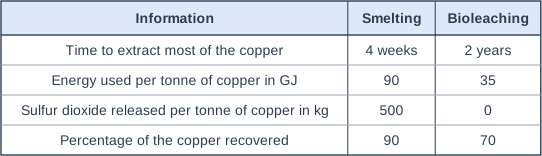
A company wants to extract copper from a large heap of low-grade copper sulfide ore. It is considering two methods. Smelting involves concentrating the ore and heating it in a furnace. Bioleaching involves spraying the heap with a solution containing bacteria.

The table shows information about the two methods for this ore.

Evaluate the two methods. Give a justified conclusion about which method the company should use.

Table with columns "Information", "Smelting", "Bioleaching". Information: Time to extract most of the copper; Smelting: 4 weeks; Bioleaching: 2 years | Information: Energy used per tonne of copper in GJ; Smelting: 90; Bioleaching: 35 | Information: Sulfur dioxide released per tonne of copper in kg; Smelting: 500; Bioleaching: 0 | Information: Percentage of the copper recovered; Smelting: 90; Bioleaching: 70.

Model answer

Smelting is much faster, taking 4 weeks instead of 2 years, and recovers more of the copper (90% compared with 70%). However, bioleaching uses much less energy (35 GJ per tonne instead of 90 GJ), so it is cheaper and burns less fossil fuel, and it releases no sulfur dioxide, whereas smelting releases 500 kg per tonne of copper, which causes acid rain. I think the company should use bioleaching, because the heap is low-grade ore that is not needed urgently, and the energy and pollution savings outweigh the slower rate and lower recovery.

Explanation

An evaluation needs points for and against each method, using the data, then a conclusion that weighs them up. Either conclusion can score if it is supported by the data; a conclusion with no reason does not earn the final mark.

Mark scheme
  1. 1 mark

    smelting is much faster (4 weeks compared with 2 years)

    max 4; max 3 if no justified conclusion

  2. 1 mark

    smelting recovers a higher percentage of the copper (90% compared with 70%)

  3. 1 mark

    bioleaching uses less energy (35 GJ compared with 90 GJ per tonne), so it costs less / burns less fuel

    allow bioleaching uses less than half the energy

  4. 1 mark

    bioleaching releases no sulfur dioxide, whereas smelting releases 500 kg per tonne, which causes acid rain

  5. 1 mark

    justified conclusion, e.g. bioleaching, because its lower energy use and lack of sulfur dioxide outweigh it being slower and recovering less copper

    allow smelting if justified, e.g. copper is needed quickly and more copper is recovered

Ready to try the rest? Every answer you write is marked against the mark scheme, so you can see exactly where the marks are.

AI Tutor Hints first, answers after you try

Hi! Stuck? Ask me for a hint and I’ll help you work it out. Once you’ve checked your answer I can explain exactly where the marks are.