
Level:
Correct: 0
Incorrect: 0
Marks: 0/0
Exam Practice
Subject:
Topics:
AQA GCSE Chemistry Smart practice A mixed round aimed at your weak spots
Unit 1
Atomic structure and the periodic table
Unit 2
Bonding, structure, and the properties of matter
Unit 3
Quantitative chemistry
Unit 4
Chemical changes
Unit 5
Energy changes
Unit 6
The rate and extent of chemical change
Unit 7
Organic chemistry
Unit 8
Chemical analysis
Unit 9
Chemistry of the atmosphere
Unit 10
Using resources
Avg
score:
–
Topics
done:
0/124

Polymers

Practise 16 exam-style questions on Polymers for AQA GCSE Chemistry. Write your answer as you would in the exam and get it marked in seconds against the mark scheme, point by point, with an AI tutor on hand if you get stuck.

  • 16 questions
  • 1–6 marks each
  • Instant marking
  • No sign-up needed
16 questions, marked as you go

Sample questions with model answers

Here are 4 of the questions in this topic, each with a model answer, an explanation of why it earns the marks and the mark scheme an examiner would use.

Question 1

2 marks

Describe the size of polymer molecules. Name the type of bond that joins the atoms together within a polymer molecule.

Model answer

Polymer molecules are very large: long chains containing thousands of atoms. The atoms are joined together by strong covalent bonds.

Explanation

A polymer is made of very large molecules, but each one is still a separate molecule, so polymers are not giant covalent structures. Within each chain, every atom is linked to other atoms by strong covalent bonds.

Mark scheme
  1. 1 mark

    very large (molecules)

    allow long chains / made of thousands of atoms; do not accept 'giant lattice'

  2. 1 mark

    covalent (bonds)

    allow strong covalent bonds
Question 2

2 marks

Pure substances made of small molecules melt at a single, sharp temperature. Poly(ethene) does not have a sharp melting point; it softens gradually over a range of temperatures.

A sample of poly(ethene) contains chains of many different lengths. Suggest why poly(ethene) softens over a range of temperatures.

Model answer

Longer chains have stronger intermolecular forces than shorter chains. Because the sample contains chains of many different lengths, the forces between them are overcome at different temperatures, so the polymer softens over a range of temperatures instead of melting at one temperature.

Explanation

Intermolecular forces increase with the size of the molecules. A polymer sample is a mixture of molecules of different sizes, so it behaves more like a mixture than a single pure substance when heated.

Mark scheme
  1. 1 mark

    the chains of different lengths have intermolecular forces of different strengths

    allow longer chains have stronger intermolecular forces

  2. 1 mark

    so different amounts of energy are needed to overcome the forces / the forces are overcome at different temperatures

Question 3

3 marks

Poly(tetrafluoroethene), PTFE, is a polymer used to coat non-stick frying pans. PTFE melts at 327 °C.

Explain, in terms of its structure and bonding, why the PTFE coating does not melt when food is fried at 200 °C.

Model answer

PTFE is a polymer with very large molecules, so the intermolecular forces between its molecules are relatively strong. A lot of energy is needed to overcome these forces, so its melting point (327 °C) is well above the frying temperature of 200 °C and the coating stays solid.

Explanation

You do not need to know anything about PTFE in particular: apply the general idea that polymers have very large molecules with relatively strong intermolecular forces, then compare the melting point with the temperature of use.

Mark scheme
  1. 1 mark

    PTFE has very large molecules

    allow long chains

  2. 1 mark

    the intermolecular forces between the molecules are relatively strong

    do not accept covalent bonds break when it melts

  3. 1 mark

    a lot of energy is needed to overcome them, so its melting point (327 °C) is higher than 200 °C

Question 4

5 marks

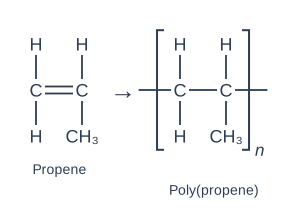
The diagram shows propene molecules joining to form poly(propene).

Propene is a gas at room temperature but poly(propene) is a solid. Compare the structure and bonding of propene and poly(propene), and use this to explain the difference in their states.

Displayed formula of an alkene monomer CH₂=CHCH₃ (labelled "Propene") arrow to displayed formula of the repeating unit of an addition polymer (substituent CH₃) (labelled "Poly(propene)").

Model answer

In both substances the atoms are joined by strong covalent bonds. Propene is made of small molecules containing a C=C double bond, while poly(propene) is made of very large molecules: long chains of repeating units joined by single bonds. The intermolecular forces between small propene molecules are weak, so little energy is needed to overcome them and propene is a gas at room temperature. The intermolecular forces between the very large poly(propene) molecules are relatively strong, so much more energy is needed to overcome them and poly(propene) is a solid at room temperature.

Explanation

Joining thousands of small molecules into one very large molecule does not change the type of bonding, but it greatly increases the strength of the intermolecular forces. Make sure each point is a comparison between the monomer and the polymer.

Mark scheme
  1. 1 mark

    in both, the atoms are joined by strong covalent bonds

    max 5

  2. 1 mark

    propene consists of small molecules

  3. 1 mark

    propene has weak intermolecular forces, so little energy is needed to overcome them and it is a gas

  4. 1 mark

    poly(propene) consists of very large molecules / long chains of many repeating units

  5. 1 mark

    poly(propene) has relatively strong intermolecular forces

  6. 1 mark

    more energy is needed to overcome these forces, so poly(propene) is a solid at room temperature

  7. 1 mark

    propene has a C=C double bond but poly(propene) has only single bonds

Ready to try the rest? Every answer you write is marked against the mark scheme, so you can see exactly where the marks are.

AI Tutor Hints first, answers after you try

Hi! Stuck? Ask me for a hint and I’ll help you work it out. Once you’ve checked your answer I can explain exactly where the marks are.