
Level:
Correct: 0
Incorrect: 0
Marks: 0/0
Exam Practice
Subject:
Topics:
AQA GCSE Chemistry Smart practice A mixed round aimed at your weak spots
Unit 1
Atomic structure and the periodic table
Unit 2
Bonding, structure, and the properties of matter
Unit 3
Quantitative chemistry
Unit 4
Chemical changes
Unit 5
Energy changes
Unit 6
The rate and extent of chemical change
Unit 7
Organic chemistry
Unit 8
Chemical analysis
Unit 9
Chemistry of the atmosphere
Unit 10
Using resources
Avg
score:
–
Topics
done:
0/124

Carboxylic acids (chemistry only)

Practise 30 exam-style questions on Carboxylic acids (chemistry only) for AQA GCSE Chemistry. Write your answer as you would in the exam and get it marked in seconds against the mark scheme, point by point, with an AI tutor on hand if you get stuck.

  • 30 questions
  • 1–6 marks each
  • Instant marking
  • No sign-up needed
20 questions, marked as you go

Sample questions with model answers

Here are 4 of the questions in this topic, each with a model answer, an explanation of why it earns the marks and the mark scheme an examiner would use.

Question 1

2 marks

Name the carboxylic acids that have these formulae:
CH₃CH₂COOH
HCOOH

Model answer

CH₃CH₂COOH is propanoic acid.
HCOOH is methanoic acid.

Explanation

Count all the carbon atoms, including the one in the –COOH group: CH₃CH₂COOH has three carbon atoms, so it is propanoic acid, and HCOOH has one, so it is methanoic acid. The ending -oic acid shows a carboxylic acid.

Mark scheme
  1. 1 mark

    CH₃CH₂COOH: propanoic acid

    do not accept propanol or propanoate

  2. 1 mark

    HCOOH: methanoic acid

    do not accept methanol
Question 2

2 marks

Ethyl ethanoate is made by this reaction:
CH₃COOH + C₂H₅OH → CH₃COOC₂H₅ + H₂O
Relative formula masses (Mr): CH₃COOH = 60, C₂H₅OH = 46, CH₃COOC₂H₅ = 88

Calculate the percentage atom economy for making ethyl ethanoate. Give the answer to 3 significant figures.

Model answer

atom economy = Mr of desired product ÷ total Mr of reactants × 100
= 88 ÷ (60 + 46) × 100
= 88 ÷ 106 × 100 = 83.0%

Explanation

The only waste product is water, so the atom economy is high but not 100%. Use the total Mr of all the reactants on the bottom of the fraction. 83.02% rounds to 83.0% to 3 significant figures - the final zero is needed.

Mark scheme
  1. 1 mark

    atom economy = 88 ÷ (60 + 46) × 100

    allow 88 ÷ 106 × 100

  2. 1 mark

    83.0(%)

    must be 3 significant figures; correct answer with no working scores 2 marks

Question 3

3 marks

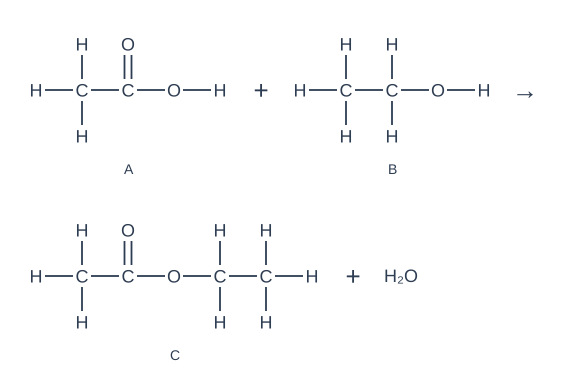
The diagram shows the displayed formulae of the substances in a reaction.

Name compounds A, B and C.

Displayed formula of ethanoic acid (labelled "A") plus displayed formula of ethanol (labelled "B") arrow to displayed formula of ethyl ethanoate (labelled "C") plus H₂O.

Model answer

A is ethanoic acid, B is ethanol and C is ethyl ethanoate.

Explanation

A contains the –COOH group with two carbon atoms, so it is ethanoic acid. B has an –OH group on a two-carbon chain, so it is ethanol. They react to form the ester ethyl ethanoate, which contains the –COO– link, and water.

Mark scheme
  1. 1 mark

    A: ethanoic acid

  2. 1 mark

    B: ethanol

  3. 1 mark

    C: ethyl ethanoate

    'an ester' alone does not score; do not accept ethyl ethanol

Question 4

4 marks

Ethyl ethanoate is made by this reaction:
CH₃COOH + C₂H₅OH ⇌ CH₃COOC₂H₅ + H₂O

A chemist reacted 12.0 g of ethanoic acid with excess ethanol and obtained 11.0 g of ethyl ethanoate.

Calculate the percentage yield of ethyl ethanoate.
Relative atomic masses (Ar): H = 1, C = 12, O = 16

Model answer

Mr of CH₃COOH = 60
moles of ethanoic acid = 12.0 ÷ 60 = 0.200 mol
Mr of CH₃COOC₂H₅ = (4 × 12) + (8 × 1) + (2 × 16) = 88
maximum mass of ester = 0.200 × 88 = 17.6 g
percentage yield = (11.0 ÷ 17.6) × 100 = 62.5%

Explanation

The ethanol is in excess, so the ethanoic acid decides the maximum amount of ester. Percentage yield = actual mass ÷ maximum mass × 100. The yield is well below 100% because the reaction is reversible and some ester is lost when it is separated.

Mark scheme
  1. 1 mark

    moles of ethanoic acid = 12.0 ÷ 60 = 0.200

    allow Mr = 60 for this mark

  2. 1 mark

    Mr of ethyl ethanoate = 88

  3. 1 mark

    maximum mass of ethyl ethanoate = 0.200 × 88 = 17.6 (g)

    allow ecf; allow ratio method: 60 g gives 88 g, so 12.0 g gives 17.6 g

  4. 1 mark

    percentage yield = (11.0 ÷ 17.6) × 100 = 62.5(%)

    allow ecf; correct answer with no working scores 4 marks

Ready to try the rest? Every answer you write is marked against the mark scheme, so you can see exactly where the marks are.

AI Tutor Hints first, answers after you try

Hi! Stuck? Ask me for a hint and I’ll help you work it out. Once you’ve checked your answer I can explain exactly where the marks are.