Practise 30 exam-style questions on Potable water for AQA GCSE Chemistry. Write your answer as you would in the exam and get it marked in seconds against the mark scheme, point by point, with an AI tutor on hand if you get stuck.
30 questions
1–6 marks each
Instant marking
No sign-up needed
20 questions, marked as you go
Sample questions with model answers
Here are 4 of the questions in this topic, each with a model answer, an explanation of why it earns the marks and the mark scheme an examiner would use.
Question 1
2 marks
Give two features of water that make it safe to drink.
Model answer
It has sufficiently low levels of dissolved salts and sufficiently low levels of microbes.
Explanation
Drinking water does not have to be free of dissolved substances, but the levels of salts and microbes must be low enough not to cause harm. High salt levels and disease-causing microbes are the two main problems.
Mark scheme
1 mark
sufficiently low levels of dissolved salts
max 2; allow low levels of dissolved substances
1 mark
sufficiently low levels of microbes
allow few / no harmful bacteria
1 mark
pH within a safe range / no harmful (toxic) chemicals
do not accept 'no dissolved substances'
Question 2
2 marks
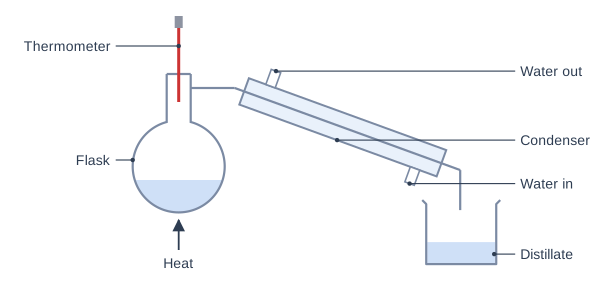
The diagram shows apparatus used to distil a sample of river water. The bulb of the thermometer is level with the side arm that leads to the condenser.
Explain why the thermometer is placed in this position.
Model answer
The thermometer measures the temperature of the vapour that is passing into the condenser. If the reading is 100 °C, the student knows that it is water that is being distilled and collected.
Explanation
The boiling point identifies the substance being distilled. Measuring the vapour at the side arm, rather than the liquid in the flask, gives the temperature of what is actually being collected.
Mark scheme
1 mark
it measures the temperature of the vapour entering the condenser
do not accept measures the temperature of the water in the flask
1 mark
to check that it is 100 °C, so that water (and not another substance) is being collected
Question 3
3 marks
Describe how reverse osmosis is used to produce potable water from sea water.
Model answer
Sea water is pumped at high pressure against a special membrane. The membrane allows water molecules to pass through but stops the dissolved salt ions, so the water on the other side has very low levels of dissolved salts.
Explanation
Reverse osmosis uses a membrane with extremely small pores. Pushing water through it needs high pressure, which is why the process uses a lot of energy.
Mark scheme
1 mark
sea water is pumped / forced at high pressure
1 mark
through a membrane
1 mark
the membrane lets water molecules through but not dissolved salts / ions
do not accept 'filters out the salt' without reference to a membrane
Question 4
4 marks
A coastal town needs 2.0 × 10⁴ m³ of potable water each day from sea water. Reverse osmosis uses about 3.5 kWh of energy for each m³ of water produced. Distillation uses about 15 kWh for each m³.
Calculate how much less energy per day reverse osmosis would use than distillation. Suggest why the large amount of energy needed is a disadvantage of desalination.
Model answer
reverse osmosis: 2.0 × 10⁴ × 3.5 = 7.0 × 10⁴ kWh distillation: 2.0 × 10⁴ × 15 = 3.0 × 10⁵ kWh difference = 3.0 × 10⁵ − 7.0 × 10⁴ = 2.3 × 10⁵ kWh per day The energy is expensive, and if it is generated by burning fossil fuels it releases carbon dioxide.
Explanation
Multiply the volume by the energy per m³ for each method, then subtract. Both methods use much more energy than treating fresh water, which is why desalination is only used where fresh water is scarce.