Practise 26 exam-style questions on Soluble salts for AQA GCSE Chemistry. Write your answer as you would in the exam and get it marked in seconds against the mark scheme, point by point, with an AI tutor on hand if you get stuck.
26 questions
1–6 marks each
Instant marking
No sign-up needed
20 questions, marked as you go
Sample questions with model answers
Here are 4 of the questions in this topic, each with a model answer, an explanation of why it earns the marks and the mark scheme an examiner would use.
Question 1
2 marks
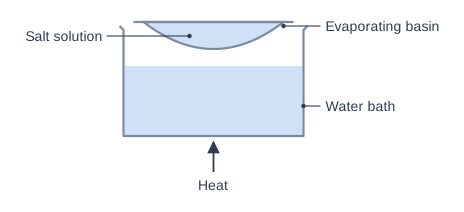
The diagram shows the apparatus a student uses to evaporate water from copper(II) sulfate solution.
Give two reasons for using a water bath rather than heating the evaporating basin directly with a Bunsen burner.
Model answer
A water bath heats the solution gently, because its temperature cannot go above 100 °C, so the solution does not spit out of the basin. It also stops the copper(II) sulfate from overheating and decomposing or losing its water of crystallisation.
Explanation
Heating directly with a Bunsen burner can make the solution boil violently and spit, which is a hazard and loses product. Gentle heating in a water bath, or with an electric heater, evaporates water steadily without damaging the salt.
Mark scheme
1 mark
gentler / more controlled heating (the temperature cannot go above 100 °C)
any two from the list; max 2
1 mark
stops the solution spitting / boiling over (which could cause burns or loss of product)
1 mark
stops the salt overheating / decomposing / losing its water of crystallisation
allow so that crystals rather than a powder are formed
Question 2
2 marks
A student makes copper(II) sulfate crystals by warming dilute sulfuric acid, adding copper(II) oxide and then evaporating the solution.
Give one hazard in this practical and describe how the student could reduce the risk.
Model answer
The hot solution may spit during evaporation and get into the eyes, so the student should heat it gently on a water bath and wear eye protection.
Explanation
A risk assessment links a specific hazard to a precaution that reduces it. Vague answers such as 'be careful' do not score; say exactly what to do and why.
Mark scheme
1 mark
hazard: acid is an irritant / corrosive; hot equipment / Bunsen burner can cause burns; hot solution can spit; copper(II) sulfate / copper(II) oxide is harmful
any one hazard
1 mark
matching precaution: wear eye protection / handle hot apparatus with tongs or leave to cool / heat gently on a water bath / wash hands after use
precaution must match the hazard given
Question 3
3 marks
Magnesium hydroxide is an insoluble base. It can be reacted with dilute nitric acid to make a soluble salt. Magnesium ions have the formula Mg²⁺ and nitrate ions have the formula NO₃⁻.
Name the salt and write a balanced symbol equation for the reaction.
Model answer
The salt is magnesium nitrate. Mg(OH)₂ + 2HNO₃ → Mg(NO₃)₂ + 2H₂O
Explanation
Acid + metal hydroxide → salt + water. Two nitrate ions balance one Mg²⁺ ion, so two HNO₃ are needed, and the two OH groups combine with the two hydrogen ions to make two water molecules.
Mark scheme
1 mark
magnesium nitrate
allow Mg(NO₃)₂
1 mark
correct formulae: Mg(OH)₂ + HNO₃ → Mg(NO₃)₂ + H₂O
1 mark
balanced: Mg(OH)₂ + 2HNO₃ → Mg(NO₃)₂ + 2H₂O
allow multiples; ignore state symbols
Question 4
4 marks
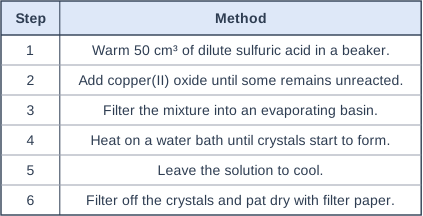
The table shows the method a student used to make copper(II) sulfate crystals.
Explain why the student carried out steps 1, 4, 5 and 6.
Model answer
Step 1: warming the acid increases the rate of reaction, so the copper(II) oxide reacts faster. Step 4: heating on a water bath evaporates some of the water to make a concentrated solution, and the gentle heating stops it spitting or the salt decomposing. Step 5: as the solution cools, copper(II) sulfate becomes less soluble, so crystals form. Step 6: filtering and patting dry separates the crystals from the remaining solution and dries them.
Explanation
Every step in required practical 1 has a purpose linked to making the salt quickly, purely and with good crystals. Being able to explain each step is as important as remembering the order.
Mark scheme
1 mark
step 1: warming the acid makes the reaction faster
allow increases the rate of reaction
1 mark
step 4: to evaporate some water / concentrate the solution, heating gently so it does not spit or decompose
1 mark
step 5: crystals form as the solution cools because the salt is less soluble at lower temperature
1 mark
step 6: to separate the crystals from the remaining solution and dry them
Ready to try the rest? Every answer you write is marked against the mark scheme, so you can see exactly where the marks are.
Ctrl + Enter to check
AI TutorHints first, answers after you try
Hi! Stuck? Ask me for a hint and I’ll help you work it out. Once you’ve checked your answer I can explain exactly where the marks are.