Practise 16 exam-style questions on Global climate change for AQA GCSE Chemistry. Write your answer as you would in the exam and get it marked in seconds against the mark scheme, point by point, with an AI tutor on hand if you get stuck.
16 questions
1–6 marks each
Instant marking
No sign-up needed
16 questions, marked as you go
Sample questions with model answers
Here are 4 of the questions in this topic, each with a model answer, an explanation of why it earns the marks and the mark scheme an examiner would use.
Question 1
2 marks
Global climate change is causing sea levels to rise.
Give two consequences of rising sea levels for people living near the coast.
Model answer
Low-lying coastal land may flood, and coastal erosion will increase, so homes and farmland may be lost.
Explanation
Rising sea levels make floods during storms and high tides more likely and wear away the coastline faster. Many large cities are on coasts, so the effects could involve millions of people.
Mark scheme
1 mark
flooding of low-lying land
max 2
1 mark
increased coastal erosion
1 mark
loss of homes / farmland / infrastructure
allow people forced to move
1 mark
salt water getting into fresh water supplies / farmland
Question 2
2 marks
Many rivers in Asia are fed by water from melting mountain glaciers during the summer. Global climate change is causing these glaciers to shrink.
Suggest how this will affect people who rely on water from these rivers.
Model answer
At first the glaciers will melt faster, so there may be more water and a risk of flooding. Later, once the glaciers have shrunk, there will be much less water in the rivers in summer, so people will have water shortages for drinking and for growing crops.
Explanation
Glaciers act as stores of water that release it slowly in summer. Losing them changes the timing and amount of water available, which is an example of water stress caused by climate change.
Mark scheme
1 mark
in the short term, more meltwater may cause flooding
1 mark
in the long term, when the glaciers have shrunk, there will be less water in the rivers in summer, causing water shortages for drinking or farming
allow water stress / less water for crops
Question 3
3 marks
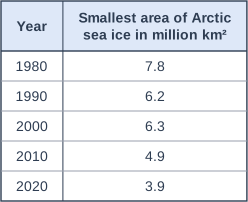
The table shows the smallest area of sea ice in the Arctic each year, measured every 10 years from 1980 to 2020.
Calculate the percentage decrease in the smallest area of Arctic sea ice between 1980 and 2020. Suggest one effect of this decrease on wildlife.
Model answer
percentage decrease = (7.8 − 3.9) ÷ 7.8 × 100 = 50% Animals such as polar bears that hunt on the sea ice lose their habitat, so their numbers may fall.
Explanation
Percentage decrease is the decrease divided by the starting value. The data also shows that the decrease is not steady every decade, because of natural variation, but the overall trend is downward as temperatures rise.
Mark scheme
1 mark
(7.8 − 3.9) ÷ 7.8 × 100
1 mark
50 (%)
correct answer with no working scores 2 marks
1 mark
loss of habitat / hunting grounds for animals such as polar bears or seals, so their distribution changes or numbers fall
Question 4
4 marks
A student says: 'A rise of 2 °C in the mean global temperature is too small to matter.'
Evaluate the student's statement.
Model answer
The statement is wrong. A rise of 2 °C in the mean global temperature means much bigger rises in some places and more extreme heatwaves. It is enough to melt large amounts of ice, raising sea levels and causing flooding, and it changes rainfall patterns, causing droughts and floods that reduce food production. Some regions might benefit from a longer growing season, but many species could not adapt fast enough, so overall the effects would be serious.
Explanation
A mean value hides large local variations. When evaluating, consider both sides - some possible benefits as well as the harmful effects - and finish with a clear judgement.
Mark scheme
1 mark
a small rise in the mean can mean much larger changes in some places / more extreme temperatures
max 4; for 4 marks there must be a judgement
1 mark
it is enough to melt large amounts of ice, causing sea level rise and flooding
1 mark
it changes rainfall patterns, causing droughts or floods that affect food production
1 mark
many species cannot move or adapt fast enough, so distributions change / some become extinct
1 mark
some regions may benefit, e.g. a longer growing season
1 mark
judgement: the statement is wrong because the effects of a 2 °C rise would be significant
Ready to try the rest? Every answer you write is marked against the mark scheme, so you can see exactly where the marks are.
Ctrl + Enter to check
AI TutorHints first, answers after you try
Hi! Stuck? Ask me for a hint and I’ll help you work it out. Once you’ve checked your answer I can explain exactly where the marks are.