
Level:
Correct: 0
Incorrect: 0
Marks: 0/0
Exam Practice
Subject:
Topics:
AQA GCSE Chemistry Smart practice A mixed round aimed at your weak spots
Unit 1
Atomic structure and the periodic table
Unit 2
Bonding, structure, and the properties of matter
Unit 3
Quantitative chemistry
Unit 4
Chemical changes
Unit 5
Energy changes
Unit 6
The rate and extent of chemical change
Unit 7
Organic chemistry
Unit 8
Chemical analysis
Unit 9
Chemistry of the atmosphere
Unit 10
Using resources
Avg
score:
–
Topics
done:
0/124

The energy change of reactions (HT only)

Practise 27 exam-style questions on The energy change of reactions (HT only) for AQA GCSE Chemistry. Write your answer as you would in the exam and get it marked in seconds against the mark scheme, point by point, with an AI tutor on hand if you get stuck.

  • 27 questions
  • 1–6 marks each
  • Instant marking
  • No sign-up needed
20 questions, marked as you go

Sample questions with model answers

Here are 4 of the questions in this topic, each with a model answer, an explanation of why it earns the marks and the mark scheme an examiner would use.

Question 1

2 marks

When methane burns in air, the temperature of the surroundings increases.

Explain, in terms of bond breaking and bond making, why the combustion of methane is exothermic.

Model answer

More energy is released when the bonds in the products (carbon dioxide and water) are formed than is needed to break the bonds in the reactants (methane and oxygen). The extra energy is transferred to the surroundings, so the temperature increases.

Explanation

Whether a reaction is exothermic or endothermic depends on the balance between energy taken in to break bonds and energy released when bonds form. For combustion, bond making releases more, so there is a net transfer of energy to the surroundings.

Mark scheme
  1. 1 mark

    more energy is released when the new bonds (in carbon dioxide and water) form

    allow energy released by bond making is greater

  2. 1 mark

    than is needed to break the bonds (in methane and oxygen)

    the comparison must be clear for 2 marks; 'energy is needed to break bonds and released when bonds form' with no comparison scores 1 mark; ignore references to activation energy
Question 2

2 marks

Two students used bond energies to calculate the energy change for the combustion of methane:
CH₄ + 2O₂ → CO₂ + 2H₂O

Bond energies in kJ/mol: C–H = 412, O=O = 498, C=O = 805, O–H = 464

Student A's answer was −822 kJ/mol, which is correct. Student B's answer was −1320 kJ/mol.

Suggest the mistake student B made. Show how you worked out your answer.

Model answer

Student B used only one O=O bond in the bonds broken, instead of two.
Bonds broken (student B) = (4 × 412) + 498 = 2146 kJ
Bonds formed = (2 × 805) + (4 × 464) = 3466 kJ
2146 − 3466 = −1320 kJ/mol

Explanation

The difference between the two answers is 498 kJ, exactly one O=O bond, which suggests the balancing number 2 in front of O₂ was ignored. Always multiply each bond energy by the number of molecules in the balanced equation.

Mark scheme
  1. 1 mark

    student B used only one O=O bond instead of two

    allow forgot to multiply 498 by 2 / ignored the 2 in front of O₂; correct answer with no working scores full marks

  2. 1 mark

    working shown: (4 × 412) + 498 = 2146 and 2146 − 3466 = −1320

    allow bonds formed = (2 × 805) + (4 × 464) = 3466 shown with bonds broken = 2146

Question 3

3 marks

Hydrogen peroxide decomposes to produce water and oxygen:
2H₂O₂ → 2H₂O + O₂

The displayed formula of hydrogen peroxide is H–O–O–H.

Bond energies in kJ/mol: O–H = 464, O–O = 146, O=O = 498

Calculate the overall energy change for this reaction.

Model answer

Bonds broken: 2 H₂O₂ = 4 O–H + 2 O–O = 1856 + 292 = 2148 kJ
Bonds formed: 2 H₂O = 4 O–H = 1856 kJ, plus O=O = 498 kJ, total 2354 kJ
Overall energy change = 2148 − 2354 = −206 kJ/mol

Explanation

The four O–H bonds are broken and four are re-formed, so the real change is breaking two weak O–O single bonds (292 kJ) and forming one O=O double bond (498 kJ). More energy is released than taken in, so the decomposition is exothermic.

Mark scheme
  1. 1 mark

    energy needed to break bonds = 2 × ((2 × 464) + 146) = 2148 (kJ)

    4 O–H and 2 O–O bonds

  2. 1 mark

    energy released forming bonds = (4 × 464) + 498 = 2354 (kJ)

    4 O–H and 1 O=O bond

  3. 1 mark

    overall energy change = 2148 − 2354 = −206 (kJ/mol)

    allow ecf from incorrect totals; allow '206 kJ/mol released'; allow 146 × 2 − 498 = −206 if O–H bonds are cancelled; +206 scores max 2; correct answer with no working scores 3 marks

Question 4

4 marks

Hydrogen reacts with the halogens fluorine and iodine:
H₂ + F₂ → 2HF
H₂ + I₂ → 2HI

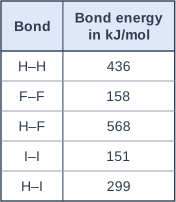
The table shows some bond energies.

Calculate the overall energy change for each reaction. Use the bond energies to explain why one reaction releases much more energy than the other.

Table with columns "Bond", "Bond energy in kJ/mol". Bond: H–H; Bond energy in kJ/mol: 436 | Bond: F–F; Bond energy in kJ/mol: 158 | Bond: H–F; Bond energy in kJ/mol: 568 | Bond: I–I; Bond energy in kJ/mol: 151 | Bond: H–I; Bond energy in kJ/mol: 299.

Model answer

H₂ + F₂: bonds broken = 436 + 158 = 594 kJ; bonds formed = 2 × 568 = 1136 kJ; energy change = 594 − 1136 = −542 kJ/mol
H₂ + I₂: bonds broken = 436 + 151 = 587 kJ; bonds formed = 2 × 299 = 598 kJ; energy change = 587 − 598 = −11 kJ/mol
The energy needed to break the F–F and I–I bonds is almost the same, but the H–F bond (568 kJ/mol) is much stronger than the H–I bond (299 kJ/mol), so far more energy is released when the H–F bonds form.

Explanation

Compare the bonds that differ between the two reactions. Breaking the halogen molecule costs about the same in each case, so the difference comes almost entirely from the energy released when the hydrogen halide bonds form.

Mark scheme
  1. 1 mark

    fluorine: bonds broken = 436 + 158 = 594 and bonds formed = 2 × 568 = 1136 (kJ)

  2. 1 mark

    energy change for fluorine = −542 (kJ/mol)

    allow ecf

  3. 1 mark

    energy change for iodine = (436 + 151) − (2 × 299) = 587 − 598 = −11 (kJ/mol)

    allow ecf

  4. 1 mark

    the H–F bond is much stronger than the H–I bond (so much more energy is released forming H–F bonds), while the F–F and I–I bond energies are similar

    allow H–F bond energy is about twice the H–I bond energy

Ready to try the rest? Every answer you write is marked against the mark scheme, so you can see exactly where the marks are.

AI Tutor Hints first, answers after you try

Hi! Stuck? Ask me for a hint and I’ll help you work it out. Once you’ve checked your answer I can explain exactly where the marks are.