Practise 27 exam-style questions on Life cycle assessment for AQA GCSE Chemistry. Write your answer as you would in the exam and get it marked in seconds against the mark scheme, point by point, with an AI tutor on hand if you get stuck.
27 questions
1–6 marks each
Instant marking
No sign-up needed
20 questions, marked as you go
Sample questions with model answers
Here are 4 of the questions in this topic, each with a model answer, an explanation of why it earns the marks and the mark scheme an examiner would use.
Question 1
2 marks
Transport and distribution are included at each stage of a life cycle assessment.
Explain why transport adds to the environmental impact of a product.
Model answer
Lorries, ships and planes burn fossil fuels, which uses up a finite resource and releases carbon dioxide and other pollutants into the atmosphere.
Explanation
Raw materials, parts and finished products may be moved many times between mines, factories, shops and disposal sites. Every journey burns fuel, so transport is counted at every stage of an LCA.
Mark scheme
1 mark
vehicles burn (fossil) fuels / use energy
allow lorries, ships or planes use diesel / petrol / fuel
1 mark
releasing carbon dioxide (which causes climate change) / releasing pollutants / using up finite resources
Two organisations carry out life cycle assessments of the same product but reach different conclusions.
Suggest two reasons why.
Model answer
They may have given different values to the effects of pollutants, because this requires value judgements. One of them may have carried out a selective LCA that left out some stages in order to reach a pre-determined conclusion.
Explanation
LCAs are not purely objective. Different value judgements, assumptions or choices of which stages to include can lead to different conclusions about the same product.
Mark scheme
1 mark
they made different value judgements about the effects of pollutants
max 2
1 mark
they included different stages / different data (one may be a selective LCA)
1 mark
one organisation may be biased, e.g. funded by the manufacturer, to reach a pre-determined conclusion
1 mark
they made different assumptions, e.g. about how many times the product is used or how it is disposed of
Question 3
3 marks
A single-use plastic bag releases 40 g of carbon dioxide during its life cycle and is used only once. A thicker 'bag for life' releases 160 g of carbon dioxide during its life cycle, however many times it is used.
Determine the smallest number of times the bag for life must be used so that the carbon dioxide released per use is less than for single-use bags.
Model answer
carbon dioxide per use for the bag for life = 160 ÷ number of uses After 4 uses: 160 ÷ 4 = 40 g per use, the same as a single-use bag. After 5 uses: 160 ÷ 5 = 32 g per use, which is less. So the bag for life must be used at least 5 times.
Explanation
When products are used different numbers of times, compare the impact per use, not per item. A bag for life only has a lower impact if it really is reused enough times; used once, it is four times worse than a single-use bag.
Mark scheme
1 mark
carbon dioxide per use = 160 ÷ number of uses (compared with 40 g)
1 mark
160 ÷ 40 = 4 uses gives the same carbon dioxide per use
allow 4 uses gives 40 g per use
1 mark
5 (uses)
allow more than 4 times for 3 marks; an answer of 4 scores 2 marks
Question 4
4 marks
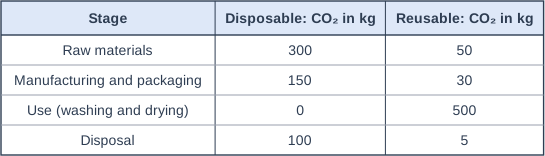
The table shows the carbon dioxide released at each stage of the life cycle of the nappies used by one baby over two and a half years. The reusable nappies are washed and then dried in a tumble dryer.
Compare the total carbon dioxide released by the two types of nappy. Suggest how parents could reduce the carbon dioxide released by using reusable nappies.
Model answer
Disposable: 300 + 150 + 0 + 100 = 550 kg Reusable: 50 + 30 + 500 + 5 = 585 kg Reusable nappies release 35 kg more carbon dioxide than disposable nappies, although the totals are quite similar. Most of the carbon dioxide from reusable nappies comes from washing and drying, so parents could dry them on a washing line instead of in a tumble dryer, or wash them at a lower temperature.
Explanation
Reusable products are not automatically better: here the use stage (washing and drying) outweighs the savings in raw materials, manufacture and disposal. Looking at which stage has the largest impact shows where changes would help most.
Mark scheme
1 mark
total for disposable nappies = 550 kg
1 mark
total for reusable nappies = 585 kg
1 mark
reusable nappies release more carbon dioxide (35 kg more) / the totals are similar
allow ecf from incorrect totals
1 mark
dry the nappies on a washing line instead of in a tumble dryer / wash at a lower temperature / wash full loads / reuse the nappies for another child
Ready to try the rest? Every answer you write is marked against the mark scheme, so you can see exactly where the marks are.
Ctrl + Enter to check
AI TutorHints first, answers after you try
Hi! Stuck? Ask me for a hint and I’ll help you work it out. Once you’ve checked your answer I can explain exactly where the marks are.