Practise 30 exam-style questions on The reactivity series for AQA GCSE Chemistry. Write your answer as you would in the exam and get it marked in seconds against the mark scheme, point by point, with an AI tutor on hand if you get stuck.
30 questions
1–6 marks each
Instant marking
No sign-up needed
20 questions, marked as you go
Sample questions with model answers
Here are 4 of the questions in this topic, each with a model answer, an explanation of why it earns the marks and the mark scheme an examiner would use.
Question 1
2 marks
A small piece of lithium is added to a trough of cold water.
Describe two things you would see.
Model answer
The lithium floats on the water and fizzes steadily as bubbles of gas are given off. It moves around on the surface and gradually gets smaller until it disappears.
Explanation
Lithium reacts steadily with water to form lithium hydroxide and hydrogen. It is less dense than water so it floats, and the hydrogen produced makes it fizz and move. Unlike sodium and potassium it does not melt or catch fire, because it is the least reactive of the three.
Mark scheme
1 mark
the lithium floats
any two from the list; max 2
1 mark
fizzing / bubbles (of gas)
allow effervescence; do not accept 'hydrogen is produced' as an observation
1 mark
the lithium moves around on the surface
1 mark
the lithium gets smaller / disappears
allow dissolves; do not accept melts; do not accept bursts into flame
Question 2
2 marks
When magnesium is added to copper(II) sulfate solution, magnesium sulfate solution and copper are produced.
Explain why this reaction happens, in terms of the tendency of magnesium and copper to form positive ions.
Model answer
Magnesium has a greater tendency to form positive ions than copper. So magnesium atoms lose electrons and become Mg²⁺ ions in solution, while the Cu²⁺ ions gain electrons and become copper atoms.
Explanation
In a displacement reaction the metal with the greater tendency to form positive ions ends up as ions, and the metal with the smaller tendency ends up as atoms. This is why a more reactive metal displaces a less reactive one from its compounds.
Mark scheme
1 mark
magnesium has a greater tendency to form positive ions than copper / magnesium is more reactive than copper
1 mark
so magnesium atoms form (Mg²⁺) ions and the copper ions turn into copper atoms
allow magnesium atoms lose electrons and copper ions gain electrons
Question 3
3 marks
A student set up four mixtures: Mixture 1: magnesium and zinc sulfate solution Mixture 2: copper and iron(II) sulfate solution Mixture 3: zinc and iron(II) sulfate solution Mixture 4: iron and magnesium sulfate solution
Which mixtures would react? Explain your answer.
Model answer
Mixtures 1 and 3 react. A more reactive metal can displace a less reactive metal from its compound. Magnesium is more reactive than zinc, and zinc is more reactive than iron, so these displacements happen. Copper is less reactive than iron and iron is less reactive than magnesium, so mixtures 2 and 4 do not react.
Explanation
In a displacement reaction the free metal must be higher in the reactivity series than the metal in the compound. Check each pair against the order K, Na, Li, Ca, Mg, Zn, Fe, Cu.
Mark scheme
1 mark
mixtures 1 and 3 (only)
both needed and no others
1 mark
a more reactive metal displaces a less reactive metal from its compound
1 mark
magnesium is more reactive than zinc and zinc is more reactive than iron; copper is less reactive than iron and iron is less reactive than magnesium
allow any two correct comparisons that support the choice
Question 4
4 marks
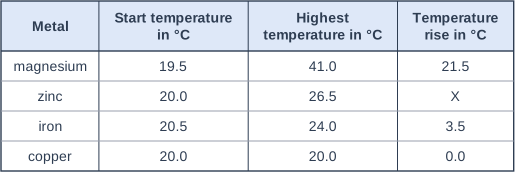
A student added 0.5 g of each metal powder to 20 cm³ of dilute hydrochloric acid and measured the temperature change. The table shows the results.
Calculate value X. Use the results to place the metals in order of reactivity, and explain why there was no temperature change with copper.
Model answer
X = 26.5 − 20.0 = 6.5 °C The order is magnesium, zinc, iron, copper, because the larger the temperature rise, the more vigorous the reaction and the more reactive the metal. There was no temperature change with copper because copper is less reactive than hydrogen, so it does not react with dilute hydrochloric acid.
Explanation
Reactions of metals with acids are exothermic, so a more vigorous reaction gives a larger temperature rise. Copper is below hydrogen in the reactivity series, so no reaction happens and the temperature stays the same.
Mark scheme
1 mark
X = 6.5
1 mark
magnesium, zinc, iron, copper (most to least reactive)
1 mark
the larger the temperature rise, the more reactive the metal
allow more energy released / more vigorous reaction
1 mark
copper does not react with dilute acid because it is less reactive than hydrogen
allow copper cannot displace hydrogen from the acid
Ready to try the rest? Every answer you write is marked against the mark scheme, so you can see exactly where the marks are.
Ctrl + Enter to check
AI TutorHints first, answers after you try
Hi! Stuck? Ask me for a hint and I’ll help you work it out. Once you’ve checked your answer I can explain exactly where the marks are.