Level:
Correct: 0
Incorrect: 0
Marks: 0/0
Exam Practice
Subject:
Topics:
AQA GCSE Chemistry Smart practice A mixed round aimed at your weak spots
Unit 1
Atomic structure and the periodic table
Unit 2
Bonding, structure, and the properties of matter
Unit 3
Quantitative chemistry
Unit 4
Chemical changes
Unit 5
Energy changes
Unit 6
The rate and extent of chemical change
Unit 7
Organic chemistry
Unit 8
Chemical analysis
Unit 9
Chemistry of the atmosphere
Unit 10
Using resources
Avg
score:
–
Topics
done:
0/124

Relative atomic mass

Practise 15 exam-style questions on Relative atomic mass for AQA GCSE Chemistry. Write your answer as you would in the exam and get it marked in seconds against the mark scheme, point by point, with an AI tutor on hand if you get stuck.

  • 15 questions
  • 1–5 marks each
  • Instant marking
  • No sign-up needed
15 questions, marked as you go

Sample questions with model answers

Here are 4 of the questions in this topic, each with a model answer, an explanation of why it earns the marks and the mark scheme an examiner would use.

Question 1

2 marks

State what is meant by the relative atomic mass (Ar) of an element.

Model answer

The relative atomic mass of an element is an average value of the masses of its atoms that takes account of the abundance of the isotopes of the element.

Explanation

Most elements are a mixture of isotopes with different masses. The relative atomic mass is a weighted average: isotopes that are more common count for more. This is why Ar values are often not whole numbers.

Mark scheme
  1. 1 mark

    an average / mean mass of the atoms of the element

    allow weighted mean of the mass numbers of the isotopes; do not accept the mass of one atom

  2. 1 mark

    taking into account the abundance of each isotope

    allow takes account of how common each isotope is
Question 2

2 marks

Two samples of lead were collected from different parts of the world. Both samples contained only lead atoms. The relative atomic mass of lead in one sample was 207.2, and in the other sample it was 206.9.

Suggest why the relative atomic masses of the two samples were different.

Model answer

The two samples must contain different proportions of the isotopes of lead. Because relative atomic mass is an average that takes account of the abundance of each isotope, different abundances give a different relative atomic mass.

Explanation

The Ar of an element is not fixed by the element alone - it depends on the mixture of isotopes in the sample. For most elements the abundances are almost the same everywhere on Earth, but for some, such as lead, they vary slightly from place to place.

Mark scheme
  1. 1 mark

    the samples contained different proportions / abundances of the isotopes of lead

  2. 1 mark

    relative atomic mass depends on the abundance of each isotope

    allow Ar is a weighted average of the masses of the isotopes

Question 3

3 marks

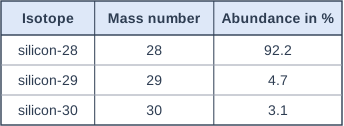
The table shows the isotopes of silicon and their percentage abundances.

Calculate the relative atomic mass (Ar) of silicon. Give the answer to 1 decimal place.

Table with columns "Isotope", "Mass number", "Abundance in %". Isotope: silicon-28; Mass number: 28; Abundance in %: 92.2 | Isotope: silicon-29; Mass number: 29; Abundance in %: 4.7 | Isotope: silicon-30; Mass number: 30; Abundance in %: 3.1.

Model answer

Ar = [(28 × 92.2) + (29 × 4.7) + (30 × 3.1)] ÷ 100
= (2581.6 + 136.3 + 93) ÷ 100
= 2810.9 ÷ 100 = 28.109
= 28.1 (1 decimal place)

Explanation

Each isotope's contribution is its mass number multiplied by its abundance. Silicon-28 makes up over 90% of silicon atoms, so the answer is only just above 28.

Mark scheme
  1. 1 mark

    (28 × 92.2) + (29 × 4.7) + (30 × 3.1)

    allow 2581.6 + 136.3 + 93

  2. 1 mark

    2810.9 ÷ 100 = 28.109

    allow ecf from an arithmetic error in the first step

  3. 1 mark

    28.1

    must be given to 1 decimal place; correct answer with no working scores 3 marks

Question 4

4 marks

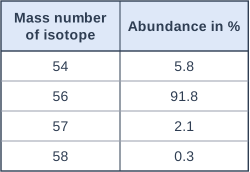
The table shows the isotopes of an element X and their percentage abundances.

Relative atomic masses (Ar): Mn = 55, Fe = 56, Co = 59

Calculate the relative atomic mass of X to 1 decimal place. Use your result to identify element X.

Table with columns "Mass number of isotope", "Abundance in %". Mass number of isotope: 54; Abundance in %: 5.8 | Mass number of isotope: 56; Abundance in %: 91.8 | Mass number of isotope: 57; Abundance in %: 2.1 | Mass number of isotope: 58; Abundance in %: 0.3.

Model answer

Ar = [(54 × 5.8) + (56 × 91.8) + (57 × 2.1) + (58 × 0.3)] ÷ 100
= (313.2 + 5140.8 + 119.7 + 17.4) ÷ 100
= 5591.1 ÷ 100 = 55.911
= 55.9 (1 decimal place)
This is closest to 56, so X is iron.

Explanation

Include every isotope, even the very rare ones. The calculated value (55.9) rounds to the Ar of iron given in the periodic table (56); manganese (55) and cobalt (59) do not fit.

Mark scheme
  1. 1 mark

    (54 × 5.8) + (56 × 91.8) + (57 × 2.1) + (58 × 0.3)

    allow 313.2 + 5140.8 + 119.7 + 17.4

  2. 1 mark

    5591.1 ÷ 100 = 55.911

    allow ecf from an arithmetic error

  3. 1 mark

    55.9

    correct answer with no working scores 3 marks

  4. 1 mark

    iron / Fe

    allow ecf: the element whose Ar is closest to their value

Ready to try the rest? Every answer you write is marked against the mark scheme, so you can see exactly where the marks are.

AI Tutor Hints first, answers after you try

Hi! Stuck? Ask me for a hint and I’ll help you work it out. Once you’ve checked your answer I can explain exactly where the marks are.