
Level:
Correct: 0
Incorrect: 0
Marks: 0/0
Exam Practice
Subject:
Topics:
AQA GCSE Chemistry Smart practice A mixed round aimed at your weak spots
Unit 1
Atomic structure and the periodic table
Unit 2
Bonding, structure, and the properties of matter
Unit 3
Quantitative chemistry
Unit 4
Chemical changes
Unit 5
Energy changes
Unit 6
The rate and extent of chemical change
Unit 7
Organic chemistry
Unit 8
Chemical analysis
Unit 9
Chemistry of the atmosphere
Unit 10
Using resources
Avg
score:
–
Topics
done:
0/124

Atom economy (chemistry only)

Practise 26 exam-style questions on Atom economy (chemistry only) for AQA GCSE Chemistry. Write your answer as you would in the exam and get it marked in seconds against the mark scheme, point by point, with an AI tutor on hand if you get stuck.

  • 26 questions
  • 1–6 marks each
  • Instant marking
  • No sign-up needed
20 questions, marked as you go

Sample questions with model answers

Here are 4 of the questions in this topic, each with a model answer, an explanation of why it earns the marks and the mark scheme an examiner would use.

Question 1

2 marks

Ethene reacts with bromine to produce 1,2-dibromoethane:
C₂H₄ + Br₂ → C₂H₄Br₂

State the percentage atom economy for making 1,2-dibromoethane by this reaction. Give a reason for your answer.

Model answer

The atom economy is 100% because 1,2-dibromoethane is the only product, so all the atoms in the reactants end up in the desired product.

Explanation

When a reaction has only one product, the relative formula mass of the product equals the total relative formula mass of the reactants, so the atom economy is 100%. Addition reactions like this one always have a 100% atom economy; you do not need to do a calculation.

Mark scheme
  1. 1 mark

    100%

  2. 1 mark

    there is only one product / all the atoms in the reactants end up in the desired product

    allow no by-products / no waste products; allow Mr of product = sum of Mr of reactants
Question 2

2 marks

Tungsten is extracted from tungsten oxide by heating it in hydrogen:
WO₃ + 3H₂ → W + 3H₂O

Calculate the percentage atom economy for producing tungsten. Give your answer correct to 3 significant figures.
Relative atomic masses (Ar): H = 1, O = 16, W = 184

Model answer

Mr of WO₃ = 184 + (3 × 16) = 232
sum of reactants = 232 + (3 × 2) = 238
atom economy = (184 ÷ 238) × 100 = 77.3%

Explanation

Tungsten has a large Ar compared with the other atoms involved, so most of the mass of the reactants ends up in the metal. The only waste product is water, which is harmless.

Mark scheme
  1. 1 mark

    (184 ÷ 238) × 100

    Mr of WO₃ = 232; sum of reactants = 232 + 6 = 238

  2. 1 mark

    77.3 (%)

    allow ecf from an incorrect sum of reactants; correct answer with no working scores 2 marks

Question 3

3 marks

Aspirin is made by reacting salicylic acid with ethanoic anhydride:
salicylic acid + ethanoic anhydride → aspirin + ethanoic acid

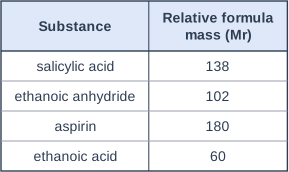
The table shows the relative formula masses (Mr) of the substances in this reaction.

Calculate the percentage atom economy for making aspirin. Then suggest how the manufacturer could make the process less wasteful without changing the reaction.

Table with columns "Substance", "Relative formula mass (Mr)". Substance: salicylic acid; Relative formula mass (Mr): 138 | Substance: ethanoic anhydride; Relative formula mass (Mr): 102 | Substance: aspirin; Relative formula mass (Mr): 180 | Substance: ethanoic acid; Relative formula mass (Mr): 60.

Model answer

sum of Mr of reactants = 138 + 102 = 240
atom economy = (180 ÷ 240) × 100 = 75.0%
The manufacturer could collect the ethanoic acid by-product and sell it or use it, so it is not wasted.

Explanation

Only reactants go on the bottom of the atom economy fraction; the Mr of the by-product is not used, although it is a useful check (180 + 60 = 240). Finding a use for a by-product reduces waste even though the calculated atom economy stays the same.

Mark scheme
  1. 1 mark

    (180 ÷ 240) × 100

    sum of reactants = 138 + 102 = 240

  2. 1 mark

    75 (%)

    allow 75.0; allow ecf from an incorrect sum of reactants; correct answer with no working scores 2 marks

  3. 1 mark

    collect / sell / use the ethanoic acid (by-product)

    allow find a use for the by-product; ignore increase the yield

Question 4

4 marks

Copper(II) sulfate can be made by two different reactions:
Route 1: CuO + H₂SO₄ → CuSO₄ + H₂O
Route 2: CuCO₃ + H₂SO₄ → CuSO₄ + H₂O + CO₂

Calculate the percentage atom economy for making copper(II) sulfate by each route. Give your answers correct to 3 significant figures.
Relative atomic masses (Ar): H = 1, C = 12, O = 16, S = 32, Cu = 63.5

Model answer

Mr of CuSO₄ = 63.5 + 32 + (4 × 16) = 159.5
Mr of H₂SO₄ = 2 + 32 + 64 = 98
Route 1: Mr of CuO = 79.5, sum of reactants = 79.5 + 98 = 177.5
atom economy = (159.5 ÷ 177.5) × 100 = 89.9%
Route 2: Mr of CuCO₃ = 63.5 + 12 + 48 = 123.5, sum of reactants = 123.5 + 98 = 221.5
atom economy = (159.5 ÷ 221.5) × 100 = 72.0%

Explanation

The desired product is the same in both routes, but route 2 also produces carbon dioxide, so a smaller proportion of the reactant mass ends up as copper(II) sulfate. Working out the Mr of CuSO₄ and H₂SO₄ once and reusing them saves time and reduces mistakes.

Mark scheme
  1. 1 mark

    Route 1: (159.5 ÷ 177.5) × 100

    Mr CuSO₄ = 159.5; Mr CuO = 79.5; Mr H₂SO₄ = 98

  2. 1 mark

    Route 1 = 89.9 (%)

    allow ecf

  3. 1 mark

    Route 2: (159.5 ÷ 221.5) × 100

    Mr CuCO₃ = 123.5; allow ecf from an incorrect Mr of CuSO₄

  4. 1 mark

    Route 2 = 72.0 (%)

    allow 72; allow ecf; correct answers with no working score 4 marks

Ready to try the rest? Every answer you write is marked against the mark scheme, so you can see exactly where the marks are.

AI Tutor Hints first, answers after you try

Hi! Stuck? Ask me for a hint and I’ll help you work it out. Once you’ve checked your answer I can explain exactly where the marks are.