Practise 30 exam-style questions on Cracking and alkenes for AQA GCSE Chemistry. Write your answer as you would in the exam and get it marked in seconds against the mark scheme, point by point, with an AI tutor on hand if you get stuck.
30 questions
1–6 marks each
Instant marking
No sign-up needed
20 questions, marked as you go
Sample questions with model answers
Here are 4 of the questions in this topic, each with a model answer, an explanation of why it earns the marks and the mark scheme an examiner would use.
Question 1
2 marks
Explain why alkenes react with bromine water but alkanes do not.
Model answer
Alkenes contain a carbon-carbon double bond, which makes them more reactive, so they react with bromine. Alkanes have only single bonds and are saturated, so they do not react with bromine water.
Explanation
The C=C double bond is what makes alkenes more reactive than alkanes. Bromine adds across the double bond, which is why the orange colour disappears.
Mark scheme
1 mark
alkenes contain a carbon-carbon double bond (C=C)
allow alkenes are unsaturated
1 mark
alkanes contain only single bonds / are saturated (so are less reactive)
Question 2
2 marks
In a laboratory cracking experiment, the gas produced is collected over water.
Explain why the delivery tube must be removed from the water before the heating is stopped.
Model answer
When the heating stops, the gas inside the boiling tube cools and contracts, so cold water would be sucked back up the delivery tube into the hot boiling tube. The sudden cooling could make the hot glass crack or shatter. Removing the delivery tube from the water first prevents this suck-back.
Explanation
Suck-back is a hazard in any experiment where a gas from a heated tube is collected over water. Always remove the delivery tube from the water before you stop heating.
Mark scheme
1 mark
to prevent suck-back: as the tube cools, cold water would be sucked back into the hot boiling tube
allow water drawn back up the delivery tube
1 mark
which could make the hot glass crack / shatter
Question 3
3 marks
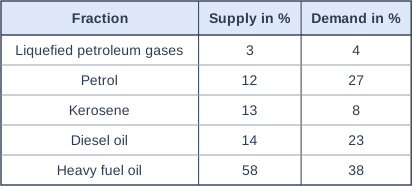
The table shows the percentage of some fractions in crude oil (supply) and the percentage of each fraction that customers need (demand).
A refinery processes 10 000 tonnes of crude oil. Calculate how many more tonnes of petrol are needed than are obtained by fractional distillation.
Model answer
petrol obtained = (12 ÷ 100) × 10 000 = 1200 tonnes petrol needed = (27 ÷ 100) × 10 000 = 2700 tonnes extra petrol needed = 2700 - 1200 = 1500 tonnes
Explanation
The shortfall of petrol is made up by cracking larger molecules from fractions that are in surplus, such as heavy fuel oil.
allow (27 - 12) = 15% of 10 000 = 1500 tonnes; correct answer with no working scores 3 marks
Question 4
5 marks
Decane is cracked to produce ethene: C₁₀H₂₂ → C₆H₁₄ + 2C₂H₄ Relative atomic masses (Ar): H = 1, C = 12 The volume of one mole of any gas at room temperature and pressure is 24 dm³.
A refinery cracks 1.42 kg of decane in this way. Calculate the mass of ethene produced and the volume of this ethene at room temperature and pressure.
Model answer
Mr of C₁₀H₂₂ = (10 × 12) + (22 × 1) = 142 mass of decane = 1.42 kg = 1420 g moles of decane = 1420 ÷ 142 = 10 mol moles of ethene = 10 × 2 = 20 mol Mr of C₂H₄ = (2 × 12) + (4 × 1) = 28 mass of ethene = 20 × 28 = 560 g volume of ethene = 20 × 24 = 480 dm³
Explanation
Convert kilograms to grams before dividing by Mr. Once you know the moles of ethene, you can find both its mass (moles × Mr) and its gas volume (moles × 24 dm³).
Mark scheme
1 mark
Mr of C₁₀H₂₂ = 142
correct answer with no working scores full marks
1 mark
moles of decane = 1420 ÷ 142 = 10 (mol)
allow ecf from an incorrect Mr; must convert kg to g
1 mark
moles of ethene = 10 × 2 = 20 (mol)
allow ecf
1 mark
mass of ethene = 20 × 28 = 560 g
allow 0.56 kg; allow ecf
1 mark
volume of ethene = 20 × 24 = 480 dm³
allow ecf from moles of ethene
Ready to try the rest? Every answer you write is marked against the mark scheme, so you can see exactly where the marks are.
Ctrl + Enter to check
AI TutorHints first, answers after you try
Hi! Stuck? Ask me for a hint and I’ll help you work it out. Once you’ve checked your answer I can explain exactly where the marks are.