Ceramics, polymers and composites (chemistry only)
Practise 30 exam-style questions on Ceramics, polymers and composites (chemistry only) for AQA GCSE Chemistry. Write your answer as you would in the exam and get it marked in seconds against the mark scheme, point by point, with an AI tutor on hand if you get stuck.
30 questions
1–6 marks each
Instant marking
No sign-up needed
20 questions, marked as you go
Sample questions with model answers
Here are 4 of the questions in this topic, each with a model answer, an explanation of why it earns the marks and the mark scheme an examiner would use.
Question 1
2 marks
Soda-lime glass is made by heating sand with two other substances.
Name the two other substances.
Model answer
Sodium carbonate and limestone.
Explanation
Most of the glass we use, for windows and bottles, is soda-lime glass made by heating sand, sodium carbonate and limestone. The name comes from soda (sodium carbonate) and lime (from limestone).
Mark scheme
1 mark
sodium carbonate
allow soda ash
1 mark
limestone
allow calcium carbonate
Question 2
2 marks
Soda-lime glass contains 72% silicon dioxide by mass. All of the silicon dioxide comes from sand.
Calculate the mass of sand needed to make 500 kg of soda-lime glass. Assume the sand is pure silicon dioxide.
Model answer
mass of sand = (72 ÷ 100) × 500 = 360 kg
Explanation
Multiply the total mass by the percentage as a decimal. The other 28% of the glass comes mainly from the sodium carbonate and limestone.
Mark scheme
1 mark
72 ÷ 100 × 500
1 mark
= 360 (kg)
correct answer with no working scores 2 marks
Question 3
3 marks
Ceramic insulators are used to support electricity cables on pylons.
Suggest three properties of clay ceramics that make them suitable for this use.
Model answer
Clay ceramics are electrical insulators, so current cannot flow from the cable into the pylon. They are hard and strong, so they can support the weight of the cables, and they do not corrode in the weather.
Explanation
Linking properties to uses is a key skill. The most important property here is that ceramics do not conduct electricity, but they must also be strong and long-lasting outdoors.
Mark scheme
1 mark
electrical insulator / does not conduct electricity
max 3
1 mark
hard / strong (when compressed)
1 mark
does not corrode / is not affected by weather
1 mark
high melting point / does not burn
Question 4
4 marks
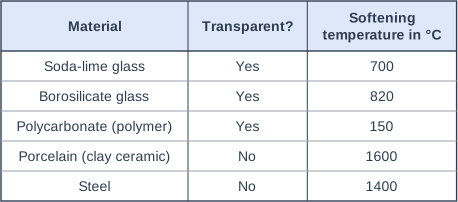
A tube is needed that will be heated in a Bunsen burner flame to about 750 °C. The tube must be transparent so that the contents can be seen. The table shows information about five materials.
Use the data to choose the most suitable material. Explain your choice and why the other materials are unsuitable.
Model answer
Borosilicate glass is the most suitable, because it is transparent and does not soften until 820 °C, which is above 750 °C. Soda-lime glass would soften at 700 °C, and polycarbonate would soften at only 150 °C. Porcelain and steel can withstand the temperature but are not transparent, so the contents could not be seen.
Explanation
Selecting a material means checking every requirement against the data. Only one material is both transparent and able to withstand 750 °C, which is why borosilicate glass is used for laboratory glassware.
Mark scheme
1 mark
borosilicate glass
1 mark
because it is transparent and softens at a temperature (820 °C) above 750 °C
1 mark
soda-lime glass would soften (at 700 °C) and polycarbonate would melt / soften (at 150 °C)
both needed
1 mark
porcelain and steel are not transparent
both needed
Ready to try the rest? Every answer you write is marked against the mark scheme, so you can see exactly where the marks are.
Ctrl + Enter to check
AI TutorHints first, answers after you try
Hi! Stuck? Ask me for a hint and I’ll help you work it out. Once you’ve checked your answer I can explain exactly where the marks are.