Structure and formulae of alkenes (chemistry only)
Practise 20 exam-style questions on Structure and formulae of alkenes (chemistry only) for AQA GCSE Chemistry. Write your answer as you would in the exam and get it marked in seconds against the mark scheme, point by point, with an AI tutor on hand if you get stuck.
20 questions
1–6 marks each
Instant marking
No sign-up needed
20 questions, marked as you go
Sample questions with model answers
Here are 4 of the questions in this topic, each with a model answer, an explanation of why it earns the marks and the mark scheme an examiner would use.
Question 1
2 marks
Alkenes are described as unsaturated.
Explain why.
Model answer
Alkene molecules contain a carbon-carbon double bond, so they contain two fewer hydrogen atoms than the alkane with the same number of carbon atoms. They do not hold the maximum possible number of hydrogen atoms, so they are unsaturated.
Explanation
Compare ethane (C₂H₆) with ethene (C₂H₄): ethene has two fewer hydrogen atoms because two of the carbon bonds are used in the double bond. Alkanes are saturated; alkenes are unsaturated.
Mark scheme
1 mark
they contain a carbon-carbon double bond
1 mark
they contain two fewer hydrogen atoms than the alkane with the same number of carbon atoms
allow they do not contain the maximum number of hydrogen atoms
Question 2
2 marks
The structural formula of ethene is CH₂=CH₂.
Explain what the '=' between the carbon atoms represents.
Model answer
The '=' represents a double covalent bond between the two carbon atoms. In a double bond, the carbon atoms share two pairs of electrons.
Explanation
A single covalent bond is one shared pair of electrons; a double bond is two shared pairs. The C=C double bond is the functional group of the alkenes.
Mark scheme
1 mark
a double (covalent) bond between the two carbon atoms
1 mark
two shared pairs of electrons
allow four shared electrons
Question 3
3 marks
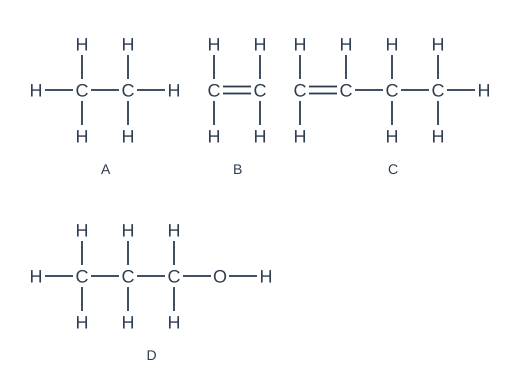
The diagram shows the displayed formulae of four compounds, A, B, C and D.
Which two compounds are alkenes? Give a reason for your answer.
Model answer
B and C are alkenes, because they contain only carbon and hydrogen and each has a carbon-carbon double bond. Their formulae, C₂H₄ and C₄H₈, fit CₙH₂ₙ.
Explanation
A has only single bonds, so it is an alkane (ethane). D contains an oxygen atom (an -OH group), so it is not a hydrocarbon and cannot be an alkene.
Mark scheme
1 mark
B
if more than two letters are given, deduct 1 mark for each incorrect one
1 mark
C
1 mark
they are hydrocarbons with a carbon-carbon double bond
allow their formulae (C₂H₄ and C₄H₈) fit CₙH₂ₙ
Question 4
4 marks
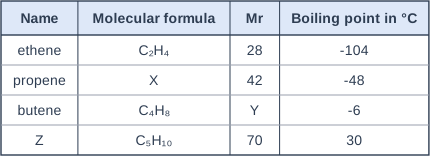
The table shows information about the first four alkenes. Relative atomic masses (Ar): H = 1, C = 12
Determine X, Y and Z.
Which of these alkenes are gases at 20 °C?
Model answer
X: propene has 3 carbon atoms, so using CₙH₂ₙ it is C₃H₆. Y: Mr of C₄H₈ = (4 × 12) + (8 × 1) = 56 Z: C₅H₁₀ is pentene. Ethene, propene and butene have boiling points below 20 °C, so they are gases at 20 °C. Pentene boils at 30 °C, so it is a liquid at 20 °C.
Explanation
Use the general formula CₙH₂ₙ to find formulae and add up relative atomic masses to find Mr. A substance is a gas at a temperature above its boiling point. Like the alkanes, the boiling points of alkenes increase as the molecules get bigger.
Mark scheme
1 mark
X = C₃H₆
allow C3H6; correct answer with no working scores full marks
1 mark
Y = 56
1 mark
Z = pentene
1 mark
ethene, propene and butene
all three needed and no others
Ready to try the rest? Every answer you write is marked against the mark scheme, so you can see exactly where the marks are.
Ctrl + Enter to check
AI TutorHints first, answers after you try
Hi! Stuck? Ask me for a hint and I’ll help you work it out. Once you’ve checked your answer I can explain exactly where the marks are.