
Level:
Correct: 0
Incorrect: 0
Marks: 0/0
Exam Practice
Subject:
Topics:
AQA GCSE Chemistry Smart practice A mixed round aimed at your weak spots
Unit 1
Atomic structure and the periodic table
Unit 2
Bonding, structure, and the properties of matter
Unit 3
Quantitative chemistry
Unit 4
Chemical changes
Unit 5
Energy changes
Unit 6
The rate and extent of chemical change
Unit 7
Organic chemistry
Unit 8
Chemical analysis
Unit 9
Chemistry of the atmosphere
Unit 10
Using resources
Avg
score:
–
Topics
done:
0/124

Mass changes when a reactant or product is a gas

Practise 23 exam-style questions on Mass changes when a reactant or product is a gas for AQA GCSE Chemistry. Write your answer as you would in the exam and get it marked in seconds against the mark scheme, point by point, with an AI tutor on hand if you get stuck.

  • 23 questions
  • 1–6 marks each
  • Instant marking
  • No sign-up needed
20 questions, marked as you go

Sample questions with model answers

Here are 4 of the questions in this topic, each with a model answer, an explanation of why it earns the marks and the mark scheme an examiner would use.

Question 1

2 marks

When copper powder is heated in an open crucible, the mass of the solid increases.

Explain why.

Model answer

The copper reacts with oxygen from the air to form copper oxide. The oxygen atoms join on to the copper, so the mass of the solid increases by the mass of oxygen that has reacted.

Explanation

Mass is still conserved, but one reactant - oxygen - is a gas from the air that was never on the balance at the start. When it becomes part of the solid product, it shows up as an apparent gain in mass.

Mark scheme
  1. 1 mark

    copper reacts with oxygen (from the air) to form copper oxide

    allow copper is oxidised

  2. 1 mark

    the mass of oxygen (atoms) is added to the mass of the copper

    allow the oxygen was not weighed at the start
Question 2

2 marks

A student burned some magnesium ribbon and found that the solid product had a greater mass than the magnesium. The student said: 'This shows that mass is not conserved in this reaction.'

Explain why the student is wrong.

Model answer

The magnesium reacted with oxygen from the air, but the mass of the oxygen was not measured at the start. If the oxygen is included, the mass of magnesium plus the mass of oxygen equals the mass of magnesium oxide, so mass is conserved.

Explanation

Apparent mass changes in open systems are explained by gases that are not weighed. No atoms are made: the extra mass of the product is exactly the mass of oxygen atoms that joined the magnesium.

Mark scheme
  1. 1 mark

    oxygen from the air reacted with the magnesium but its mass was not measured at the start

  2. 1 mark

    the mass of magnesium plus the mass of oxygen equals the mass of magnesium oxide

    allow no atoms are made / the extra mass is the oxygen atoms

Question 3

3 marks

When wood burns, the mass of the ash left is much less than the mass of the wood. When magnesium burns, the mass of the solid product is greater than the mass of the magnesium.

Both reactions use oxygen from the air. Explain why the mass changes in opposite directions.

Model answer

When wood burns, most of the products are carbon dioxide and water vapour, which are gases and escape into the air, so only a little solid ash is left. When magnesium burns, the product, magnesium oxide, is a solid, so the oxygen taken from the air stays in the product and the mass increases.

Explanation

Whether the mass seems to go up or down depends on whether gas is taken in and kept in the solid, or released and allowed to escape. In both cases the total mass of everything, including the gases, is conserved.

Mark scheme
  1. 1 mark

    wood: the products are mainly gases (carbon dioxide and water vapour)

  2. 1 mark

    which escape into the air, so the mass of solid left decreases

  3. 1 mark

    magnesium: the product (magnesium oxide) is a solid, so the oxygen gained from the air stays in the product and mass increases

Question 4

4 marks

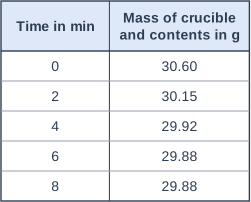
A student heated copper carbonate in a crucible, weighing the crucible and contents every 2 minutes. The table shows the results.

CuCO₃(s) → CuO(s) + CO₂(g)

Explain why the mass decreased and why it stopped changing. Calculate the total mass of gas lost.

Table with columns "Time in min", "Mass of crucible and contents in g". Time in min: 0; Mass of crucible and contents in g: 30.60 | Time in min: 2; Mass of crucible and contents in g: 30.15 | Time in min: 4; Mass of crucible and contents in g: 29.92 | Time in min: 6; Mass of crucible and contents in g: 29.88 | Time in min: 8; Mass of crucible and contents in g: 29.88.

Model answer

The copper carbonate decomposes and carbon dioxide gas escapes from the crucible, so the mass decreases. After 6 minutes the mass stays at 29.88 g because all of the copper carbonate has decomposed, so no more gas is produced.
Total mass of gas lost = 30.60 - 29.88 = 0.72 g

Explanation

Heating to constant mass shows when a decomposition is complete. The total mass lost is the starting mass minus the final constant mass, and it equals the mass of carbon dioxide given off.

Mark scheme
  1. 1 mark

    carbon dioxide (gas) is produced and escapes

  2. 1 mark

    mass stopped changing because all the copper carbonate had decomposed

    allow the reaction was complete

  3. 1 mark

    30.60 - 29.88

  4. 1 mark

    0.72 g

    correct answer with no working scores 2 marks

Ready to try the rest? Every answer you write is marked against the mark scheme, so you can see exactly where the marks are.

AI Tutor Hints first, answers after you try

Hi! Stuck? Ask me for a hint and I’ll help you work it out. Once you’ve checked your answer I can explain exactly where the marks are.