Factors which affect the rates of chemical reactions
Practise 25 exam-style questions on Factors which affect the rates of chemical reactions for AQA GCSE Chemistry. Write your answer as you would in the exam and get it marked in seconds against the mark scheme, point by point, with an AI tutor on hand if you get stuck.
25 questions
1–6 marks each
Instant marking
No sign-up needed
20 questions, marked as you go
Sample questions with model answers
Here are 4 of the questions in this topic, each with a model answer, an explanation of why it earns the marks and the mark scheme an examiner would use.
Question 1
2 marks
A student reacts 2 g of calcium carbonate with excess hydrochloric acid. In one experiment the calcium carbonate is in large lumps. In another experiment it is a fine powder.
Which form of calcium carbonate reacts faster? Give a reason for your answer.
Model answer
The powder reacts faster because it has a much larger surface area than the same mass of large lumps.
Explanation
Breaking a solid into smaller pieces exposes more surface for the acid to react with. The total mass is the same, so the powder reacts faster but produces the same amount of product.
Mark scheme
1 mark
the powder
1 mark
it has a larger surface area
allow larger surface area to volume ratio; do not accept 'larger area' alone
Question 2
2 marks
In the disappearing cross experiment, a student used the same cross and the same size of conical flask, with the same total volume of solution, in every run.
Explain why.
Model answer
The amount of sulfur precipitate needed to hide the cross depends on how deep the solution is and how dark and thick the cross is. Keeping these the same means the cross disappears at the same amount of reaction each time, so the times can be fairly compared.
Explanation
The time measured is the time to make a fixed amount of sulfur, so the 'fixed amount' must really be the same each time. Changing the flask, volume or cross would change the end point.
Mark scheme
1 mark
the depth of the solution / how dark the cross is affects how much precipitate is needed to hide the cross
1 mark
so the end point is the same in every run (fair test / results can be compared)
Question 3
3 marks
A student measured the rate of the reaction between zinc and sulfuric acid by counting the bubbles of hydrogen produced each minute. Another student used a gas syringe to measure the volume of hydrogen produced each minute.
Explain why the gas syringe method gives better results.
Model answer
Bubbles can be different sizes, so the number of bubbles does not give the amount of gas, and bubbles may be missed when they are produced quickly. The gas syringe measures the actual volume of gas on a scale, so its results are more accurate and repeatable.
Explanation
Counting bubbles only gives a rough idea of rate. Measuring a volume with a gas syringe gives a quantitative result in cm³, which can be used to calculate a rate in cm³/s.
Mark scheme
1 mark
bubbles can be different sizes
max 3
1 mark
bubbles may be missed / are too fast to count accurately
1 mark
the gas syringe measures the actual volume of gas (with a scale)
1 mark
so the gas syringe results are more accurate / precise / repeatable
Question 4
4 marks
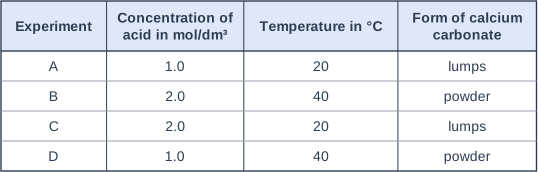
The table shows the conditions used in four experiments in which calcium carbonate reacted with hydrochloric acid. The same mass of calcium carbonate and the same volume of acid were used each time.
Which experiment had the fastest rate of reaction? Explain your answer.
Model answer
Experiment B. It uses the higher concentration of acid (2.0 mol/dm³) and the higher temperature (40 °C), and the calcium carbonate is a powder, which has a larger surface area than lumps. Each of these changes increases the rate, and B is the only experiment with all three.
Explanation
Look at each factor separately: concentration, temperature and surface area all increase the rate when they increase. The fastest experiment is the one with the highest value of every factor.
Mark scheme
1 mark
experiment B
1 mark
it has the highest concentration of acid
allow 2.0 mol/dm³
1 mark
it has the higher temperature
allow 40 °C
1 mark
the calcium carbonate is powdered, so it has a larger surface area
Ready to try the rest? Every answer you write is marked against the mark scheme, so you can see exactly where the marks are.
Ctrl + Enter to check
AI TutorHints first, answers after you try
Hi! Stuck? Ask me for a hint and I’ll help you work it out. Once you’ve checked your answer I can explain exactly where the marks are.