
Level:
Correct: 0
Incorrect: 0
Marks: 0/0
Exam Practice
Subject:
Topics:
AQA GCSE Chemistry Smart practice A mixed round aimed at your weak spots
Unit 1
Atomic structure and the periodic table
Unit 2
Bonding, structure, and the properties of matter
Unit 3
Quantitative chemistry
Unit 4
Chemical changes
Unit 5
Energy changes
Unit 6
The rate and extent of chemical change
Unit 7
Organic chemistry
Unit 8
Chemical analysis
Unit 9
Chemistry of the atmosphere
Unit 10
Using resources
Avg
score:
–
Topics
done:
0/124

Chemical bonds

Practise 22 exam-style questions on Chemical bonds for AQA GCSE Chemistry. Write your answer as you would in the exam and get it marked in seconds against the mark scheme, point by point, with an AI tutor on hand if you get stuck.

  • 22 questions
  • 1–6 marks each
  • Instant marking
  • No sign-up needed
20 questions, marked as you go

Sample questions with model answers

Here are 4 of the questions in this topic, each with a model answer, an explanation of why it earns the marks and the mark scheme an examiner would use.

Question 1

2 marks

Explain why the bonding in carbon dioxide, CO₂, is covalent.

Model answer

Carbon and oxygen are both non-metals, so their atoms share pairs of electrons to form covalent bonds rather than transferring electrons.

Explanation

Covalent bonding occurs in compounds of non-metals. Neither atom loses electrons easily, so instead they share pairs of electrons; in CO₂ the carbon atom shares two pairs with each oxygen atom.

Mark scheme
  1. 1 mark

    carbon and oxygen are both non-metals

  2. 1 mark

    so the atoms share pairs of electrons

    allow electrons are shared (between the carbon and oxygen atoms); do not accept electrons transferred
Question 2

2 marks

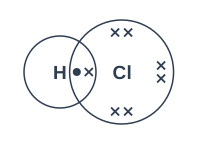
The diagram shows a dot and cross diagram for a molecule of hydrogen chloride.

Explain how the diagram shows that the bonding in hydrogen chloride is covalent.

Dot and cross diagram (outer shells only) of a hydrogen chloride molecule, HCl: overlapping circles for the atoms, 1 shared pair of electrons in the overlaps and 3 lone pairs.

Model answer

The diagram shows a pair of electrons, one dot and one cross, in the overlap between the hydrogen and chlorine atoms, so the electrons are shared. No electrons have been transferred and no charged ions are shown, so the bond is covalent.

Explanation

In a dot and cross diagram, a covalent bond appears as a shared pair of electrons where the outer shells overlap. An ionic compound is shown instead as separate ions in square brackets with their charges.

Mark scheme
  1. 1 mark

    a pair of electrons is shared between the hydrogen and chlorine atoms

    allow electrons in the overlap of the shells are shared

  2. 1 mark

    no electrons have been transferred / no ions or charges are shown

    allow the shells overlap rather than being separate ions in brackets

Question 3

3 marks

Hydrogen chloride, HCl, has covalent bonding. Sodium chloride, NaCl, has ionic bonding.

Explain why these two compounds have different types of bonding.

Model answer

Hydrogen and chlorine are both non-metals, so in hydrogen chloride their atoms share a pair of electrons, forming a covalent bond. Sodium is a metal and chlorine is a non-metal, so in sodium chloride an electron is transferred from each sodium atom to a chlorine atom, forming Na⁺ and Cl⁻ ions held together by ionic bonding.

Explanation

Chlorine forms both types of compound: with a non-metal it shares electrons, with a metal it gains electrons. The type of bond depends on both elements in the compound, not just one.

Mark scheme
  1. 1 mark

    hydrogen and chlorine are both non-metals so their atoms share a pair of electrons

  2. 1 mark

    sodium is a metal and chlorine is a non-metal

  3. 1 mark

    an electron is transferred from sodium to chlorine, forming (Na⁺ and Cl⁻) ions

Question 4

4 marks

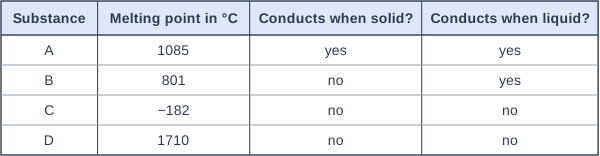
The table shows some properties of four substances, A, B, C and D.

Identify the type of strong bonding (ionic, covalent or metallic) in each substance.

Table with columns "Substance", "Melting point in °C", "Conducts when solid?", "Conducts when liquid?". Substance: A; Melting point in °C: 1085; Conducts when solid?: yes; Conducts when liquid?: yes | Substance: B; Melting point in °C: 801; Conducts when solid?: no; Conducts when liquid?: yes | Substance: C; Melting point in °C: −182; Conducts when solid?: no; Conducts when liquid?: no | Substance: D; Melting point in °C: 1710; Conducts when solid?: no; Conducts when liquid?: no.

Model answer

A is metallic: it conducts electricity both as a solid and as a liquid.
B is ionic: it has a high melting point and conducts only when molten, when its ions can move.
C is covalent: it has a very low melting point and never conducts, so it is made of small molecules.
D is covalent: it has a very high melting point but never conducts, so it is a giant covalent structure.

Explanation

Conducting as a solid points to metallic bonding; conducting only when molten points to ionic bonding. A non-conductor is covalent: a low melting point means small molecules, and a very high melting point means a giant covalent structure.

Mark scheme
  1. 1 mark

    A: metallic

  2. 1 mark

    B: ionic

  3. 1 mark

    C: covalent

    allow small molecules / simple molecular

  4. 1 mark

    D: covalent

    allow giant covalent

Ready to try the rest? Every answer you write is marked against the mark scheme, so you can see exactly where the marks are.

AI Tutor Hints first, answers after you try

Hi! Stuck? Ask me for a hint and I’ll help you work it out. Once you’ve checked your answer I can explain exactly where the marks are.