
Level:
Correct: 0
Incorrect: 0
Marks: 0/0
Exam Practice
Subject:
Topics:
AQA GCSE Chemistry Smart practice A mixed round aimed at your weak spots
Unit 1
Atomic structure and the periodic table
Unit 2
Bonding, structure, and the properties of matter
Unit 3
Quantitative chemistry
Unit 4
Chemical changes
Unit 5
Energy changes
Unit 6
The rate and extent of chemical change
Unit 7
Organic chemistry
Unit 8
Chemical analysis
Unit 9
Chemistry of the atmosphere
Unit 10
Using resources
Avg
score:
–
Topics
done:
0/124

Ionic compounds

Practise 27 exam-style questions on Ionic compounds for AQA GCSE Chemistry. Write your answer as you would in the exam and get it marked in seconds against the mark scheme, point by point, with an AI tutor on hand if you get stuck.

  • 27 questions
  • 1–6 marks each
  • Instant marking
  • No sign-up needed
20 questions, marked as you go

Sample questions with model answers

Here are 4 of the questions in this topic, each with a model answer, an explanation of why it earns the marks and the mark scheme an examiner would use.

Question 1

2 marks

Sodium chloride can be represented by a ball and stick model.

Give two limitations of using a ball and stick model to represent the structure of sodium chloride.

Model answer

The sticks suggest that each ion is joined to particular neighbours by a bond, but ionic bonding is electrostatic attraction acting in all directions. Also, the balls are spread out with large gaps, but in reality the ions are packed closely together.

Explanation

Ball and stick models are useful for showing the 3D arrangement of ions, but the sticks and spaces are not real. A limitation is a way in which the model differs from the real substance.

Mark scheme
  1. 1 mark

    the sticks suggest bonds between particular pairs of ions / ionic bonding acts in all directions, not along sticks

    max 2; any two from the list; allow sticks are not real

  2. 1 mark

    the ions are shown far apart but are really packed closely together / touching

    allow gaps between ions are exaggerated

  3. 1 mark

    it shows only a small part of the giant lattice

  4. 1 mark

    the relative sizes of the ions may not be shown correctly

    allow does not show that chloride ions are larger than sodium ions
Question 2

2 marks

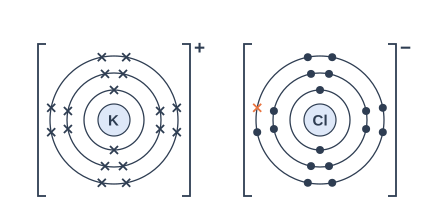
The diagram shows a dot and cross diagram for potassium chloride.

Explain how the diagram shows that potassium chloride is an ionic compound.

Electron shell diagram: ion with K in the centre and electrons 2,8,8 drawn on 3 shells, in square brackets with charge +; ion with Cl in the centre and electrons 2,8,8 drawn on 3 shells, in square brackets with charge - (1 outer electron drawn as crosses to show it came from another atom).

Model answer

The diagram shows two separate ions in square brackets with charges, K⁺ and Cl⁻, rather than atoms joined by shared electrons. The chloride ion has one cross in its outer shell, showing that an electron has been transferred from the potassium atom to the chlorine atom.

Explanation

Dot and cross diagrams of ionic compounds show separate ions with brackets and charges, and a transferred electron drawn with the other symbol. Covalent dot and cross diagrams instead show shared pairs in overlapping shells.

Mark scheme
  1. 1 mark

    the particles are ions / have charges (shown in square brackets with + and −)

  2. 1 mark

    an electron has been transferred from potassium to chlorine / the chloride ion has a cross in its outer shell

    allow no electrons are shared

Question 3

3 marks

Sodium chloride has a melting point of 801 °C.

Explain why sodium chloride has a high melting point. Refer to its structure and bonding.

Model answer

Sodium chloride has a giant ionic lattice in which there are strong electrostatic forces of attraction between the oppositely charged Na⁺ and Cl⁻ ions, acting in all directions. A lot of energy is needed to overcome these many strong forces, so the melting point is high.

Explanation

Melting an ionic compound means overcoming the ionic bonding throughout the giant lattice. Because there are so many strong attractions, a high temperature is needed. Mentioning 'intermolecular forces' would be wrong, since there are no molecules.

Mark scheme
  1. 1 mark

    giant (ionic) lattice

  2. 1 mark

    strong electrostatic forces of attraction between oppositely charged ions (in all directions)

    do not accept intermolecular forces / covalent bonds

  3. 1 mark

    a lot of energy is needed to overcome these forces / break the ionic bonds

Question 4

4 marks

A crystal of sodium chloride has a mass of 5.85 g.

Calculate the total number of ions in the crystal.

Relative atomic masses (Ar): Na = 23, Cl = 35.5
The Avogadro constant = 6.02 × 10²³ per mole

Model answer

Mr of NaCl = 23 + 35.5 = 58.5
moles of NaCl = 5.85 ÷ 58.5 = 0.1 mol
number of NaCl units = 0.1 × 6.02 × 10²³ = 6.02 × 10²²
Each NaCl unit contains one Na⁺ and one Cl⁻ ion, so the total number of ions = 2 × 6.02 × 10²² = 1.204 × 10²³

Explanation

One mole of NaCl contains 6.02 × 10²³ formula units, not molecules, because sodium chloride is a giant lattice. Each formula unit is one Na⁺ and one Cl⁻, so the number of ions is twice the number of formula units.

Mark scheme
  1. 1 mark

    Mr of NaCl = 58.5

  2. 1 mark

    moles of NaCl = 5.85 ÷ 58.5 = 0.1 (mol)

    allow ecf from incorrect Mr

  3. 1 mark

    number of NaCl formula units = 0.1 × 6.02 × 10²³ = 6.02 × 10²²

    allow ecf

  4. 1 mark

    total number of ions = 2 × 6.02 × 10²² = 1.204 × 10²³

    allow 1.2 × 10²³; allow ecf; 6.02 × 10²² (ions not doubled) scores 3 marks; correct answer with no working scores 4 marks

Ready to try the rest? Every answer you write is marked against the mark scheme, so you can see exactly where the marks are.

AI Tutor Hints first, answers after you try

Hi! Stuck? Ask me for a hint and I’ll help you work it out. Once you’ve checked your answer I can explain exactly where the marks are.