Practise 22 exam-style questions on Flame tests (chemistry only) for AQA GCSE Chemistry. Write your answer as you would in the exam and get it marked in seconds against the mark scheme, point by point, with an AI tutor on hand if you get stuck.
22 questions
1–6 marks each
Instant marking
No sign-up needed
20 questions, marked as you go
Sample questions with model answers
Here are 4 of the questions in this topic, each with a model answer, an explanation of why it earns the marks and the mark scheme an examiner would use.
Question 1
2 marks
Give the flame test colour produced by:
sodium compounds calcium compounds
Model answer
Sodium compounds give a yellow flame. Calcium compounds give an orange-red flame.
Explanation
The five flame colours to learn are lithium crimson, sodium yellow, potassium lilac, calcium orange-red and copper green. Calcium's orange-red must be distinguished from lithium's crimson, so 'red' alone is not enough.
Mark scheme
1 mark
sodium: yellow
allow orange-yellow; do not accept orange alone
1 mark
calcium: orange-red
allow brick red; do not accept red alone or crimson
Question 2
2 marks
A student does not have a wire loop. Instead, the student soaks a wooden splint in a solution of an unknown compound and holds it in a Bunsen flame. The flame is orange-yellow.
The student concludes that the compound contains sodium ions. Suggest why this conclusion may not be valid.
Model answer
If the splint starts to burn, the wood itself produces an orange-yellow flame (and wood naturally contains small amounts of sodium compounds). The colour seen may therefore come from the splint rather than from the unknown compound, or may hide its real flame colour.
Explanation
A valid flame test must make sure the only source of colour is the sample. This is why an unreactive wire loop that gives no flame colour is normally used.
Mark scheme
1 mark
the wooden splint itself may burn / char with an orange-yellow flame
allow wood contains (sodium) compounds that colour the flame
1 mark
so the colour may not come from the unknown compound / may mask its true colour
Question 3
3 marks
A white solid gives a crimson flame in a flame test. A solution of the solid is acidified with dilute nitric acid and silver nitrate solution is added. A cream precipitate forms.
Name the solid and give its formula.
Model answer
The solid is lithium bromide, LiBr. The crimson flame shows lithium ions and the cream precipitate with silver nitrate shows bromide ions.
Explanation
Each test identifies one of the ions. Li⁺ and Br⁻ have charges of the same size, so the formula is LiBr. Remember to use the ion name, bromide, not the element name, bromine.
Mark scheme
1 mark
lithium (ion present)
from the crimson flame
1 mark
bromide (ion present), so the solid is lithium bromide
from the cream precipitate; do not accept bromine
1 mark
LiBr
allow ecf for the correct formula of an incorrectly identified lithium or Group 1 halide
Question 4
4 marks
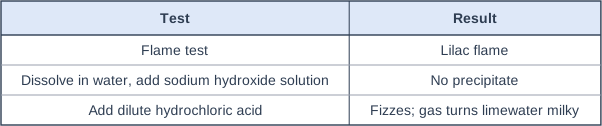
A student carries out tests on a white solid, Y. The table shows the results.
Identify compound Y. Explain how the results support your answer.
Model answer
Y is potassium carbonate (K₂CO₃). The lilac flame shows potassium ions. The fizzing with dilute hydrochloric acid gives a gas that turns limewater milky, which is carbon dioxide, so Y contains carbonate ions. There is no precipitate with sodium hydroxide, which fits because potassium hydroxide is soluble, so there are no ions such as calcium, magnesium or copper present.
Explanation
In the required practical you combine results from several tests. The flame test identifies the metal ion, the acid and limewater test identifies the carbonate, and the negative sodium hydroxide test rules out the metal ions that form insoluble hydroxides.
Mark scheme
1 mark
lilac flame shows potassium ions
1 mark
fizzing with acid and limewater turning milky shows carbonate ions / carbon dioxide produced
1 mark
no precipitate with sodium hydroxide shows no aluminium / calcium / magnesium / copper(II) / iron ions
allow consistent with potassium ions
1 mark
Y is potassium carbonate
allow K₂CO₃
Ready to try the rest? Every answer you write is marked against the mark scheme, so you can see exactly where the marks are.
Ctrl + Enter to check
AI TutorHints first, answers after you try
Hi! Stuck? Ask me for a hint and I’ll help you work it out. Once you’ve checked your answer I can explain exactly where the marks are.