Practise 20 exam-style questions on Atmospheric pollutants from fuels for AQA GCSE Chemistry. Write your answer as you would in the exam and get it marked in seconds against the mark scheme, point by point, with an AI tutor on hand if you get stuck.
20 questions
1–6 marks each
Instant marking
No sign-up needed
20 questions, marked as you go
Sample questions with model answers
Here are 4 of the questions in this topic, each with a model answer, an explanation of why it earns the marks and the mark scheme an examiner would use.
Question 1
2 marks
Explain how sulfur dioxide is produced when coal is burned in a power station.
Model answer
Coal contains sulfur as an impurity. When the coal burns, the sulfur reacts with oxygen from the air to form sulfur dioxide.
Explanation
The sulfur comes from the fuel and the oxygen comes from the air. This is different from oxides of nitrogen, where both elements come from the air.
Mark scheme
1 mark
coal contains sulfur (as an impurity)
allow sulfur compounds
1 mark
the sulfur reacts with oxygen (from the air) when the coal burns
allow sulfur is oxidised / burns; do not accept sulfur reacts with nitrogen
Question 2
2 marks
A gas fire in a house burns methane. If the air vent for the fire becomes blocked, the fire may release carbon monoxide.
Explain why.
Model answer
With the vent blocked, not enough oxygen reaches the flame. The methane undergoes incomplete combustion, and the carbon in it forms carbon monoxide instead of carbon dioxide.
Explanation
Incomplete combustion happens whenever the oxygen supply is limited. This is why gas appliances must be serviced and rooms ventilated, and why carbon monoxide detectors are fitted in homes.
Mark scheme
1 mark
less oxygen / air reaches the flame
1 mark
so incomplete combustion of the methane occurs (producing carbon monoxide)
Question 3
3 marks
A fuel oil contains compounds of carbon and hydrogen, and a small amount of sulfur. The fuel oil is burned in a power station furnace at a high temperature with plenty of air.
Predict the gases that are released into the atmosphere.
Model answer
Carbon dioxide and water vapour (from the carbon and hydrogen), sulfur dioxide (from the sulfur) and oxides of nitrogen (from nitrogen and oxygen in the air reacting at the high temperature).
Explanation
Work out the products element by element: carbon gives carbon dioxide, hydrogen gives water, sulfur gives sulfur dioxide. The high temperature also makes nitrogen from the air react with oxygen. With plenty of air, little carbon monoxide or soot forms.
Mark scheme
1 mark
carbon dioxide and water (vapour)
both needed
1 mark
sulfur dioxide
1 mark
oxides of nitrogen
allow NO / NO₂; ignore unreacted nitrogen; do not accept carbon monoxide as a main product (there is plenty of air)
Question 4
4 marks
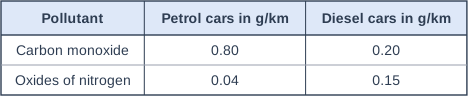
The table shows the mean mass of two pollutants released per kilometre by some petrol cars and some diesel cars. Diesel engines run with more air and at higher temperatures than petrol engines.
Use the table and this information to compare the pollutants released by the petrol and diesel cars, and explain the differences.
Model answer
Diesel cars release less carbon monoxide (0.20 g/km compared with 0.80 g/km) because diesel engines run with more air, so more of the fuel burns completely. Diesel cars release more oxides of nitrogen (0.15 g/km compared with 0.04 g/km) because the higher temperature in the engine makes more nitrogen and oxygen from the air react.
Explanation
Link each pollutant to the condition that causes it: carbon monoxide to a shortage of oxygen, oxides of nitrogen to high temperature. Quoting values from the table makes the comparison precise.
Mark scheme
1 mark
diesel cars release less carbon monoxide (0.20 g/km) than petrol cars (0.80 g/km)
allow four times less
1 mark
because more air (oxygen) means more complete combustion
allow less incomplete combustion
1 mark
diesel cars release more oxides of nitrogen (0.15 g/km) than petrol cars (0.04 g/km)
1 mark
because the higher temperature makes more nitrogen and oxygen from the air react
Ready to try the rest? Every answer you write is marked against the mark scheme, so you can see exactly where the marks are.
Ctrl + Enter to check
AI TutorHints first, answers after you try
Hi! Stuck? Ask me for a hint and I’ll help you work it out. Once you’ve checked your answer I can explain exactly where the marks are.