Practise 15 exam-style questions on Metallic bonding for AQA GCSE Chemistry. Write your answer as you would in the exam and get it marked in seconds against the mark scheme, point by point, with an AI tutor on hand if you get stuck.
15 questions
1–6 marks each
Instant marking
No sign-up needed
15 questions, marked as you go
Sample questions with model answers
Here are 4 of the questions in this topic, each with a model answer, an explanation of why it earns the marks and the mark scheme an examiner would use.
Question 1
1 mark
What is the charge on the metal ions in a metallic structure?
Model answer
Positive
Explanation
When metal atoms lose their outer electrons to the delocalised sea, they are left with more protons than electrons, so the ions are positive.
Mark scheme
1 mark
positive
allow a specific positive charge, e.g. 2+ for magnesium; do not accept negative or neutral
Question 2
2 marks
Metals are described as having giant structures.
Explain what is meant by a giant structure for a metal.
Model answer
A giant structure contains a very large number of atoms (as positive ions), with no fixed number. They are arranged in a regular pattern that repeats throughout the whole piece of metal, and all of them are held together by metallic bonding.
Explanation
Metals do not contain molecules. A bigger piece of metal simply has more ions arranged in the same regular pattern, all bonded together by the shared delocalised electrons.
Mark scheme
1 mark
a very large number of atoms / ions with no fixed number
allow the number depends on the size of the piece of metal
1 mark
arranged in a regular pattern that repeats throughout the structure / all held together by metallic bonds
Question 3
3 marks
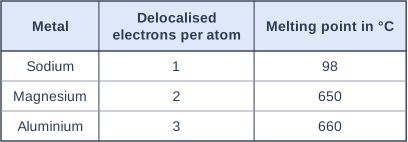
The table shows the melting points of three metals and the number of delocalised electrons each atom provides.
A student concludes: 'The melting point is directly proportional to the number of delocalised electrons per atom.'
Evaluate the student's conclusion.
Model answer
The data support part of the conclusion: as the number of delocalised electrons per atom increases from 1 to 3, the melting point increases. However, the relationship is not directly proportional. From sodium to magnesium the melting point increases by 552 °C, but from magnesium to aluminium it increases by only 10 °C, even though one extra delocalised electron is added each time. So the trend is supported but the claim of direct proportion is not.
Explanation
Direct proportion means that doubling one quantity doubles the other, so equal steps should give equal increases. Calculating the differences shows they are very unequal, so the conclusion goes further than the data allow.
Mark scheme
1 mark
melting point does increase as the number of delocalised electrons increases
1 mark
but it is not directly proportional: from sodium to magnesium the melting point increases by 552 °C, but from magnesium to aluminium by only 10 °C
allow any correct use of the data to show that equal increases in delocalised electrons give very unequal increases in melting point
1 mark
so the conclusion is only partly supported / the trend is correct but the relationship is not proportional
a judgement is needed for this mark
Question 4
4 marks
A teacher models a metal by placing marbles in a regular pattern in a tray. Tiny ball bearings, which represent electrons, roll around in the gaps between the marbles.
Evaluate this model of metallic bonding.
Model answer
The model shows some features well: the marbles are in a regular arrangement, like the positive ions in a metal, and the ball bearings can move anywhere between them, like delocalised electrons moving through the whole structure. However, the marbles and ball bearings are not charged, so the model does not show the electrostatic attraction that actually holds the metal together. It is also only one layer, so it does not show the three-dimensional structure, and the sizes of the particles are not to scale.
Explanation
When evaluating a model, compare each feature with the real thing. The most important weakness here is that nothing in the model represents the attraction between positive ions and negative electrons, which is the metallic bond itself.
Mark scheme
1 mark
strength: the marbles are in a regular arrangement like the ions in a metal
max 4; max 2 for strengths
1 mark
strength: the ball bearings move around the whole tray, like delocalised electrons
1 mark
weakness: the marbles and ball bearings have no charge / there is no electrostatic attraction holding them together
1 mark
weakness: the model is two-dimensional / only one layer
1 mark
weakness: the sizes are not to scale / the number of ball bearings may not match the charges on the ions
allow only a small part of the giant structure
Ready to try the rest? Every answer you write is marked against the mark scheme, so you can see exactly where the marks are.
Ctrl + Enter to check
AI TutorHints first, answers after you try
Hi! Stuck? Ask me for a hint and I’ll help you work it out. Once you’ve checked your answer I can explain exactly where the marks are.