
Level:
Correct: 0
Incorrect: 0
Marks: 0/0
Exam Practice
Subject:
Topics:
AQA GCSE Chemistry Smart practice A mixed round aimed at your weak spots
Unit 1
Atomic structure and the periodic table
Unit 2
Bonding, structure, and the properties of matter
Unit 3
Quantitative chemistry
Unit 4
Chemical changes
Unit 5
Energy changes
Unit 6
The rate and extent of chemical change
Unit 7
Organic chemistry
Unit 8
Chemical analysis
Unit 9
Chemistry of the atmosphere
Unit 10
Using resources
Avg
score:
–
Topics
done:
0/124

Greenhouse gases

Practise 15 exam-style questions on Greenhouse gases for AQA GCSE Chemistry. Write your answer as you would in the exam and get it marked in seconds against the mark scheme, point by point, with an AI tutor on hand if you get stuck.

  • 15 questions
  • 1–5 marks each
  • Instant marking
  • No sign-up needed
15 questions, marked as you go

Sample questions with model answers

Here are 4 of the questions in this topic, each with a model answer, an explanation of why it earns the marks and the mark scheme an examiner would use.

Question 1

1 mark

What type of radiation is emitted by the Earth's surface and absorbed by greenhouse gases?

Model answer

Long wavelength (infrared) radiation.

Explanation

The Sun emits mostly short wavelength radiation, which passes through the atmosphere. The cooler Earth emits long wavelength infrared radiation, and it is this radiation that greenhouse gases absorb.

Mark scheme
  1. 1 mark

    long wavelength radiation

    allow infrared / IR / heat radiation; do not accept short wavelength / ultraviolet / visible light
Question 2

2 marks

Scientists estimate that without greenhouse gases the mean surface temperature of the Earth would be about −18 °C. The actual mean surface temperature is about 15 °C.

Calculate the difference between these temperatures and suggest why this difference is important for life on Earth.

Model answer

Difference = 15 − (−18) = 33 °C
Without this warming, most of the water on Earth would be frozen, and the Earth would be too cold to support most life.

Explanation

Subtracting a negative number means adding: 15 + 18 = 33 °C. The natural greenhouse effect keeps the Earth warm enough for liquid water, which living things need.

Mark scheme
  1. 1 mark

    15 − (−18) = 33 °C

    do not accept 3 °C; correct answer with no working scores full marks

  2. 1 mark

    without it most water would be frozen / the Earth would be too cold for most living things

    allow liquid water is needed for life

Question 3

3 marks

In one year a country emitted 400 million tonnes of carbon dioxide and 2.0 million tonnes of methane.
Over 100 years, 1 tonne of methane causes the same amount of warming as 28 tonnes of carbon dioxide.

Calculate the percentage of the country's total warming effect from these emissions that was caused by methane. Give the answer to 3 significant figures.

Model answer

Warming effect of methane = 2.0 × 28 = 56 million tonnes of carbon dioxide equivalent
Total warming effect = 400 + 56 = 456 million tonnes
Percentage from methane = 56 ÷ 456 × 100 = 12.3%

Explanation

Methane is a much more powerful greenhouse gas than carbon dioxide, so its mass must be converted to an equivalent mass of carbon dioxide before comparing. Remember to divide by the total of both gases, not by the carbon dioxide alone.

Mark scheme
  1. 1 mark

    warming effect of methane = 2.0 × 28 = 56 (million tonnes of carbon dioxide equivalent)

  2. 1 mark

    total = 400 + 56 = 456 (million tonnes)

    allow ecf

  3. 1 mark

    56 ÷ 456 × 100 = 12.3 (%)

    allow ecf; 14% (56 ÷ 400 × 100) scores 2 marks; correct answer with no working scores 3 marks

Question 4

4 marks

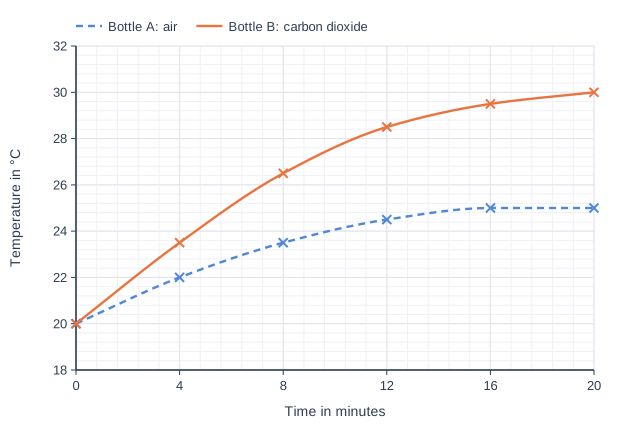
A student did an experiment to model the greenhouse effect. Two identical sealed plastic bottles were placed the same distance from a lamp. Bottle A contained air. Bottle B contained carbon dioxide. The temperature inside each bottle was measured every 4 minutes.

The graph shows the results.

Compare the temperature changes in the two bottles over 20 minutes and give a conclusion. Use data from the graph.

Line graph of temperature in °C (y-axis, 18 to 32) against time in minutes (x-axis, 0 to 20). "Bottle A: air" (dashed) is a smooth curve through (0, 20), (4, 22), (8, 23.5), (12, 24.5), (16, 25), (20, 25). "Bottle B: carbon dioxide" is a smooth curve through (0, 20), (4, 23.5), (8, 26.5), (12, 28.5), (16, 29.5), (20, 30).

Model answer

Both temperatures rose and then levelled off. The air in bottle A rose from 20 °C to 25 °C, a rise of 5 °C. The carbon dioxide in bottle B rose faster, from 20 °C to 30 °C, a rise of 10 °C, which is twice as much. This suggests that carbon dioxide absorbs more radiation than air, so it causes more warming.

Explanation

A good comparison describes the shape of both curves and uses values from the graph, ideally calculating the temperature rise for each. The conclusion links the bigger rise to carbon dioxide being a greenhouse gas.

Mark scheme
  1. 1 mark

    both temperatures increased and then levelled off

  2. 1 mark

    air: from 20 °C to 25 °C (a rise of 5 °C)

    allow readings ± 0.5 °C

  3. 1 mark

    carbon dioxide: from 20 °C to 30 °C (a rise of 10 °C), twice the rise in air

    allow readings ± 0.5 °C; allow carbon dioxide temperature rose faster

  4. 1 mark

    conclusion: carbon dioxide absorbs more (long wavelength) radiation / causes more warming than air

    allow carbon dioxide is a greenhouse gas

Ready to try the rest? Every answer you write is marked against the mark scheme, so you can see exactly where the marks are.

AI Tutor Hints first, answers after you try

Hi! Stuck? Ask me for a hint and I’ll help you work it out. Once you’ve checked your answer I can explain exactly where the marks are.