
Level:
Correct: 0
Incorrect: 0
Marks: 0/0
Exam Practice
Subject:
Topics:
AQA GCSE Chemistry Smart practice A mixed round aimed at your weak spots
Unit 1
Atomic structure and the periodic table
Unit 2
Bonding, structure, and the properties of matter
Unit 3
Quantitative chemistry
Unit 4
Chemical changes
Unit 5
Energy changes
Unit 6
The rate and extent of chemical change
Unit 7
Organic chemistry
Unit 8
Chemical analysis
Unit 9
Chemistry of the atmosphere
Unit 10
Using resources
Avg
score:
–
Topics
done:
0/124

The effect of changing conditions on equilibrium (HT only)

Practise 19 exam-style questions on The effect of changing conditions on equilibrium (HT only) for AQA GCSE Chemistry. Write your answer as you would in the exam and get it marked in seconds against the mark scheme, point by point, with an AI tutor on hand if you get stuck.

  • 19 questions
  • 1–6 marks each
  • Instant marking
  • No sign-up needed
19 questions, marked as you go

Sample questions with model answers

Here are 4 of the questions in this topic, each with a model answer, an explanation of why it earns the marks and the mark scheme an examiner would use.

Question 1

2 marks

Name two conditions that can be changed to alter the position of equilibrium of a reversible reaction between gases.

Model answer

Temperature and pressure (the concentration of a reactant or product could also be changed).

Explanation

The relative amounts of reactants and products at equilibrium depend on the conditions: temperature, pressure (for gases) and concentration. A catalyst is not one of them - it speeds up the forward and reverse reactions equally, so the equilibrium is reached faster but its position does not change.

Mark scheme
  1. 1 mark

    temperature

    max 2; do not accept catalyst; ignore surface area

  2. 1 mark

    pressure

  3. 1 mark

    concentration (of a reactant or product)

    allow adding or removing a reactant or product
Question 2

2 marks

Chlorine can be made by the Deacon process:
4HCl(g) + O₂(g) ⇌ 2Cl₂(g) + 2H₂O(g)
The forward reaction is exothermic.

Suggest one change, other than changing the temperature, that would increase the yield of chlorine at equilibrium. Explain your answer.

Model answer

Increase the pressure. There are 5 molecules of gas on the left and 4 on the right, so increasing the pressure shifts the equilibrium towards the side with fewer molecules, to the right, increasing the yield of chlorine.

Explanation

Several changes work here, as long as the reason matches the change: count gas molecules for pressure, or use the idea that adding a reactant or removing a product shifts the equilibrium towards the products. A catalyst does not change the yield.

Mark scheme
  1. 1 mark

    increase the pressure / add more oxygen (or hydrogen chloride) / remove water (or chlorine) as it forms

    do not accept adding a catalyst

  2. 1 mark

    matching reason: fewer molecules on the right (4) than on the left (5), so the equilibrium shifts right / adding a reactant shifts the equilibrium right to use it up / removing a product shifts the equilibrium right to replace it

Question 3

3 marks

Sulfur dioxide and oxygen react in a reversible reaction:
2SO₂(g) + O₂(g) ⇌ 2SO₃(g)
The forward reaction is exothermic.

The temperature of an equilibrium mixture is increased. A student says: 'To counteract the change, the system will make more sulfur trioxide, because making sulfur trioxide releases energy.'

Explain why the student is wrong and state the correct effect on the amount of sulfur trioxide.

Model answer

Releasing more energy would raise the temperature even further, so it would not counteract the change. To counteract an increase in temperature, the system must take in energy, so the equilibrium shifts in the endothermic direction. The forward reaction is exothermic, so the reverse reaction is endothermic and the equilibrium shifts to the left. The amount of sulfur trioxide decreases.

Explanation

'Counteract' means oppose. An increase in temperature is opposed by the endothermic direction, which absorbs energy. For an exothermic forward reaction this always means less product at a higher temperature.

Mark scheme
  1. 1 mark

    to counteract an increase in temperature, the system must take in energy / lower the temperature

    allow releasing energy would increase the temperature further, which does not counteract the change

  2. 1 mark

    so the equilibrium shifts in the endothermic direction, which is the reverse reaction (to the left)

  3. 1 mark

    the amount of sulfur trioxide decreases

Question 4

4 marks

Nitrogen and oxygen in the air react at the high temperatures inside a car engine to form nitrogen monoxide (NO):
N₂(g) + O₂(g) ⇌ 2NO(g)
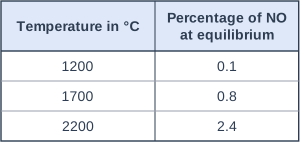
The table shows the percentage of NO in an equilibrium mixture made from air at different temperatures.

Use the data to deduce whether the forward reaction is exothermic or endothermic. Explain your answer.

Predict the effect of increasing the pressure on the percentage of NO at equilibrium. Give a reason for your answer.

Table with columns "Temperature in °C", "Percentage of NO at equilibrium". Temperature in °C: 1200; Percentage of NO at equilibrium: 0.1 | Temperature in °C: 1700; Percentage of NO at equilibrium: 0.8 | Temperature in °C: 2200; Percentage of NO at equilibrium: 2.4.

Model answer

As the temperature increases from 1200 °C to 2200 °C, the percentage of NO at equilibrium increases from 0.1% to 2.4%. So increasing the temperature shifts the equilibrium to the right. A higher temperature favours the endothermic direction, so the forward reaction must be endothermic.
Increasing the pressure would have no effect on the percentage of NO, because there are 2 molecules of gas on each side of the equation.

Explanation

To deduce the energy change from data, see which way the equilibrium moves when the temperature rises: whichever direction is favoured is the endothermic one. For pressure, count gas molecules; equal numbers on both sides means pressure does not affect the position of equilibrium.

Mark scheme
  1. 1 mark

    the percentage of NO increases as the temperature increases

  2. 1 mark

    so increasing the temperature shifts the equilibrium to the right

  3. 1 mark

    so the forward reaction is endothermic (a higher temperature favours the endothermic direction)

    do not award this mark if the reasoning is missing or wrong

  4. 1 mark

    pressure has no effect because there are the same number of molecules (2) on each side

Ready to try the rest? Every answer you write is marked against the mark scheme, so you can see exactly where the marks are.

AI Tutor Hints first, answers after you try

Hi! Stuck? Ask me for a hint and I’ll help you work it out. Once you’ve checked your answer I can explain exactly where the marks are.