Level:
Correct: 0
Incorrect: 0
Marks: 0/0
Exam Practice
Subject:
Topics:
AQA GCSE Chemistry Smart practice A mixed round aimed at your weak spots
Unit 1
Atomic structure and the periodic table
Unit 2
Bonding, structure, and the properties of matter
Unit 3
Quantitative chemistry
Unit 4
Chemical changes
Unit 5
Energy changes
Unit 6
The rate and extent of chemical change
Unit 7
Organic chemistry
Unit 8
Chemical analysis
Unit 9
Chemistry of the atmosphere
Unit 10
Using resources
Avg
score:
–
Topics
done:
0/124

Relative electrical charges of subatomic particles

Practise 18 exam-style questions on Relative electrical charges of subatomic particles for AQA GCSE Chemistry. Write your answer as you would in the exam and get it marked in seconds against the mark scheme, point by point, with an AI tutor on hand if you get stuck.

  • 18 questions
  • 1–6 marks each
  • Instant marking
  • No sign-up needed
18 questions, marked as you go

Sample questions with model answers

Here are 4 of the questions in this topic, each with a model answer, an explanation of why it earns the marks and the mark scheme an examiner would use.

Question 1

2 marks

Give the relative electrical charges of a proton, a neutron and an electron.

Model answer

proton: +1
neutron: 0
electron: −1

Explanation

Relative charges compare each particle with the charge on a proton. A proton and an electron have equal and opposite charges, and a neutron has no charge at all.

Mark scheme
  1. 1 mark

    proton +1 and electron −1

    both needed for the mark; allow 'plus one' / 'minus one'; do not accept 'positive' / 'negative' without the value 1

  2. 1 mark

    neutron 0

    allow no charge / neutral
Question 2

2 marks

An aluminium atom has 13 protons. It loses electrons to form an aluminium ion, Al³⁺.

Give the number of electrons in an aluminium ion. Explain your answer.

Model answer

An aluminium atom has 13 electrons, the same as its number of protons. To have a charge of 3+ it must have 3 more protons than electrons, so it loses 3 electrons: 13 − 3 = 10 electrons.

Explanation

A positive ion has fewer electrons than protons; the size of the charge tells you how many electrons were lost. Check: +13 + (−10) = +3.

Mark scheme
  1. 1 mark

    10

  2. 1 mark

    the atom has 13 electrons (the same as its number of protons) and loses 3 electrons to have a charge of 3+

    allow 13 − 3 = 10; allow 13 protons (+13) and 10 electrons (−10) give 3+

Question 3

3 marks

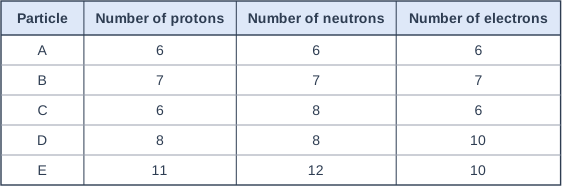
The table shows the numbers of subatomic particles in five particles, A to E.

Give the letter of the particle that has an overall charge of +1, and explain your answer. Give the atomic number of particle B.

Table with columns "Particle", "Number of protons", "Number of neutrons", "Number of electrons". Particle: A; Number of protons: 6; Number of neutrons: 6; Number of electrons: 6 | Particle: B; Number of protons: 7; Number of neutrons: 7; Number of electrons: 7 | Particle: C; Number of protons: 6; Number of neutrons: 8; Number of electrons: 6 | Particle: D; Number of protons: 8; Number of neutrons: 8; Number of electrons: 10 | Particle: E; Number of protons: 11; Number of neutrons: 12; Number of electrons: 10.

Model answer

E has an overall charge of +1, because its 11 protons give +11 and its 10 electrons give −10, and neutrons have no charge, so the total is +1. The atomic number of B is 7, because it has 7 protons.

Explanation

Overall charge = number of protons − number of electrons; the neutrons do not count. The atomic number is always the number of protons, whatever the numbers of neutrons and electrons.

Mark scheme
  1. 1 mark

    E

  2. 1 mark

    11 protons (+11) and 10 electrons (−10) give an overall charge of +1

    allow it has one more proton than electrons

  3. 1 mark

    7

Question 4

4 marks

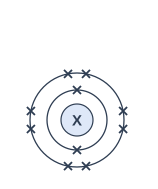
The nucleus of particle X contains 12 protons and 12 neutrons. The diagram shows the arrangement of the electrons in particle X.

Atomic numbers: Na = 11, Mg = 12, Al = 13

Identify element X. State whether particle X is an atom or an ion, and give its overall charge. Explain your answer.

Electron shell diagram: particle with X in the centre and electrons 2,8 drawn on 2 shells.

Model answer

X is magnesium, because it has 12 protons (atomic number 12). The diagram shows 10 electrons (2,8), but there are 12 protons. Because the numbers of protons and electrons are different, X is an ion. Its overall charge is (+12) + (−10) = 2+.

Explanation

Identify the element from the number of protons only. Then count the electrons in the diagram: an atom would have 12 electrons (2,8,2), so this particle has lost 2 electrons and is the Mg²⁺ ion.

Mark scheme
  1. 1 mark

    magnesium

    allow Mg

  2. 1 mark

    the diagram shows 10 electrons, but there are 12 protons

  3. 1 mark

    so X is an ion

  4. 1 mark

    overall charge 2+ / +2

    allow ecf from an incorrect count of electrons

Ready to try the rest? Every answer you write is marked against the mark scheme, so you can see exactly where the marks are.

AI Tutor Hints first, answers after you try

Hi! Stuck? Ask me for a hint and I’ll help you work it out. Once you’ve checked your answer I can explain exactly where the marks are.