
Level:
Correct: 0
Incorrect: 0
Marks: 0/0
Exam Practice
Subject:
Topics:
AQA GCSE Chemistry Smart practice A mixed round aimed at your weak spots
Unit 1
Atomic structure and the periodic table
Unit 2
Bonding, structure, and the properties of matter
Unit 3
Quantitative chemistry
Unit 4
Chemical changes
Unit 5
Energy changes
Unit 6
The rate and extent of chemical change
Unit 7
Organic chemistry
Unit 8
Chemical analysis
Unit 9
Chemistry of the atmosphere
Unit 10
Using resources
Avg
score:
–
Topics
done:
0/124

Test for chlorine

Practise 12 exam-style questions on Test for chlorine for AQA GCSE Chemistry. Write your answer as you would in the exam and get it marked in seconds against the mark scheme, point by point, with an AI tutor on hand if you get stuck.

  • 12 questions
  • 1–6 marks each
  • Instant marking
  • No sign-up needed
12 questions, marked as you go

Sample questions with model answers

Here are 4 of the questions in this topic, each with a model answer, an explanation of why it earns the marks and the mark scheme an examiner would use.

Question 1

2 marks

Describe how to test a gas to show that it is chlorine. Give the result of the test.

Model answer

Hold a piece of damp litmus paper in the gas (in a fume cupboard). If the gas is chlorine, the litmus paper is bleached and turns white.

Explanation

The paper must be damp, because chlorine has to dissolve in water to act as a bleach. Blue litmus may turn red for a moment before it is bleached white; the key result is the bleaching.

Mark scheme
  1. 1 mark

    put damp / moist litmus paper into the gas

    damp / moist / wet needed; allow damp universal indicator paper

  2. 1 mark

    the paper is bleached / turns white

    dependent on litmus or indicator paper being used; ignore turns red first
Question 2

2 marks

During the electrolysis of sodium chloride solution, chlorine gas is produced at the positive electrode.

Write a half equation for the formation of chlorine at the positive electrode.

Model answer

2Cl⁻ → Cl₂ + 2e⁻

Explanation

At the positive electrode, negative chloride ions lose electrons (oxidation). Two chloride ions are needed to make one Cl₂ molecule, so two electrons are released, and the charges balance (2− on each side).

Mark scheme
  1. 1 mark

    Cl⁻ → Cl₂ and electrons

    correct species: chloride ions forming chlorine molecules with electrons as a product

  2. 1 mark

    balanced: 2Cl⁻ → Cl₂ + 2e⁻

    allow 2Cl⁻ − 2e⁻ → Cl₂; allow e for e⁻; ignore state symbols

Question 3

3 marks

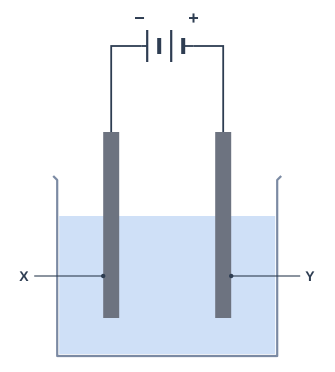
The diagram shows apparatus for the electrolysis of copper(II) chloride solution. Electrode X is connected to the negative terminal and electrode Y is connected to the positive terminal. A brown solid forms on electrode X and bubbles of gas form on electrode Y.

Name the gas formed at electrode Y and describe a test to identify it.

Diagram of an electrolysis cell. Label X points to the left electrode, connected to the negative terminal; label Y points to the right electrode, connected to the positive terminal.

Model answer

The gas at electrode Y is chlorine. Hold a piece of damp litmus paper near electrode Y: the paper is bleached and turns white.

Explanation

At the positive electrode (anode), chloride ions lose electrons and form chlorine gas; copper forms at the negative electrode. Remember to name the element (chlorine), not the ion (chloride).

Mark scheme
  1. 1 mark

    chlorine

    allow Cl₂; do not accept chloride

  2. 1 mark

    hold damp litmus paper near / in the gas

    damp / moist / wet needed

  3. 1 mark

    the paper is bleached / turns white

    dependent on litmus or indicator paper being used

Question 4

4 marks

Chlorine is made by the electrolysis of sodium chloride solution.

2NaCl(aq) + 2H₂O(l) → 2NaOH(aq) + H₂(g) + Cl₂(g)

Relative atomic masses (Ar): Na = 23, Cl = 35.5
The volume of one mole of any gas at room temperature and pressure is 24 dm³.

Calculate the volume of chlorine produced from 11.7 g of sodium chloride.

Model answer

Mr of NaCl = 23 + 35.5 = 58.5
moles of NaCl = 11.7 ÷ 58.5 = 0.20 mol
2 mol NaCl gives 1 mol Cl₂, so moles of Cl₂ = 0.20 ÷ 2 = 0.10 mol
volume of Cl₂ = 0.10 × 24 = 2.4 dm³

Explanation

Use the 2 : 1 ratio between sodium chloride and chlorine from the balanced equation, then multiply the moles of gas by 24 dm³. The question does not give a unit, so you must state one with your answer.

Mark scheme
  1. 1 mark

    Mr of NaCl = 58.5

  2. 1 mark

    moles of NaCl = 11.7 ÷ 58.5 = 0.2(0) mol

    allow ecf from an incorrect Mr

  3. 1 mark

    moles of Cl₂ = 0.20 ÷ 2 = 0.1(0) mol

    allow ecf

  4. 1 mark

    volume = 0.10 × 24 = 2.4 dm³

    allow ecf; allow 2400 cm³; unit needed; correct answer with unit and no working scores 4 marks

Ready to try the rest? Every answer you write is marked against the mark scheme, so you can see exactly where the marks are.

AI Tutor Hints first, answers after you try

Hi! Stuck? Ask me for a hint and I’ll help you work it out. Once you’ve checked your answer I can explain exactly where the marks are.