Level:
Correct: 0
Incorrect: 0
Marks: 0/0
Exam Practice
Subject:
Topics:
AQA GCSE Chemistry Smart practice A mixed round aimed at your weak spots
Unit 1
Atomic structure and the periodic table
Unit 2
Bonding, structure, and the properties of matter
Unit 3
Quantitative chemistry
Unit 4
Chemical changes
Unit 5
Energy changes
Unit 6
The rate and extent of chemical change
Unit 7
Organic chemistry
Unit 8
Chemical analysis
Unit 9
Chemistry of the atmosphere
Unit 10
Using resources
Avg
score:
–
Topics
done:
0/124

Electronic structure

Practise 18 exam-style questions on Electronic structure for AQA GCSE Chemistry. Write your answer as you would in the exam and get it marked in seconds against the mark scheme, point by point, with an AI tutor on hand if you get stuck.

  • 18 questions
  • 1–6 marks each
  • Instant marking
  • No sign-up needed
18 questions, marked as you go

Sample questions with model answers

Here are 4 of the questions in this topic, each with a model answer, an explanation of why it earns the marks and the mark scheme an examiner would use.

Question 1

2 marks

State the maximum number of electrons that can occupy the first energy level (shell) and the maximum number that can occupy the second energy level (shell).

Model answer

The first energy level can hold up to 2 electrons and the second energy level can hold up to 8 electrons.

Explanation

These limits decide how electrons are arranged: the innermost shell fills with 2 electrons before any go into the second shell, which then fills with up to 8.

Mark scheme
  1. 1 mark

    first energy level: 2

  2. 1 mark

    second energy level: 8

Question 2

2 marks

Lithium has atomic number 3 and sodium has atomic number 11.

Compare the electronic structures of lithium and sodium atoms.

Model answer

Lithium is 2,1 and sodium is 2,8,1. Both have one electron in their outer shell, but sodium has one more occupied shell than lithium (three shells instead of two).

Explanation

A comparison needs a similarity or difference, not just two separate structures. Having the same number of outer electrons is why lithium and sodium have similar chemical properties.

Mark scheme
  1. 1 mark

    both have 1 electron in the outer shell

    giving both structures (2,1 and 2,8,1) without any comparison scores 1 mark only

  2. 1 mark

    sodium has one more occupied shell than lithium (3 shells compared with 2)

    allow sodium has 8 more electrons / a full second shell

Question 3

3 marks

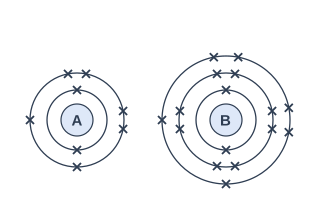
The diagram shows the electronic structures of atoms of two elements, A and B.

Atomic numbers: N = 7, O = 8, F = 9, P = 15, S = 16, Cl = 17

Identify elements A and B. Give one similarity and one difference between the electronic structures of A and B.

Electron shell diagram: particle with A in the centre and electrons 2,6 drawn on 2 shells; particle with B in the centre and electrons 2,8,6 drawn on 3 shells.

Model answer

A has 2 + 6 = 8 electrons, so it is oxygen. B has 2 + 8 + 6 = 16 electrons, so it is sulfur. Both atoms have 6 electrons in their outer shell, but B has three occupied shells while A has only two.

Explanation

Count the electrons to find the atomic number of each atom. Atoms with the same number of outer electrons are in the same group, and an extra shell means the element is one period further down.

Mark scheme
  1. 1 mark

    A is oxygen and B is sulfur

    both needed

  2. 1 mark

    similarity: both have 6 electrons in the outer shell

  3. 1 mark

    difference: B has three occupied shells and A has two

    allow B has 8 more electrons / B has 16 electrons and A has 8

Question 4

4 marks

There are 2 elements in the first period (row) of the periodic table and 8 elements in the second period.

Explain this in terms of electronic structure.

Model answer

Elements in the first period have electrons only in the first shell, which can hold a maximum of 2 electrons. Hydrogen has 1 and helium has 2, so there are only 2 elements in period 1. In the second period, electrons are added one at a time to the second shell, which can hold a maximum of 8 electrons: from lithium (2,1) to neon (2,8). So there are 8 elements in period 2.

Explanation

Each element has one more electron than the one before it. A period ends when the shell being filled is full, so the number of elements in a period matches the number of electrons that shell can hold.

Mark scheme
  1. 1 mark

    the first shell can hold a maximum of 2 electrons

  2. 1 mark

    so only 2 elements (hydrogen and helium) have electrons in the first shell only

    allow each element in period 1 adds one electron to the first shell until it is full

  3. 1 mark

    the second shell can hold a maximum of 8 electrons

  4. 1 mark

    so there are 8 elements (lithium to neon) as electrons are added one at a time to the second shell

Ready to try the rest? Every answer you write is marked against the mark scheme, so you can see exactly where the marks are.

AI Tutor Hints first, answers after you try

Hi! Stuck? Ask me for a hint and I’ll help you work it out. Once you’ve checked your answer I can explain exactly where the marks are.