Practise 19 exam-style questions on Giant covalent structures for AQA GCSE Chemistry. Write your answer as you would in the exam and get it marked in seconds against the mark scheme, point by point, with an AI tutor on hand if you get stuck.
19 questions
1–6 marks each
Instant marking
No sign-up needed
19 questions, marked as you go
Sample questions with model answers
Here are 4 of the questions in this topic, each with a model answer, an explanation of why it earns the marks and the mark scheme an examiner would use.
Question 1
1 mark
State whether substances with giant covalent structures are usually solids, liquids or gases at room temperature.
Model answer
Solids.
Explanation
Giant covalent substances have very high melting points because strong covalent bonds must be broken to melt them, so they are solids at room temperature.
Mark scheme
1 mark
solids
Question 2
2 marks
In silicon dioxide, each silicon atom forms four covalent bonds to oxygen atoms, and each oxygen atom forms two covalent bonds to silicon atoms.
Explain why the formula of silicon dioxide is SiO₂.
Model answer
Each silicon atom is bonded to four oxygen atoms, but each of those oxygen atoms is also bonded to another silicon atom, so it is shared between two silicon atoms. This means each silicon atom has a share of 4 × ½ = 2 oxygen atoms, so the ratio is 1 : 2 and the formula is SiO₂.
Explanation
In a giant structure atoms are shared between neighbours, so you cannot simply count the bonds around one atom. Counting bonds from both sides gives the ratio of atoms in the formula.
Mark scheme
1 mark
each silicon atom is bonded to four oxygen atoms but each oxygen atom is shared between two silicon atoms
1 mark
so there are (4 × ½ =) 2 oxygen atoms for every silicon atom / ratio Si : O = 1 : 2
Question 3
3 marks
A scientist describes the structure of quartz: 'Each silicon atom is covalently bonded to four oxygen atoms, and each oxygen atom is covalently bonded to two silicon atoms. The bonds continue in all directions throughout the crystal.'
What type of structure does quartz have? Explain how the description shows this.
Model answer
Quartz has a giant covalent structure. The description shows that every atom is joined to other atoms by covalent bonds, and that the bonding continues in all directions throughout the crystal, so there are no separate molecules.
Explanation
To recognise a giant covalent structure, look for atoms (not ions) joined by covalent bonds in a network that keeps going, with no separate molecules. Quartz is a crystalline form of silicon dioxide.
Mark scheme
1 mark
giant covalent (structure)
allow macromolecular / giant lattice of atoms
1 mark
all the atoms are joined by covalent bonds
1 mark
the bonds continue throughout the crystal, so there are no separate molecules
allow continuous network / bonds extend in all directions
Question 4
4 marks
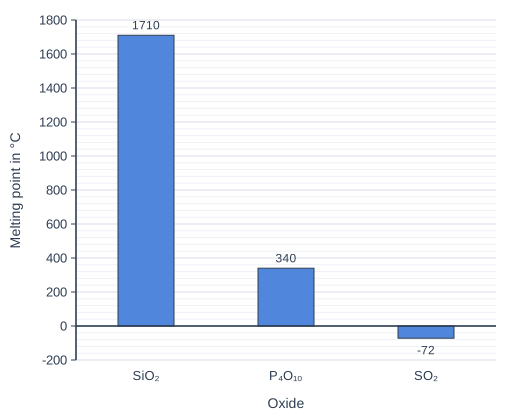
The bar chart shows the melting points of three oxides of non-metals. Silicon dioxide has a giant covalent structure. Phosphorus oxide (P₄O₁₀) and sulfur dioxide (SO₂) consist of molecules.
Use the bar chart and your knowledge of structure and bonding to explain the differences in their melting points.
Model answer
Silicon dioxide melts at 1710 °C, far higher than phosphorus oxide (340 °C) and sulfur dioxide (−72 °C). To melt silicon dioxide, many strong covalent bonds in its giant structure must be broken, which needs a lot of energy. Phosphorus oxide and sulfur dioxide are made of molecules, so only the intermolecular forces between molecules are overcome when they melt, which needs much less energy. P₄O₁₀ molecules are larger than SO₂ molecules, so their intermolecular forces are stronger and P₄O₁₀ has the higher melting point of the two.
Explanation
All three oxides contain covalent bonds, so the big jump in melting point shows a change in structure, from giant covalent to molecular. Between the two molecular oxides, the difference is explained by the size of the molecules.
Mark scheme
1 mark
silicon dioxide has a much higher melting point (1710 °C) than the other two oxides
max 4
1 mark
melting silicon dioxide requires (many) strong covalent bonds to be broken
1 mark
melting P₄O₁₀ or SO₂ only requires weak intermolecular forces to be overcome
1 mark
much more energy is needed to break covalent bonds than to overcome intermolecular forces
1 mark
P₄O₁₀ has a higher melting point than SO₂ because its molecules are larger, so the intermolecular forces are stronger
Ready to try the rest? Every answer you write is marked against the mark scheme, so you can see exactly where the marks are.
Ctrl + Enter to check
AI TutorHints first, answers after you try
Hi! Stuck? Ask me for a hint and I’ll help you work it out. Once you’ve checked your answer I can explain exactly where the marks are.