
Level:
Correct: 0
Incorrect: 0
Marks: 0/0
Exam Practice
Subject:
Topics:
AQA GCSE Chemistry Smart practice A mixed round aimed at your weak spots
Unit 1
Atomic structure and the periodic table
Unit 2
Bonding, structure, and the properties of matter
Unit 3
Quantitative chemistry
Unit 4
Chemical changes
Unit 5
Energy changes
Unit 6
The rate and extent of chemical change
Unit 7
Organic chemistry
Unit 8
Chemical analysis
Unit 9
Chemistry of the atmosphere
Unit 10
Using resources
Avg
score:
–
Topics
done:
0/124

Pure substances

Practise 20 exam-style questions on Pure substances for AQA GCSE Chemistry. Write your answer as you would in the exam and get it marked in seconds against the mark scheme, point by point, with an AI tutor on hand if you get stuck.

  • 20 questions
  • 1–6 marks each
  • Instant marking
  • No sign-up needed
20 questions, marked as you go

Sample questions with model answers

Here are 4 of the questions in this topic, each with a model answer, an explanation of why it earns the marks and the mark scheme an examiner would use.

Question 1

2 marks

A carton of orange juice is labelled '100% pure'.

Explain why a chemist would not describe the orange juice as pure.

Model answer

Orange juice contains many different substances, such as water, sugars, acids and vitamins, so it is a mixture. The label uses the everyday meaning of 'pure' - that nothing has been added and the juice is in its natural state - whereas in chemistry a pure substance is a single element or compound.

Explanation

Everyday 'pure' means unadulterated, like pure milk or pure orange juice. Chemically, these are all mixtures. Explaining both meanings shows you understand why the label and the chemist disagree.

Mark scheme
  1. 1 mark

    the orange juice is a mixture of different substances (e.g. water, sugars, acids)

    allow 'it contains more than one substance'

  2. 1 mark

    on the label 'pure' means nothing has been added / it is in its natural state, but in chemistry pure means a single element or compound
Question 2

2 marks

Pharmaceutical companies test the purity of the medicines they make.

Suggest two reasons why this is important.

Model answer

Impurities in a medicine could be harmful to the patient. Also, if the medicine is impure, each tablet may contain less of the active substance than intended, so the dose would be wrong and the medicine might not work properly.

Explanation

Purity matters most where substances go into people's bodies. Melting point tests are a quick check: a pure drug melts sharply at its known melting point.

Mark scheme
  1. 1 mark

    impurities could be harmful / toxic to the patient

    max 2

  2. 1 mark

    the dose of the active substance must be correct / impurities could make the medicine less effective

  3. 1 mark

    to make sure every batch is the same / meets legal standards

Question 3

3 marks

Here is a list of substances:
oxygen gas distilled water air seawater sodium chloride steel

Which of these are pure substances in the chemical sense?

Model answer

Oxygen gas, distilled water and sodium chloride.

Explanation

Oxygen is a single element, and distilled water and sodium chloride are single compounds. Air is a mixture of gases, seawater is water with dissolved salts, and steel is an alloy - a mixture of iron with carbon and other elements.

Mark scheme
  1. 1 mark

    oxygen (gas)

    deduct 1 mark for each incorrect substance included

  2. 1 mark

    distilled water

  3. 1 mark

    sodium chloride

Question 4

4 marks

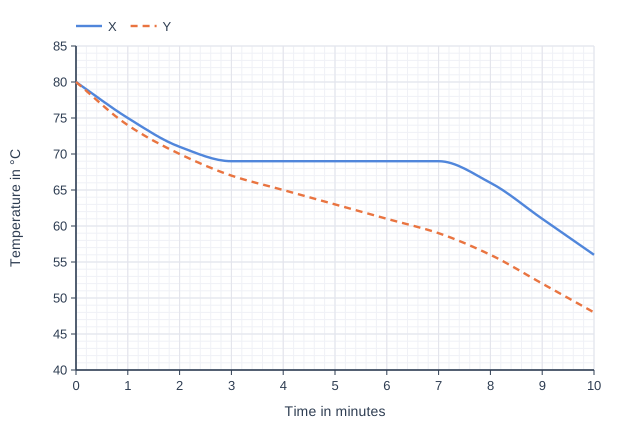
A student melted two samples of stearic acid, X and Y, and then recorded the temperature of each sample every minute as it cooled. The graph shows the results.

Which sample is pure stearic acid? Give the melting point of pure stearic acid. Explain how the graph shows which sample is pure and which is impure.

Line graph of temperature in °C (y-axis, 40 to 85) against time in minutes (x-axis, 0 to 10). "X" is a smooth curve through (0, 80), (1, 75), (2, 71), (3, 69), (4, 69), (5, 69), (6, 69), (7, 69), (8, 66), (9, 61), (10, 56). "Y" (dashed) is a smooth curve through (0, 80), (1, 74), (2, 70), (3, 67), (4, 65), (5, 63), (6, 61), (7, 59), (8, 56), (9, 52), (10, 48).

Model answer

Sample X is pure stearic acid. Its melting point is 69 °C. The cooling curve for X has a flat section at 69 °C, showing that the temperature stays constant while the liquid freezes, so it changes state at one specific temperature. The curve for Y has no flat section: its temperature keeps falling gradually as it solidifies, so it freezes over a range of temperatures, which shows that it is impure.

Explanation

A substance freezes at the same temperature as it melts, so the flat part of a cooling curve gives the melting point. Pure substances change state at a fixed temperature; mixtures change state over a range, so their curves only level off slightly.

Mark scheme
  1. 1 mark

    X

  2. 1 mark

    69 °C

    allow 68-70 °C

  3. 1 mark

    X: the temperature stays constant (flat section) while it freezes / turns solid

    allow 'X freezes at a specific temperature'

  4. 1 mark

    Y: the temperature falls gradually with no flat section / it freezes over a range of temperatures

Ready to try the rest? Every answer you write is marked against the mark scheme, so you can see exactly where the marks are.

AI Tutor Hints first, answers after you try

Hi! Stuck? Ask me for a hint and I’ll help you work it out. Once you’ve checked your answer I can explain exactly where the marks are.