Level:
Correct: 0
Incorrect: 0
Marks: 0/0
Exam Practice
Subject:
Topics:
AQA GCSE Chemistry Smart practice A mixed round aimed at your weak spots
Unit 1
Atomic structure and the periodic table
Unit 2
Bonding, structure, and the properties of matter
Unit 3
Quantitative chemistry
Unit 4
Chemical changes
Unit 5
Energy changes
Unit 6
The rate and extent of chemical change
Unit 7
Organic chemistry
Unit 8
Chemical analysis
Unit 9
Chemistry of the atmosphere
Unit 10
Using resources
Avg
score:
–
Topics
done:
0/124

The Earth's early atmosphere

Practise 30 exam-style questions on The Earth's early atmosphere for AQA GCSE Chemistry. Write your answer as you would in the exam and get it marked in seconds against the mark scheme, point by point, with an AI tutor on hand if you get stuck.

  • 30 questions
  • 1–6 marks each
  • Instant marking
  • No sign-up needed
20 questions, marked as you go

Sample questions with model answers

Here are 4 of the questions in this topic, each with a model answer, an explanation of why it earns the marks and the mark scheme an examiner would use.

Question 1

2 marks

The Earth's early atmosphere is thought to have been mainly carbon dioxide, with some water vapour and nitrogen.

Name two other gases that may have been present in small proportions.

Model answer

Methane and ammonia

Explanation

As well as carbon dioxide, water vapour and nitrogen from volcanoes, the early atmosphere may have contained small proportions of methane (CH₄) and ammonia (NH₃).

Mark scheme
  1. 1 mark

    methane

    allow CH₄

  2. 1 mark

    ammonia

    allow NH₃; do not accept ammonium
Question 2

2 marks

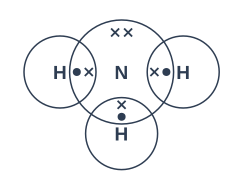
The diagram shows a dot and cross diagram of a molecule of a gas that may have been present in small proportions in the Earth's early atmosphere.

Name the gas and give its formula.

Dot and cross diagram (outer shells only) of a ammonia molecule, NH₃: overlapping circles for the atoms, 3 shared pairs of electrons in the overlaps and 1 lone pair.

Model answer

The gas is ammonia, NH₃.

Explanation

The diagram shows one nitrogen atom sharing pairs of electrons with three hydrogen atoms, with one lone pair on the nitrogen. Ammonia and methane may have been present in small proportions in the early atmosphere.

Mark scheme
  1. 1 mark

    ammonia

    do not accept ammonium

  2. 1 mark

    NH₃

Question 3

3 marks

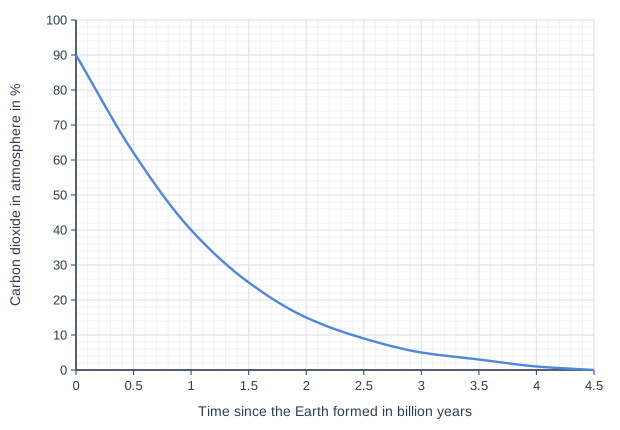
The graph shows one model's estimate of how the percentage of carbon dioxide in the Earth's atmosphere changed after the Earth formed.

Determine the percentage of carbon dioxide 1 billion years after the Earth formed. Then calculate the percentage decrease in carbon dioxide over the first billion years.

Line graph of carbon dioxide in atmosphere in % (y-axis, 0 to 100) against time since the Earth formed in billion years (x-axis, 0 to 4.5). The line is a smooth curve through (0, 90), (0.5, 62), (1, 40), (1.5, 25), (2, 15), (2.5, 9), (3, 5), (3.5, 3), (4, 1), (4.5, 0).

Model answer

After 1 billion years the percentage of carbon dioxide is 40%.
percentage decrease = (90 − 40) ÷ 90 × 100 = 50 ÷ 90 × 100 = 56%

Explanation

Percentage decrease = change ÷ original value × 100. The carbon dioxide fell by 50 percentage points, but as a percentage of the starting value of 90% that is a 56% decrease.

Mark scheme
  1. 1 mark

    40%

    allow 39-41; correct answer with no working scores full marks

  2. 1 mark

    (90 − 40) ÷ 90 × 100

    allow ecf from the value read from the graph

  3. 1 mark

    = 56%

    allow 55.6%; allow ecf; do not accept 50% (the change in percentage points)

Question 4

4 marks

When carbon dioxide was removed from the early atmosphere, each mole of carbon dioxide removed formed one mole of calcium carbonate.

Relative atomic masses (Ar): C = 12, O = 16, Ca = 40
The volume of one mole of any gas at room temperature and pressure is 24 dm³.

Calculate the mass of calcium carbonate, in kg, formed when 2400 dm³ of carbon dioxide (measured at room temperature and pressure) is removed.

Model answer

moles of CO₂ = 2400 ÷ 24 = 100 mol
1 mol CO₂ forms 1 mol CaCO₃, so moles of CaCO₃ = 100 mol
Mr of CaCO₃ = 40 + 12 + (3 × 16) = 100
mass = 100 × 100 = 10 000 g = 10 kg

Explanation

Convert the gas volume to moles, use the 1 : 1 ratio, then multiply by the Mr. Finally divide by 1000 to convert grams to kilograms.

Mark scheme
  1. 1 mark

    moles of CO₂ = 2400 ÷ 24 = 100 mol

  2. 1 mark

    moles of CaCO₃ = 100 mol

    allow ecf

  3. 1 mark

    mass = 100 × 100 = 10 000 g

    allow ecf; Mr of CaCO₃ = 100

  4. 1 mark

    = 10 (kg)

    allow ecf for correct conversion of an incorrect mass in g; correct answer with no working scores 4 marks

Ready to try the rest? Every answer you write is marked against the mark scheme, so you can see exactly where the marks are.

AI Tutor Hints first, answers after you try

Hi! Stuck? Ask me for a hint and I’ll help you work it out. Once you’ve checked your answer I can explain exactly where the marks are.