
Level:
Correct: 0
Incorrect: 0
Marks: 0/0
Exam Practice
Subject:
Topics:
AQA GCSE Chemistry Smart practice A mixed round aimed at your weak spots
Unit 1
Atomic structure and the periodic table
Unit 2
Bonding, structure, and the properties of matter
Unit 3
Quantitative chemistry
Unit 4
Chemical changes
Unit 5
Energy changes
Unit 6
The rate and extent of chemical change
Unit 7
Organic chemistry
Unit 8
Chemical analysis
Unit 9
Chemistry of the atmosphere
Unit 10
Using resources
Avg
score:
–
Topics
done:
0/124

Electrolysis of molten ionic compounds

Practise 15 exam-style questions on Electrolysis of molten ionic compounds for AQA GCSE Chemistry. Write your answer as you would in the exam and get it marked in seconds against the mark scheme, point by point, with an AI tutor on hand if you get stuck.

  • 15 questions
  • 1–6 marks each
  • Instant marking
  • No sign-up needed
15 questions, marked as you go

Sample questions with model answers

Here are 4 of the questions in this topic, each with a model answer, an explanation of why it earns the marks and the mark scheme an examiner would use.

Question 1

2 marks

Molten potassium chloride is electrolysed using inert electrodes.

Name the product formed at each electrode.

Model answer

Potassium is formed at the cathode and chlorine is formed at the anode.

Explanation

When a molten binary ionic compound is electrolysed, the metal is produced at the cathode and the non-metal at the anode. Chlorine is the element; chloride is the name of the ion, so it is not a product.

Mark scheme
  1. 1 mark

    cathode / negative electrode: potassium

  2. 1 mark

    anode / positive electrode: chlorine

    do not accept chloride or Cl
Question 2

2 marks

During the electrolysis of molten lead bromide, bromide ions are discharged at the anode.

Balance this half equation:
Br⁻ → Br₂ + e⁻

Model answer

2Br⁻ → Br₂ + 2e⁻

Explanation

Bromine is diatomic, so two bromide ions are needed to form one Br₂ molecule. Each bromide ion loses one electron, so two electrons appear on the right and the total charge is −2 on both sides.

Mark scheme
  1. 1 mark

    2Br⁻ on the left

  2. 1 mark

    2e⁻ on the right: 2Br⁻ → Br₂ + 2e⁻

    allow 2Br⁻ − 2e⁻ → Br₂

Question 3

3 marks

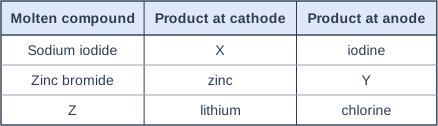
The table shows the products of electrolysing some molten ionic compounds using inert electrodes.

Give the names of X, Y and Z.

Table with columns "Molten compound", "Product at cathode", "Product at anode". Molten compound: Sodium iodide; Product at cathode: X; Product at anode: iodine | Molten compound: Zinc bromide; Product at cathode: zinc; Product at anode: Y | Molten compound: Z; Product at cathode: lithium; Product at anode: chlorine.

Model answer

X is sodium, Y is bromine and Z is lithium chloride.

Explanation

The metal in the compound always forms at the cathode and the non-metal at the anode. Working backwards, a compound that gives lithium and chlorine must be lithium chloride.

Mark scheme
  1. 1 mark

    X: sodium

  2. 1 mark

    Y: bromine

    do not accept bromide

  3. 1 mark

    Z: lithium chloride

    allow LiCl

Question 4

4 marks

During the electrolysis of molten lead bromide, the overall reaction is:
PbBr₂ → Pb + Br₂

Explain, in terms of electrons, which ions are oxidised and which ions are reduced.

Model answer

At the cathode, lead ions gain electrons (Pb²⁺ + 2e⁻ → Pb). Gain of electrons is reduction, so the lead ions are reduced. At the anode, bromide ions lose electrons (2Br⁻ → Br₂ + 2e⁻). Loss of electrons is oxidation, so the bromide ions are oxidised.

Explanation

Electrolysis is a redox process: reduction always happens at the cathode and oxidation at the anode. Remember OIL RIG: Oxidation Is Loss, Reduction Is Gain of electrons.

Mark scheme
  1. 1 mark

    lead ions (Pb²⁺) gain electrons (at the cathode)

    allow Pb²⁺ + 2e⁻ → Pb

  2. 1 mark

    so lead ions are reduced

  3. 1 mark

    bromide ions (Br⁻) lose electrons (at the anode)

    allow 2Br⁻ → Br₂ + 2e⁻

  4. 1 mark

    so bromide ions are oxidised

Ready to try the rest? Every answer you write is marked against the mark scheme, so you can see exactly where the marks are.

AI Tutor Hints first, answers after you try

Hi! Stuck? Ask me for a hint and I’ll help you work it out. Once you’ve checked your answer I can explain exactly where the marks are.