Practise 26 exam-style questions on Metals and non-metals for AQA GCSE Chemistry. Write your answer as you would in the exam and get it marked in seconds against the mark scheme, point by point, with an AI tutor on hand if you get stuck.
26 questions
1–6 marks each
Instant marking
No sign-up needed
20 questions, marked as you go
Sample questions with model answers
Here are 4 of the questions in this topic, each with a model answer, an explanation of why it earns the marks and the mark scheme an examiner would use.
Question 1
2 marks
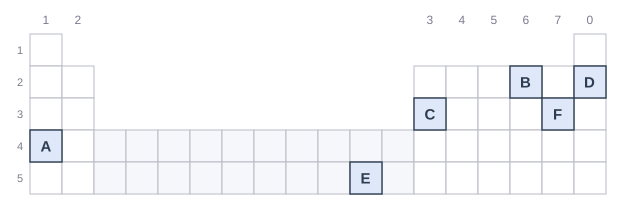
The diagram shows an outline of the periodic table. The letters A to F show the positions of six elements. The letters are not chemical symbols.
Give the letters of all the elements that are metals. Give a reason for your answer.
Model answer
A, C and E are metals. A is in group 1, C is in group 3 towards the left, and E is in the transition metal block - metals are found on the left and towards the bottom of the periodic table.
Explanation
B, D and F are in the top right of the table, where the non-metals are. The transition metals in the middle block are all metals.
Mark scheme
1 mark
A, C and E
all three needed and no others
1 mark
they are on the left / towards the bottom of the periodic table / in the transition metal block
allow they form positive ions
Question 2
3 marks
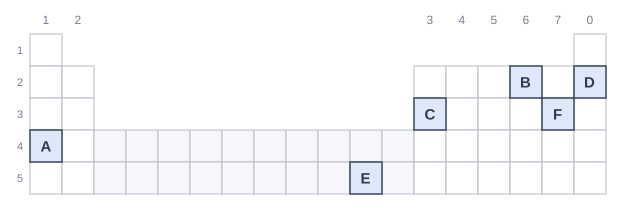
The diagram shows an outline of the periodic table. The letters A to F show the positions of six elements. The letters are not chemical symbols.
Predict the charge on the ion formed by each of the elements A, C and F when they react.
Model answer
A is in group 1, so it loses 1 electron to form a 1+ ion. C is in group 3, so it loses 3 electrons to form a 3+ ion. F is in group 7, so it gains 1 electron to form a 1− ion.
Explanation
Metals lose their outer electrons to form positive ions with a charge equal to their group number. Non-metals in groups 6 and 7 gain enough electrons to fill their outer shell, forming 2− and 1− ions.
Mark scheme
1 mark
A: 1+
allow +1 / A⁺
1 mark
C: 3+
allow +3 / C³⁺
1 mark
F: 1−
allow −1 / F⁻
Question 3
3 marks
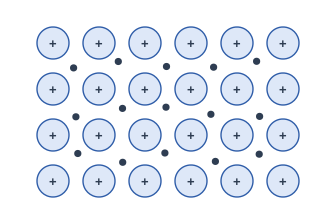
The diagram shows the structure of a metal such as copper.
Copper is a good conductor of electricity, but sulfur, a non-metal, is not. Explain why.
Model answer
Copper's structure contains positive metal ions surrounded by delocalised electrons. These electrons are free to move through the structure, so they can carry charge and copper conducts electricity. Sulfur has no delocalised electrons or other charged particles that are free to move, so it does not conduct.
Explanation
To conduct electricity a substance needs charged particles that can move. In metals these are the delocalised electrons; in most non-metals all the electrons are held in atoms or covalent bonds.
Mark scheme
1 mark
copper has delocalised electrons
allow free electrons / sea of electrons
1 mark
which are free to move through the structure and carry charge
1 mark
sulfur has no delocalised electrons / no charged particles that are free to move
Question 4
4 marks
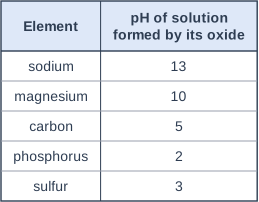
The oxides of some elements were added to water and the pH of each solution was measured. The table shows the results.
Describe the pattern in the results. Explain how this pattern could be used to classify elements as metals or non-metals.
Model answer
The oxides of the metals, sodium and magnesium, give alkaline solutions with pH 13 and 10. The oxides of the non-metals, carbon, phosphorus and sulfur, give acidic solutions with pH 5, 2 and 3. Metal oxides are basic and non-metal oxides are acidic. So to classify an unknown element, you could burn it in oxygen, add the oxide to water and measure the pH: above 7 means a metal and below 7 means a non-metal.
Explanation
When describing a pattern, refer to the data and group the elements. The acid-base nature of oxides is a chemical difference between metals and non-metals, so it can be used as a test.
Mark scheme
1 mark
the metals (sodium and magnesium) give solutions with pH above 7 / alkaline
1 mark
the non-metals (carbon, phosphorus and sulfur) give solutions with pH below 7 / acidic
1 mark
metal oxides are basic and non-metal oxides are acidic
1 mark
so testing the pH of the solution formed by an element's oxide shows whether the element is a metal or a non-metal
Ready to try the rest? Every answer you write is marked against the mark scheme, so you can see exactly where the marks are.
Ctrl + Enter to check
AI TutorHints first, answers after you try
Hi! Stuck? Ask me for a hint and I’ll help you work it out. Once you’ve checked your answer I can explain exactly where the marks are.