Practise 25 exam-style questions on The process of electrolysis for AQA GCSE Chemistry. Write your answer as you would in the exam and get it marked in seconds against the mark scheme, point by point, with an AI tutor on hand if you get stuck.
25 questions
1–6 marks each
Instant marking
No sign-up needed
20 questions, marked as you go
Sample questions with model answers
Here are 4 of the questions in this topic, each with a model answer, an explanation of why it earns the marks and the mark scheme an examiner would use.
Question 1
2 marks
Explain what is meant by an electrolyte.
Model answer
An electrolyte is an ionic compound that has been melted or dissolved in water. It conducts electricity because its ions are free to move, and it is broken down by the current.
Explanation
Ionic compounds only conduct when their ions can move, which happens when they are molten or in solution. A metal conducts electricity but is not an electrolyte, because its current is carried by electrons and it is not decomposed.
Mark scheme
1 mark
an ionic compound that is molten / melted or dissolved in water
allow a liquid or solution containing ions
1 mark
which conducts electricity because its ions are free to move
allow and is decomposed by an electric current
Question 2
2 marks
During the electrolysis of molten sodium chloride, chloride ions are discharged at the anode.
Balance this half equation for the reaction at the anode: Cl⁻ → Cl₂ + e⁻
Model answer
2Cl⁻ → Cl₂ + 2e⁻
Explanation
Chlorine forms diatomic molecules, so two chloride ions are needed to make one Cl₂ molecule. Each chloride ion loses one electron, so two electrons are released and the charges balance (−2 on each side).
Mark scheme
1 mark
2Cl⁻ on the left
1 mark
2e⁻ on the right: 2Cl⁻ → Cl₂ + 2e⁻
allow 2Cl⁻ − 2e⁻ → Cl₂
Question 3
3 marks
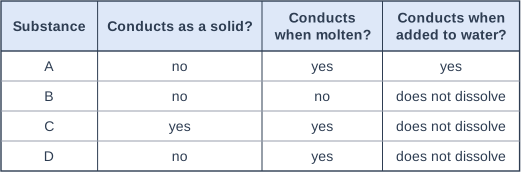
The table shows the results of conductivity tests on four substances, A to D.
Identify the two substances that are ionic compounds. Give a reason for your answer. Identify the substance that is a metal.
Model answer
A and D are ionic compounds, because they do not conduct when solid but do conduct when molten (A also conducts in solution). C is the metal, because it conducts when it is solid.
Explanation
Ionic compounds conduct only when their ions are free to move, so they conduct when molten (and in solution if they dissolve) but never as solids. Metals conduct as solids because of their delocalised electrons. B does not conduct in any state, so it is a covalent substance.
Mark scheme
1 mark
A and D
both needed and no others
1 mark
they do not conduct as solids but do conduct when molten
allow their ions can only move when molten
1 mark
C
Question 4
4 marks
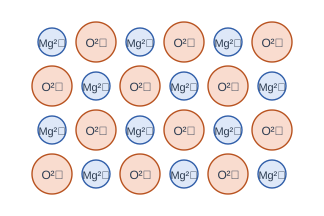
The diagram shows part of the structure of magnesium oxide. Magnesium oxide has a melting point of 2852 °C.
Explain why magnesium oxide must be heated to a very high temperature before it can be electrolysed.
Model answer
In solid magnesium oxide the Mg²⁺ and O²⁻ ions are held in fixed positions in a giant lattice, so they cannot move to the electrodes. The compound must be melted so the ions are free to move. There are very strong electrostatic forces of attraction between the oppositely charged ions in all directions, so a large amount of energy is needed to overcome them, which is why the temperature must be very high.
Explanation
Electrolysis needs mobile ions, so an ionic solid must be melted or dissolved first. Magnesium oxide has ions with 2+ and 2− charges, which attract very strongly, giving it an extremely high melting point.
Mark scheme
1 mark
in the solid the ions are in fixed positions / cannot move
1 mark
it must be melted so that the ions are free to move (to the electrodes)
1 mark
there are strong electrostatic forces of attraction between the oppositely charged ions
allow strong ionic bonds; do not accept intermolecular forces or covalent bonds
1 mark
so a lot of energy is needed to overcome these forces / to melt it
Ready to try the rest? Every answer you write is marked against the mark scheme, so you can see exactly where the marks are.
Ctrl + Enter to check
AI TutorHints first, answers after you try
Hi! Stuck? Ask me for a hint and I’ll help you work it out. Once you’ve checked your answer I can explain exactly where the marks are.