Practise 27 exam-style questions on Alloys as useful materials (chemistry only) for AQA GCSE Chemistry. Write your answer as you would in the exam and get it marked in seconds against the mark scheme, point by point, with an AI tutor on hand if you get stuck.
27 questions
1–6 marks each
Instant marking
No sign-up needed
20 questions, marked as you go
Sample questions with model answers
Here are 4 of the questions in this topic, each with a model answer, an explanation of why it earns the marks and the mark scheme an examiner would use.
Question 1
2 marks
Bronze and brass are both alloys of copper.
Name the other metal in bronze and the other metal in brass.
Model answer
Bronze is copper and tin. Brass is copper and zinc.
Explanation
These two alloys are easily mixed up. Both are mainly copper: bronze, the alloy that gave the Bronze Age its name, contains tin, while brass contains zinc.
Mark scheme
1 mark
bronze: tin
1 mark
brass: zinc
Question 2
2 marks
24 carat gold is 100% gold.
Calculate the percentage of gold in 22 carat gold, to 3 significant figures.
Divide the carat number by 24 and multiply by 100. To round to 3 significant figures, look at the fourth figure (6), which rounds the third figure up.
Mark scheme
1 mark
22 ÷ 24 × 100
1 mark
= 91.7 (%)
must be 3 significant figures for this mark; 91.666... alone scores 1 mark
Question 3
3 marks
Stainless steel is used to make cutlery.
Name the two metals, other than iron, that are added to make stainless steel. Give the property of stainless steel that makes it suitable for cutlery.
Model answer
Chromium and nickel. Stainless steel is resistant to corrosion, so the cutlery does not rust when it is washed.
Explanation
Steels containing chromium and nickel are stainless steels, which are hard and resistant to corrosion. That makes them ideal for cutlery, sinks and surgical instruments.
Mark scheme
1 mark
chromium
1 mark
nickel
1 mark
resistant to corrosion / does not rust
allow hard
Question 4
4 marks
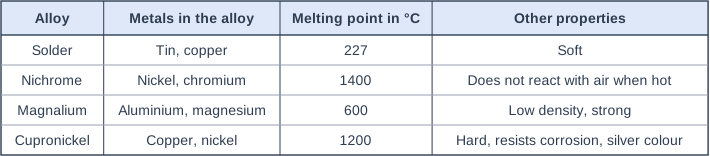
The table shows information about four alloys.
Suggest which alloy is most suitable for the heating element in a toaster and which alloy is most suitable for making coins. Give a reason for each choice.
Model answer
Nichrome should be used for the heating element because it has a very high melting point and does not react with air when it is hot. Cupronickel should be used for coins because it is hard, so the coins do not wear away, and it resists corrosion.
Explanation
When choosing an unfamiliar alloy, match the properties in the data to what the use needs. A heating element gets very hot, so it needs a high melting point and must not react with air; coins are handled constantly, so they must be hard and resist corrosion.
Mark scheme
1 mark
heating element: nichrome
1 mark
because it has a high melting point / does not react with air when hot
1 mark
coins: cupronickel
1 mark
because it is hard (so does not wear away) / resists corrosion / has a silver colour
Ready to try the rest? Every answer you write is marked against the mark scheme, so you can see exactly where the marks are.
Ctrl + Enter to check
AI TutorHints first, answers after you try
Hi! Stuck? Ask me for a hint and I’ll help you work it out. Once you’ve checked your answer I can explain exactly where the marks are.