Practise 23 exam-style questions on Extraction of metals and reduction for AQA GCSE Chemistry. Write your answer as you would in the exam and get it marked in seconds against the mark scheme, point by point, with an AI tutor on hand if you get stuck.
23 questions
1–6 marks each
Instant marking
No sign-up needed
20 questions, marked as you go
Sample questions with model answers
Here are 4 of the questions in this topic, each with a model answer, an explanation of why it earns the marks and the mark scheme an examiner would use.
Question 1
1 mark
Name the method used to extract metals that are more reactive than carbon.
Model answer
Electrolysis.
Explanation
Carbon cannot remove oxygen from the oxides of metals above it in the reactivity series, such as aluminium and magnesium. These metals are extracted by electrolysis, which uses a lot of electrical energy and is therefore more expensive.
Mark scheme
1 mark
electrolysis
allow electrolysis of the molten compound
Question 2
2 marks
When metal oxides are reduced by heating with carbon, the other product is carbon dioxide.
Suggest why this makes it easy to obtain the metal.
Model answer
Carbon dioxide is a gas, so it escapes from the furnace, leaving the metal behind without needing to separate it from another solid product.
Explanation
If the other product were a solid, such as magnesium oxide, it would be mixed with the metal and would have to be separated. A gaseous product separates itself, which is one reason carbon is so widely used to extract metals.
Mark scheme
1 mark
carbon dioxide is a gas
1 mark
so it escapes from the reaction mixture, leaving the metal behind / the metal does not need to be separated from another product
Question 3
3 marks
A student heats a mixture of black copper(II) oxide powder and carbon powder strongly in a test tube. The gas produced is bubbled through limewater.
Describe what the student would observe and name the two products of the reaction.
Model answer
The black powder turns pinkish-brown as copper forms, and the limewater turns milky. The products are copper and carbon dioxide.
Explanation
Carbon is more reactive than copper, so it removes oxygen from copper(II) oxide. The brown solid is copper metal, and limewater turning milky is the test for the carbon dioxide formed when the carbon is oxidised.
Mark scheme
1 mark
the black powder turns (pink-)brown / orange-brown
allow copper-coloured solid forms
1 mark
the limewater turns milky / cloudy
1 mark
copper and carbon dioxide
both needed
Question 4
4 marks
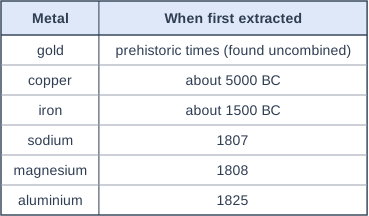
The table shows when some metals were first extracted.
Explain how the dates are linked to the reactivity of the metals.
Model answer
The more reactive the metal, the later it was first extracted. Gold is unreactive and found uncombined, so it was used in prehistoric times. Copper and iron are less reactive than carbon, so they could be extracted by heating their ores with charcoal; copper came first because it is less reactive and easier to reduce. Sodium, magnesium and aluminium are more reactive than carbon, so carbon cannot reduce their compounds. They were only extracted in the 1800s, once new methods such as electrolysis had been developed.
Explanation
The history of metal extraction follows the reactivity series: unreactive metals first, then metals that carbon can reduce, then reactive metals that needed electricity or other new techniques. Linking each group of dates to a position relative to carbon is the key to a full answer.
Mark scheme
1 mark
gold is unreactive / found uncombined, so it did not need to be extracted and was used first
1 mark
copper and iron are less reactive than carbon, so they could be extracted by heating their ores with carbon (charcoal)
1 mark
copper was extracted before iron because copper is less reactive / easier to reduce
allow iron needs a higher temperature
1 mark
sodium, magnesium and aluminium are more reactive than carbon, so they could not be extracted until new methods (such as electrolysis) were developed
allow electricity was not available until about 1800
Ready to try the rest? Every answer you write is marked against the mark scheme, so you can see exactly where the marks are.
Ctrl + Enter to check
AI TutorHints first, answers after you try
Hi! Stuck? Ask me for a hint and I’ll help you work it out. Once you’ve checked your answer I can explain exactly where the marks are.